sorting rimfire ammo questions

Do you recall the theory behind the "experimental procedure" described in high school science classes? The idea was to change only one factor at a time and test for it. You're separating lots of ammo by a number of factors regarding bullet shape and rim thickness. That's all well and good so far. And it's setting the stage for the testing you'll do.

So now the testing is about determining which factors are significant. Rim thickness was already identified in a couple of posts above. And that makes sense since rim thickness will alter the head spacing.

But there's also the other factors of bullet shape and diameter you are checking for. These factors will affect the seal in the bore and how quickly the bullet engraves the rifling. So those are valid things to test as well.

Well.... clearly you have the right idea so far.

The trick will be taking all the batches you've got and forming a matrix of ammo in some sort of grid box. Because you want to sort by each variable.

Think of having a set of grid boxes. If your ammo rims vary by .004 from smallest to largest you would want 4 separate boxes. Now each box can be sorted by two other factors.

It's sort of like a graph arranged in 3D. The rows and columns in one box are the X and Y. The stack of boxes that sort a third factor is the Z axis. If you want to sort a fourth variable in this mix you would need multiple stacks of boxes by however many steps you need again.

With the ammo all sorted by two, three or four variables then it's time to test and compare test samples to see if any one variable is significant. If it is then retain that sorting. If something you measured proves to be insignificant to group size or placement then collapse that sorting by distributing the ammo out into the other bins as appropriate.

I'd also suggest that working in this way with something like 1000 rounds SHOULD be enough of a sampling to prove which variables are significant and which are not. Until you know what matters there's no need to sort your whole stash for all possible variables. But this initial 1000 should be sorted by all the variables you can imagine.

It's likely also fair to suggest that the extremes for any one variable should be set aside for plinking. Out of 100 rounds tested for any one factor I'd likely discard any where there's only two or three at the extreme ends of the range. For example with rim thickness. If you find that 85 of the bullets fall within a .004" range I'd discard the 15 that are outside of that range as too extreme. Those within the .004 size range would result in 5 sets that are then measured and broken down to some other factor. And then the next, and the next and so on until you have it all matrixed out into sets that identical in 3 or 4 ways. Once you have all this done then you can begin shooting to test to see which factors are significant and which are not.
 
Do you recall the theory behind the "experimental procedure" described in high school science classes? The idea was to change only one factor at a time and test for it. You're separating lots of ammo by a number of factors regarding bullet shape and rim thickness. That's all well and good so far. And it's setting the stage for the testing you'll do.

So now the testing is about determining which factors are significant. Rim thickness was already identified in a couple of posts above. And that makes sense since rim thickness will alter the head spacing.

But there's also the other factors of bullet shape and diameter you are checking for. These factors will affect the seal in the bore and how quickly the bullet engraves the rifling. So those are valid things to test as well.

Well.... clearly you have the right idea so far.

The trick will be taking all the batches you've got and forming a matrix of ammo in some sort of grid box. Because you want to sort by each variable.

Think of having a set of grid boxes. If your ammo rims vary by .004 from smallest to largest you would want 4 separate boxes. Now each box can be sorted by two other factors.

It's sort of like a graph arranged in 3D. The rows and columns in one box are the X and Y. The stack of boxes that sort a third factor is the Z axis. If you want to sort a fourth variable in this mix you would need multiple stacks of boxes by however many steps you need again.

With the ammo all sorted by two, three or four variables then it's time to test and compare test samples to see if any one variable is significant. If it is then retain that sorting. If something you measured proves to be insignificant to group size or placement then collapse that sorting by distributing the ammo out into the other bins as appropriate.

I'd also suggest that working in this way with something like 1000 rounds SHOULD be enough of a sampling to prove which variables are significant and which are not. Until you know what matters there's no need to sort your whole stash for all possible variables. But this initial 1000 should be sorted by all the variables you can imagine.

It's likely also fair to suggest that the extremes for any one variable should be set aside for plinking. Out of 100 rounds tested for any one factor I'd likely discard any where there's only two or three at the extreme ends of the range. For example with rim thickness. If you find that 85 of the bullets fall within a .004" range I'd discard the 15 that are outside of that range as too extreme. Those within the .004 size range would result in 5 sets that are then measured and broken down to some other factor. And then the next, and the next and so on until you have it all matrixed out into sets that identical in 3 or 4 ways. Once you have all this done then you can begin shooting to test to see which factors are significant and which are not.

Oh no...this makes me feel like I am back at work wrestling with a 6 sigma project! But seriously, BC Rider has the right idea. I just can't imagine how the o.p. will be able to implement this experiment outdoors with wind and temperature being huge variables influencing the results. The O.P. might need one of those 50 yd shooting tunnels!
 
Oh no...this makes me feel like I am back at work wrestling with a 6 sigma project! But seriously, BC Rider has the right idea. I just can't imagine how the o.p. will be able to implement this experiment outdoors with wind and temperature being huge variables influencing the results. The O.P. might need one of those 50 yd shooting tunnels!

I have access to a 50 yard indoor range............that's not a problem...

a couple of key things to remember or think about here....the bullet ogive comparator measures from the top of the rim to the ogive, so sorting by both ogive length and rim thickness is achieving 2 different things, and then there is the measuring of weight.

What I found so far is that the rim thickness is split roughly 47% and 47% of .040 and .041 inches with the final few either being thicker or thinner, so the majority of the rims so far are within 1 thou of each other, and we have divided those 2 into groups and donated the rejects to a separate pile, I have shot groups with both of these rim thicknesses and differing ogive lengths, is there a difference.....absolutely...in my rifle the extremely long cartridges don't group for me at all, do they impact the same on a target....no they do not....they add over a half inch to groups size at 50 meters but land random on the target....am I glad I have segregated these out of the bunch...absolutely

was it rim thickness or the ogive length that made the difference? okay busted on that one as I didn't do enough pre sort sampling to steer everyone in the right direction, but given that there is enough info out there on the subject I think it is safe to say that rim thickness plays an important role in all of this, and the fact that we have now taken it the second step and can say that that ogive measurement seams to me to be more of an importance then the rim thickness, and to date I have shot more that have not been sorted by weight then those that have been weight sorted, so we have a good base to compare sorted to unsorted by weight now...

So what is the moral of the story as of today...........well the findings so far do indicate that we have taken a lot of ammo and made it shoot better at 50 meters then that of a ammo costing almost twice as much, how did it compare unsorted?? well the occasional flier or dropped shot made it less likely to be comparable at that distance, by finally sorting all of this now sorted ammo by weight really make it shine? that is still to be determined.......and we have the time to run that test....

There are three kinds of rimfire shooters out in the field, those that sort by weight, those that sort by rim thickness, and those that sort by ogive length, all 3 of which swear it makes a difference.......but if each step is an improvement then just how much of an improvement can all three sorts equate to???? that is the purpose of this test, are the shooter and the equipment up to the level required to notice any of this.......I have a pretty decent resume and those that I am proving this to have seen the rifle, and I am not using no 5 shot groups to make notes on, I am averaging between 1 and 200 shots per test lot, what am I going to have when all of this is done and finished???.....the need to start over as I will be out of ammo...........
 
It would be interesting to find out what key parameters are measured to determine lot quality at the manufacturer but even more important would be to know how much weight is given to each parameter when they determine the quality level of each lot produced. Very interesting project, keep up the good work!
PS: Shooting indoors is the key IMO, it enables you to isolate all external noise/environmental factors.
 
Eley considers well over 100 factors in creating their ammunition. Their testing is done by performance in known to be consistent firearms. If the ammunition meets or exceeds a standard it is rated as a particular grade. If it falls below, that batch is downgraded. Lapua grades some of their ammo similarly. When the ammo is sent to market they(ELEY & Lapua) are confident a particular grade of ammo will perform to a given standard in a range of firearms that have the capability of extracting that performance. They do not sort by the criteria discussed in the thread because they are not trying to make it work in one particular FA.

Dave - I used those rejects to shoot those possibles today !;)
 
Last edited:
Just a thought on the ogive measurement. I have to wonder if it's the shape of the ogive or the length of it? And is it the ogive itself or the riding bands being closer or farther from the leade of the rifling? I know that in center fire shooting that the position of the bullet with respect to where the rifling starts is a big deal. so perhaps the real issue here isn't the ogive itself but how close the riding bans on the bullet are to the rifling. Perhaps measuring up from the head to the front of the riding bands is worth consideration?
 
the bullet comparator measures to the driving band, so it boils down to wear the driving band is going to contact the rifling and how much jam or jump you end up with, so it is doing exactly like you say
 
still sorting out the pile of boxes.............and here is my new thought on this to speed up the process in the future.........

-between 2 cases of ammo there is a difference of 12 thou in driving band to base measurement
-between half a case now there is a difference of 3.5 in rim thickness with 90% being 41 thou thick
-90% of the cartridges weight within a tolerable spread

so in future if anyone is planning on taking on such an undertaking do it in the semi reversed order as I am........lol

step 1- rim thickness
step 2 weight
step 3 length

repackage all your rejects as you go and set them to the side, these may shoot okay in one of your other rifles and or may be traded or sold off to fun another case that you can get the good stuff out of........
 
interesting results today............especially for the non-believers...........

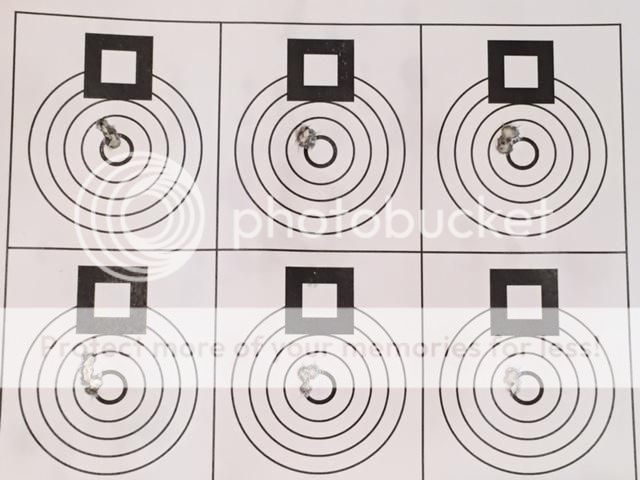
shot 3 sets of rim thickness today, 40, 41 and 42 thou rims. Shot a 5 shot group of each thickness at 50 yards and then repeated this a half an hour later, conditions were very very calm, 8 degrees warm with heavy rain at times, no rain when the groups were shot. All of this test batch had a driving band to rim measurement of .323, this is the short side of my test lot, shortest rounds were .323.....

rimthickness_zpsafa7d6e6.jpg


so in both cases the thicker rims had the most spread, not to much difference between the 40 and 41 when you average the 4 groups out, so after seeing these results I think it's pretty safe to say that rim thickness does play a key in how a particular lot of ammo is going to shoot.

second interesting thing was that when sighted in with a length of .323 I shot another group of ammo that measured at .330+/_ the longer ammo had the same group size but the center of this new group was low and left.....so the next step is to shoot 5 shot groups of each length with the same rim thickness to see if it rules anything out or adds more to the unknown..........
 
Doing what you're doing is a LOT of work. But already this first test is paying off. This is going to be an interesting thread to watch as it develops.
 
Interesting results. Where did you get the attachment to measure the rim thickness? It fits on a std 6" dial vernier?

interesting results today............especially for the non-believers...........

shot 3 sets of rim thickness today, 40, 41 and 42 thou rims. Shot a 5 shot group of each thickness at 50 yards and then repeated this a half an hour later, conditions were very very calm, 8 degrees warm with heavy rain at times, no rain when the groups were shot. All of this test batch had a driving band to rim measurement of .323, this is the short side of my test lot, shortest rounds were .323.....

so in both cases the thicker rims had the most spread, not to much difference between the 40 and 41 when you average the 4 groups out, so after seeing these results I think it's pretty safe to say that rim thickness does play a key in how a particular lot of ammo is going to shoot.

second interesting thing was that when sighted in with a length of .323 I shot another group of ammo that measured at .330+/_ the longer ammo had the same group size but the center of this new group was low and left.....so the next step is to shoot 5 shot groups of each length with the same rim thickness to see if it rules anything out or adds more to the unknown..........
 
G3 rimfire thickness gauge from neconos.com, that is where I also got the case length gauge. with the digital calipers I can actually sort to the 3rd decimal point if I really wanted
 
Back
Top Bottom