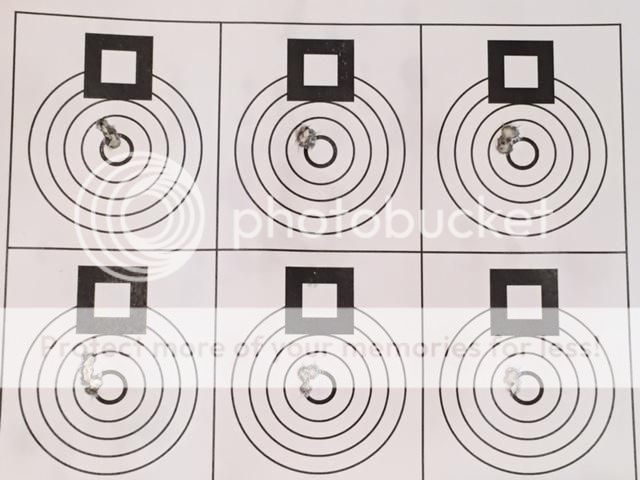
Do you recall the theory behind the "experimental procedure" described in high school science classes? The idea was to change only one factor at a time and test for it. You're separating lots of ammo by a number of factors regarding bullet shape and rim thickness. That's all well and good so far. And it's setting the stage for the testing you'll do.
So now the testing is about determining which factors are significant. Rim thickness was already identified in a couple of posts above. And that makes sense since rim thickness will alter the head spacing.
But there's also the other factors of bullet shape and diameter you are checking for. These factors will affect the seal in the bore and how quickly the bullet engraves the rifling. So those are valid things to test as well.
Well.... clearly you have the right idea so far.
The trick will be taking all the batches you've got and forming a matrix of ammo in some sort of grid box. Because you want to sort by each variable.
Think of having a set of grid boxes. If your ammo rims vary by .004 from smallest to largest you would want 4 separate boxes. Now each box can be sorted by two other factors.
It's sort of like a graph arranged in 3D. The rows and columns in one box are the X and Y. The stack of boxes that sort a third factor is the Z axis. If you want to sort a fourth variable in this mix you would need multiple stacks of boxes by however many steps you need again.
With the ammo all sorted by two, three or four variables then it's time to test and compare test samples to see if any one variable is significant. If it is then retain that sorting. If something you measured proves to be insignificant to group size or placement then collapse that sorting by distributing the ammo out into the other bins as appropriate.
I'd also suggest that working in this way with something like 1000 rounds SHOULD be enough of a sampling to prove which variables are significant and which are not. Until you know what matters there's no need to sort your whole stash for all possible variables. But this initial 1000 should be sorted by all the variables you can imagine.
It's likely also fair to suggest that the extremes for any one variable should be set aside for plinking. Out of 100 rounds tested for any one factor I'd likely discard any where there's only two or three at the extreme ends of the range. For example with rim thickness. If you find that 85 of the bullets fall within a .004" range I'd discard the 15 that are outside of that range as too extreme. Those within the .004 size range would result in 5 sets that are then measured and broken down to some other factor. And then the next, and the next and so on until you have it all matrixed out into sets that identical in 3 or 4 ways. Once you have all this done then you can begin shooting to test to see which factors are significant and which are not.
So now the testing is about determining which factors are significant. Rim thickness was already identified in a couple of posts above. And that makes sense since rim thickness will alter the head spacing.
But there's also the other factors of bullet shape and diameter you are checking for. These factors will affect the seal in the bore and how quickly the bullet engraves the rifling. So those are valid things to test as well.
Well.... clearly you have the right idea so far.
The trick will be taking all the batches you've got and forming a matrix of ammo in some sort of grid box. Because you want to sort by each variable.
Think of having a set of grid boxes. If your ammo rims vary by .004 from smallest to largest you would want 4 separate boxes. Now each box can be sorted by two other factors.
It's sort of like a graph arranged in 3D. The rows and columns in one box are the X and Y. The stack of boxes that sort a third factor is the Z axis. If you want to sort a fourth variable in this mix you would need multiple stacks of boxes by however many steps you need again.
With the ammo all sorted by two, three or four variables then it's time to test and compare test samples to see if any one variable is significant. If it is then retain that sorting. If something you measured proves to be insignificant to group size or placement then collapse that sorting by distributing the ammo out into the other bins as appropriate.
I'd also suggest that working in this way with something like 1000 rounds SHOULD be enough of a sampling to prove which variables are significant and which are not. Until you know what matters there's no need to sort your whole stash for all possible variables. But this initial 1000 should be sorted by all the variables you can imagine.
It's likely also fair to suggest that the extremes for any one variable should be set aside for plinking. Out of 100 rounds tested for any one factor I'd likely discard any where there's only two or three at the extreme ends of the range. For example with rim thickness. If you find that 85 of the bullets fall within a .004" range I'd discard the 15 that are outside of that range as too extreme. Those within the .004 size range would result in 5 sets that are then measured and broken down to some other factor. And then the next, and the next and so on until you have it all matrixed out into sets that identical in 3 or 4 ways. Once you have all this done then you can begin shooting to test to see which factors are significant and which are not.