Cutting case in half

regulate34

CGN frequent flyer
Rating - 100%
67   0   0
Location
BC
Hi guys.

I don't have any of they Specialized gauges for measuring case wall thickness. Since I am on my 5th reload on some 375ruger brass. all full loads and FL sized. I started to wonder ware the brass is at in its life span.

I have not had any issues with neck tension or cracked or splits on any of the cases.

I had a piece of brass the I slipped with the trimmer so I thought I am going to cut it in half.

I did it and took some measurements

problem is I don't want to open a fresh box of brass to cut one to compare.

so what are some limits in the thinness?

body meets head = .040"

3/4 the way up the body = .024"

on the angle for the shoulder = .013" too thin???

neck wall = .015"

so what do the experts say?
 
The way I understand it you want to look for thin areas in the tapering thickness.

For example with the thickness measurements you give you're sort of looking at a trapezoid which is .040 on one end and .013 on the other. At 75% of the way to the smaller side you're looking at .013 + (.25x(.040-.013))= the expected thickness at the wall at your 75% point. Or another way is .040-(.75x(.040-.013)) which will give the same answer.

The answer I get is .02 when the smaller decimal positions are rounded up. So with .024 at that point it suggests that the wall tapering isn't consistent or that your shoulder is pulling thin. As I understand these things any thinning should be more noticeable a short way above the head. So maybe look for some thinning in that area that doesn't calculate out correctly as well.
 
Sharpen a piece of wire and bend it at a 90 degree angle. Insert it through the mouth of the case and drag it up the inside and see if it catches in a groove just above the head. If there's a groove, toss it. If there isn't, you're GTG. I use a dental pick.
 
so what are some limits in the thinness?

body meets head = .040"

3/4 the way up the body = .024"

on the angle for the shoulder = .013" too thin???

neck wall = .015"

so what do the experts say?

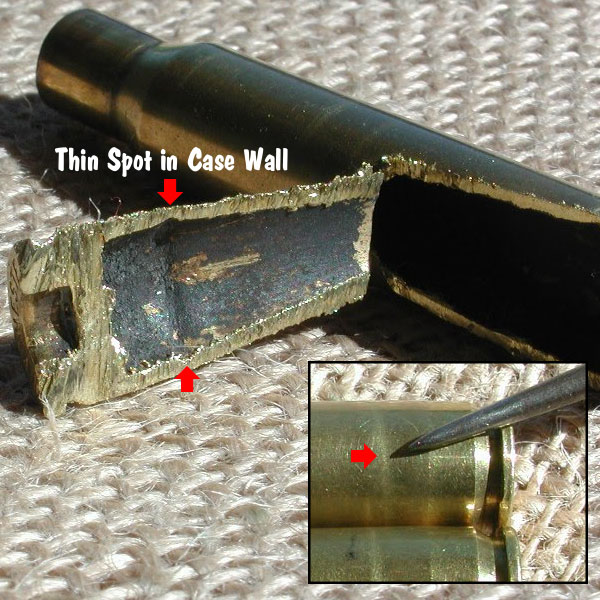
Absolute thickness is not really important. What you are looking for is localized thin spots (which indicates the brass has yielded and "necked" at that location) or cracks.

This picture taken from here shows it:
casehead02.jpg
 
The way I understand it you want to look for thin areas in the tapering thickness.

For example with the thickness measurements you give you're sort of looking at a trapezoid which is .040 on one end and .013 on the other. At 75% of the way to the smaller side you're looking at .013 + (.25x(.040-.013))= the expected thickness at the wall at your 75% point. Or another way is .040-(.75x(.040-.013)) which will give the same answer.

The answer I get is .02 when the smaller decimal positions are rounded up. So with .024 at that point it suggests that the wall tapering isn't consistent or that your shoulder is pulling thin. As I understand these things any thinning should be more noticeable a short way above the head. So maybe look for some thinning in that area that doesn't calculate out correctly as well.
:confused: :confused:
 
I did the bent pick trick. found no ridges or any kind, all smooth.

what I was measuring was the thickness of the area. they were consistent around the case in that spot.

I don't see any visible signs that concern me.

I have never had a case rupture. what could I expect if a neck splits?
I have read that Head separation can be very dangerous
 
You won't even notice a neck splitting, Head seperation would be a different story. Do you need to FL size your brass everytime? I always wait till I feel a bit of resistance on the bolt lift before I FL size and then only push the shoulder back a couple thou.
 
I have been FL sizing. Never tryed neck sizing.
The price of brass I probly should try neck sizing.

Neck sizing only will really extends the life of your brass, certain situations like dangerous game hunts you might still might want to FL size. The necks will split in as few as 5 firings in my experience but annealing the neck/shoulder prevents that problem then just shoot your brass till the primer pockets loosen up.
 
I've had case head separations in some very old .32S&W Long. These loads have a small pistol primer, 1.8 grains of 231 or Bullseye pushing a 98 grain hollow-base wadcutter.

The case head pops out with the extractor/ejector.
The gases push the bullet down to the target - accuracy most likely compromised - I can't remember. It was in the 90s. During a match.

Gases also escape out the ejection port, down through the magazine well, and in a Walther GSP they escape through the trigger group (requiring cleaning) and into your trigger finger. Sometimes there are brass fragments, sometimes burning and/or unburned powder.

Hurts, but I don't think I have any permanent scars.

Have also had a .303 case pop its head off during firing in a SMLE. Glad the breech is so far ahead of the trigger and I was wearing glasses. Pulled and threw out the rest of that batch of ammo...
 
I did the bent pick trick. found no ridges or any kind, all smooth.

what I was measuring was the thickness of the area. they were consistent around the case in that spot.

I don't see any visible signs that concern me.

I have never had a case rupture. what could I expect if a neck splits?
I have read that Head separation can be very dangerous

Usually when a neck splits not much of anything happens except the shot might be a flier. When a case separates you might see a little hot puff of gas and get a taste and not much else. Of course, if you're really unlucky it might be the last thing you ever see so the potential downside is severe. Best case scenario you have to get the broken case out of the chamber. Usually a brush and rod is all you need.
 
I have never had a case rupture. what could I expect if a neck splits?
I have read that Head separation can be very dangerous

You won't notice a neck split until you go to pick up the fired case, guaranteed.

The same is probably true of the head separation. I've experienced a couple dozen, occasionally there is a puff of smoke from the action to alert you, but more commonly I didn't notice until the case flying through the air looked vaguely bent, or I found the case in pieces on the ground. I've never had the front half remain in the gun. And if anybody has ever been injured, or had a gun damaged, by a case head separation, I've never heard a credible report of it.
 
Back
Top Bottom