












































Determining muzzle velocity using chronograph at different ranges VS truing

Roddy

CGN Ultra frequent flyer
Rating - 100%
113   0   0
Location
Leduc, AB
I have been trying to determine a more precise velocity for my handloads. I find the exact definition of muzzle velocity to be somewhat subjective.

When I chronoed my load (178 AMAX over 43.5 grains Varget at 2.840 in a Federal case) I set up the chronograph ($100 ProChrono) about fifteen to twenty feet from the muzzle. I averaged 2647 fps over eight rounds with the biggest difference 16 fps.

To try to get a more accurate velocity (and to practice in case my chronograph ever gets taken hostage) I set my chronograph up at exactly 100 meters and got an ever age velocity there. When I put the numbers into my Strelok ballistic program the velocity at the muzzle was a but higher.

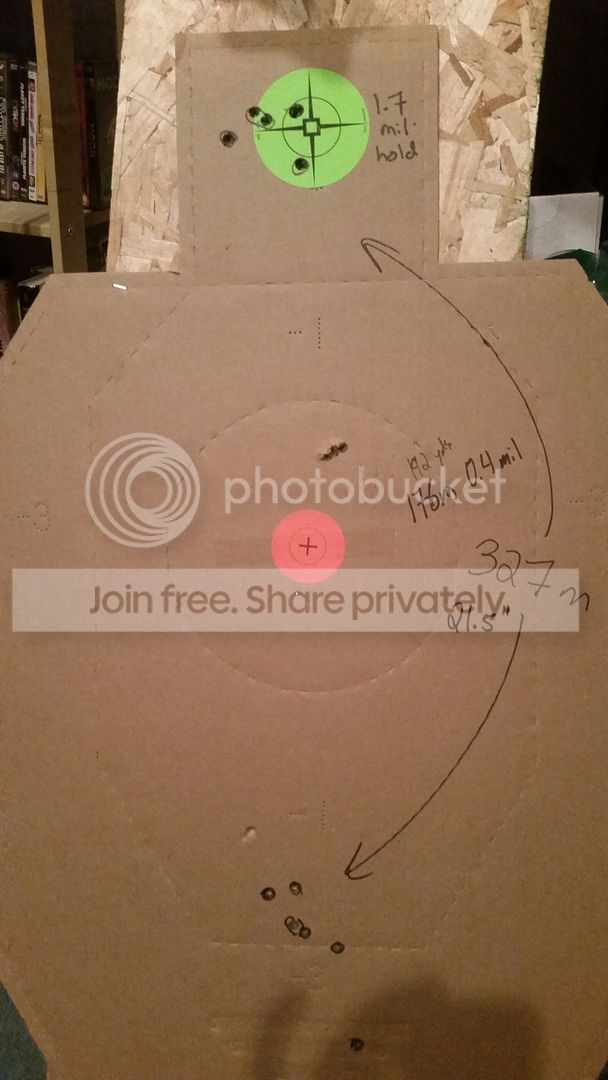
Finally I shot at 327 meters and got a 21.5" drop and used that to true the data and it figured I had a 2733 fps muzzle velocity. That seems fast compared to other data I have seen for similar loads from a 24" barrel but maybe they measured differently.

Now a few questions becase I don't know much about this stuff:

Is the chronograph 15 feet from the muzzle giving any valuable information other than shot to shot velocity variations?

Is setting the chronograph at 100 meters a more accurate way to determine velocity?

Is the actual bullet drop the most accurate way regardless if what the chronograph says?

Is 327 meters far enough to get good data? That's as far as I can shoot right now and I already used it to make a laminated range card for wind and bullet drop out to 1000 meters and I hope it not all GIGO useless info.

Sorry for the long winded and proably confusing post. Thanks in advance for any advice!
 
Is the actual bullet drop the most accurate way regardless if what the chronograph says?

If you chart the actual bullet drops at various distances, you don't really need to know the velocity, in order to properly place your bullets at various distances. I use a magnetospeed, which measures the velocity as the bullet leaves the barrel, but I am only interested in the velocity to determine that I will have enough impact velocity for proper bullet performance, and to decide, if I am going to work up the powder charge any more. If I find an accurate load, and the velocity seems normal for that combination, I leave the load alone, but if the velocity is reading a couple of hundred fps less than I expected, I will usually try working up the load a bit more.
 
Thanks for the reply stubblejumper. The thing is I only have that 327 meters to test my loads at. I have to use a ballistic app to determine drop at longer distances.

The idea was when I get a chance to shoot further I will have the bullet drop compensation figured out.
 
Whatever your situation, I will never take a shot at a living animal, until I have taken that shot at a target at that distance, with that load.
 
This is my target and coyote rifle. Currently my longest hunting shot would be the length of my range. If I got a chance to hunt at longer distances I would check my bullet drop chart first and make sure it was accurate.

For what it's worth here is my 327 meter targrt before and after dialing in 1.7 mils of elevation.

20151129_191938_zpsa5yfmb9p.jpg


The middle holes are from when I re used the target.
 
One of the problems associated with using bullet drop to calculate velocity is the fact that the Genuine BC of any given bullet
may be different than the Advertised BC of said bullet.

That being said, if you know the velocity at the muzzle, and at 100 yards [or 200, etc] the true BC can be calculated.

Dave.
 
Eagleye I am not so much concerned with the actual muzzle velocity as the bullet drop.

I had been assuming that if I had an exact bullet drop at a certain distance it wouldn't matter if my chronograph or ballistic app was a bit off because I could still determine the come ups at other distances. I could be completely wrong though. That's why I started this thread.

I'm also not sure exactly which muzzle velocity I should be using as if I measure fifteen feet from the muzzle that's not really muzzle velocity but velocity fifteen feet from the muzzle, no?
 
One of the problems associated with using bullet drop to calculate velocity is the fact that the Genuine BC of any given bullet
may be different than the Advertised BC of said bullet.

That being said, if you know the velocity at the muzzle, and at 100 yards [or 200, etc] the true BC can be calculated.

Dave.

Eagleye I am not so much concerned with the actual muzzle velocity as the bullet drop.

I had been assuming that if I had an exact bullet drop at a certain distance it wouldn't matter if my chronograph or ballistic app was a bit off because I could still determine the come ups at other distances. I could be completely wrong though. That's why I started this thread.

I'm also not sure exactly which muzzle velocity I should be using as if I measure fifteen feet from the muzzle that's not really muzzle velocity but velocity fifteen feet from the muzzle, no?


Pay heed to Eagleye's advice.

If you have the muzzle velocity, and 100 meter velocity, which you do, you can then calculate the BC of the bullet you are using and input that into your ballistics program and quite accurately determine both drop and drift at longer distances. Instead of using the advertised BC, you have the ability to determine the ACTUAL BC of the bullet from your rifle at the velocities you launch them at. Remember the BC of a bullet changes at different velocities, you now have what you need to EXACTLY calculate what you are looking for.
 
I had been assuming that if I had an exact bullet drop at a certain distance it wouldn't matter if my chronograph or ballistic app was a bit off because I could still determine the come ups at other distances. I could be completely wrong though. That's why I started this thread.

Knowing the exact bullet drop at only one distance is not enough to be 100% sure of the bullet drop at other distances. The trajectory calculations depend on the velocity and B.C. of the bullet being correct, and if there is an error with either, there will be an error in all calculations based on those numbers.

The best solution is to simply shoot your load at 100,200,300,400,500 etc yards, as far as you will ever shoot at an animal. Once you have done that, and you know the actual bullet drop at each distance, you won't need the calculations.
 
Last edited:
Best way to true/validate your trajectory is to build a drop chart for your load, zero your rifle at 100 yards and then put a target out at a distance where your bullet will be going transonic, approx 1300 fps (+200 fps above speed of sound). Adjust for the drop as per the chart and then measure your results on the target. In this case, approx 900 yards. Punch the info into the Gseven ballistic program and it will give you a trued velocity. The Bryan Litz BC for the 178gr Amax is .469g1
 
Okay thank you everyone for all the information. I will try to get out and find a longer range and get better bullet drop data.

Oh and todbartell that is the BC I am using. It was in G7 but I changed it.

Eagleye I didn't mean to disregard your advice. I do value your input. Also I don't completely trust my chronograph, it has taken some abuse. I feel I should look else where for good data.
 
Last edited:
Someone posted somewhere that there are two eras or reloading, pre chronograph and post chronograph. It's handy but I don't see it as the end all be all tool. Maybe I'm using mine wrong.
 
The reason for varying distances from the muzzle to record muzzle velocity is muzzle blast. Too close and two things might happen, 1. Muzzle blast will cause an incorrect velocity reading and 2. muzzle blast could upset or destroy your chronograph. Most will set the chronograph 10-12 feet from the muzzle for "normal" calibers and maybe 15 feet for magnums.
 
The reason for varying distances from the muzzle to record muzzle velocity is muzzle blast. Too close and two things might happen, 1. Muzzle blast will cause an incorrect velocity reading and 2. muzzle blast could upset or destroy your chronograph. Most will set the chronograph 10-12 feet from the muzzle for "normal" calibers and maybe 15 feet for magnums.

I understand the idea behind it. I had to play with distances before I got consistent readings. But does that not create errors in true muzzle velocity compared to say a Lab Radar that is measuring the exact velocity at the muzzle?

I always wonder that when I see someone say I'm getting ###X and someone else says that's slow I'm getting XXYY velocity. If one guy is using a fancy radar machine and one guy is using a shot up unit that's half way down range to keep it in the shade there must be some discrepancy between the two readings.
 
Moat ballistic apps will have a "Chrono Distance" field, so you put in 5 yards or whatever and it works out what the muzzle velocity must have been. Some apps, such as GunSim, will calculate multiple BC values based on your drop data and muzzle velocity. Manufacturer's BCs may not agree exactly with observed BCs.
 
If the drops don't match the chronograph velocity which one are you going to believe? Its going to take some shooting. Or if your come-ups don't match the chart, do you believe in the chart or the accuracy of the scope adjustments? Math is math, subject to the right data being entered, starting with the velocity being correct. The clicks can be confirmed but its going to take a lot of shooting. Without confirming its just a nice fantasy. Unless you are clocking the velocity of the same shot at two distances with two chronographs all you can get is a BC calculated on a couple of averages. Although that's a nice fantasy, even if you believed both chronographs and you had an ES of zero it would still only give you a calculated BC over that distance and BC changes with velocity. Or you could just shoot those distances and write the results down. BC is of use for calculating wind drift, but do you really know the windspeed and direction over the entire distance? Fact is you don't, but that's OK since most people have never confirmed the accuracy of their windage adjustments either.

Between chronograph error, BCs that vary between pretty close to out right lies, faulty testing that doesn't prove what we would like it to prove, adjustments of unknown accuracy, wind that is unknown and unknowable most of shooting beyond point blank is just a SWAG. The most reliable thing is the target.
 
Also your bullet drop at various distances will change daily depending on temperature, humidity, elevation, angle to target, etc, etc.
 
Back
Top Bottom





















