Death of a Trigger Pack: Timney Tavor Bites the Dust

TV-PressPass

CGN Ultra frequent flyer
Rating - 99.1%
116   1   0
Originally published on TFB:

IMG_0508_small-660x400.jpg


This is a sad story. During the last 3-Gun of the season, a team match, I was having a whale of a time blasting away with my Tavor. I dropped into prone to start ringing 200 yard gongs, and got a click with no bang. Cycle the gun manually, squeeze again, same result! I cycle twice more before I give up, pick up my partner’s AR-15, and finish the stage. It sucked.

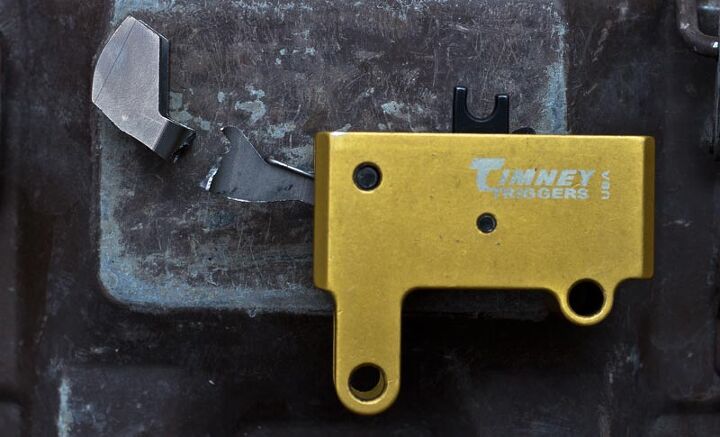
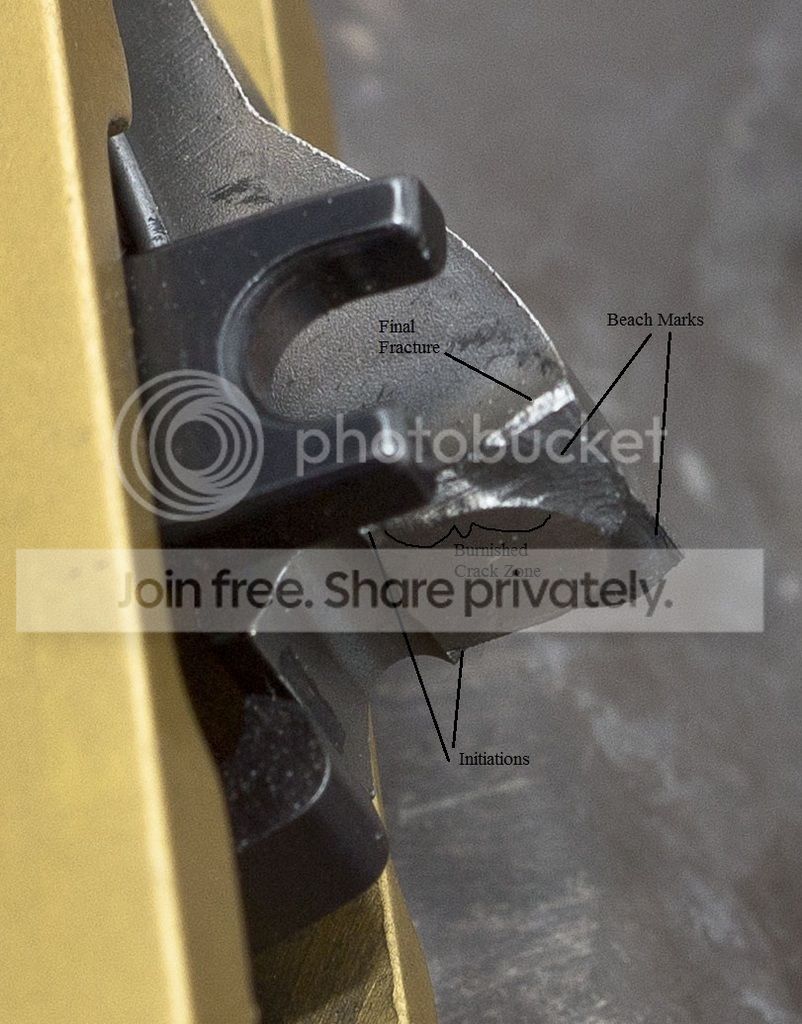
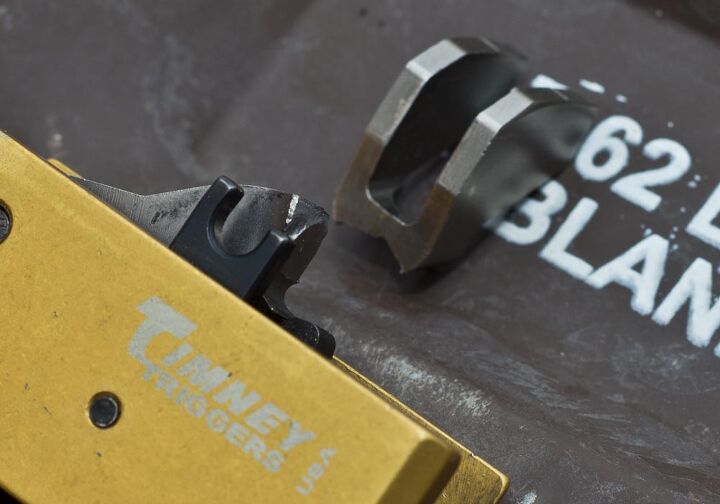
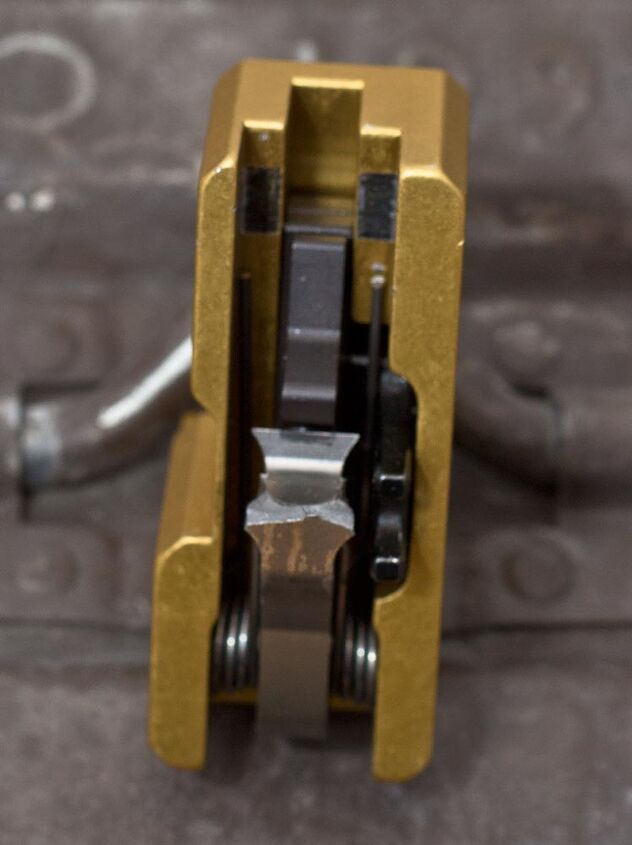
Upon disassembly the cause was pretty darn obvious: something was rattling inside the gun, never a good sign. The hammer from my Timney Trigger pack had sheared clean off during the stage. You might remember my review from early last year.

Now, I have a theory as to why this catastrophic failure happened, but I’ll save that for after the gory photos. Scroll down, and see if you reach the same conclusion I do. Perhaps someone with more metallurgical knowledge than me can see some indicators in the break.
IMG_0499_small.jpg


IMG_0497_small.jpg


IMG_0500.jpg


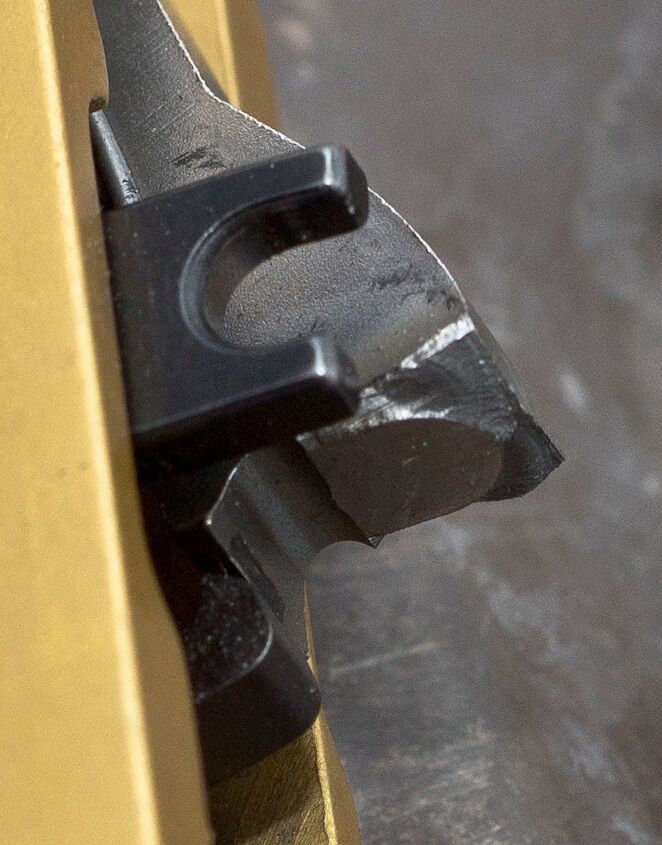
The two marks inside the body of the trigger pack say to me that the hammer was over traveling and impacting the inside housing. And clearly it wasn’t built to take that kind of stress.

My working theory as to why this pack failed comes from the fact that I’m shooting it in a TAR-21 rather than a SAR-21 rifle. You see, Canadian Tavors are still built on a semi-auto receiver, but they are 100% Israeli made.

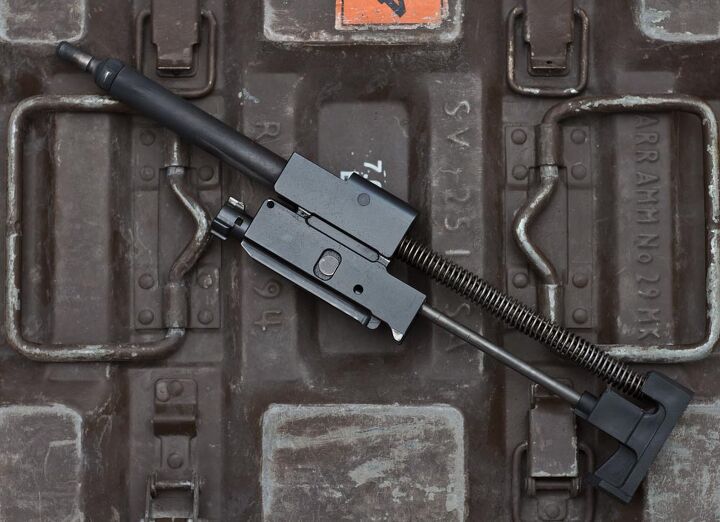
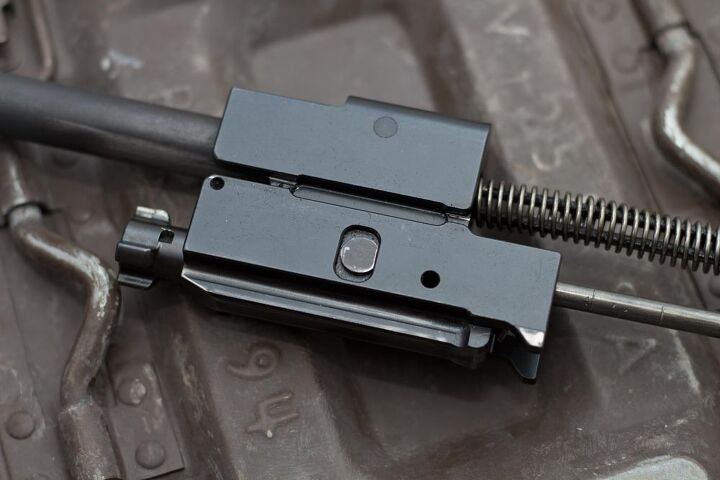
As a result, my bolt carrier groups look a little different from the current SAR-21 family.
IMG_0502_small.jpg


If you look closely, there are two flanges on the bottom of a TAR-21 bolt carrier group, which would normally engage the auto sear on the IDF select-fire version of the rifle. Like an AR-15, this full auto BCG is only a small part of actual automatic fire, but it was removed from the US rifles. I suspect these flanges are applying pressure to the Timney Trigger pack, forcing it deeper into the housing than was intended.
IMG_0505_small.jpg


If that is the reason, it’s the kind of problem you’d never see until you put the pack into a different rifle, but it’s still disappointing to see a fancy bit of gear fail like that, particularly when the clock is running.

A spot of good news? With the Giessele lightning bow installed, and my factory IWI trigger pack, I get a crisp, consistent 5.5lb single stage pull. That’ll do for me.

I also recently had the opportunity to gather 20 Canadian Tavor owners together for an IDF Tavor course and survey a few different trigger packs. We couldn’t find similar impact marks in the Super Sabra and Shooting Sight trigger packs, but many of those rifles had seen less than 1000 rounds.

For original Tavor owners, I’d encourage a regular check on your after-market trigger pack to avoid a disappointing click and no-bang.
 
It's been almost 30 years since my Metallurgical Engineering course but the two different patterns in the fracture area (one with striations and one without) make me think it was a fatigue failure...msybe originating at a stress concentration near the centre of the fractured edge.
 
It's been almost 30 years since my Metallurgical Engineering course but the two different patterns in the fracture area (one with striations and one without) make me think it was a fatigue failure...msybe originating at a stress concentration near the centre of the fractured edge.

haha, so my 1 year (in mech engineering) of material sciences has stuck! I saw the fatigue striations as well, as well as the impact point where it all started. The very rough/dull surface was a dead give-away for fatigue failure.

What did timney say? SOL?
 
Last edited:
Hey TV. How long did you have the Timney pack for and how many rounds through? I just purchased the geissele trigger pack and would be pissed if that happend to me!!! Sorry for your loss
 
haha, so my 1 year (in mech engineering) of material sciences has stuck! I saw the fatigue striations as well, as well as the impact point where it all started. The very rough/dull surface was a dead give-away for fatigue failure.

What did timney say? SOL?

I would like to be the third engineer here to say he has also seen these fatigue marks as well. Too bad I've forgotten a lot of my material science.

However, that part shouldn't have failed that early. I'm willing to be there was a defect in it, in which the fatigue failure propogated from. Any chance on getting a warenty replacement?
 
My working theory as to why this pack failed comes from the fact that I’m shooting it in a TAR-21 rather than a SAR-21 rifle. You see, Canadian Tavors are still built on a semi-auto receiver, but they are 100% Israeli made.


I don't believe that one bit,They are far more failed trigger packs in the US Tavors from both Geissele and Timney.

From what I understand is Geissele had a bad batch, and will overnight you a new one. and Ive seen pics of 3 broken Timney in the exact same spot as TVPP.

So in conclusion i'm keeping my spare OEM pack in my rifle bag in the event my Tav-D fails.
 
Last edited:
However, that part shouldn't have failed that early. I'm willing to be there was a defect in it, in which the fatigue failure propogated from. Any chance on getting a warenty replacement?
I'm wondering if there was casting porosity? (if it was cast...it looks like it may have been but although I graduated in Mechanical Engineering I've spent 28 years working in landline and wireless communications). Or maybe a small surface defect to act as a stress concentrator?
 
I would like to be the third engineer here to say he has also seen these fatigue marks as well. Too bad I've forgotten a lot of my material science.

However, that part shouldn't have failed that early. I'm willing to be there was a defect in it, in which the fatigue failure propogated from. Any chance on getting a warenty replacement?

I guess I'd be the third engineer to say that it was definately a fracture that propagated from the rear thin point towards the front.

If I'm not mistaken, geissele metal parts uses an S7 shock steel, which basically prevents things like this to happen.
 
Last edited:
Hey TV. How long did you have the Timney pack for and how many rounds through? I just purchased the geissele trigger pack and would be pissed if that happend to me!!! Sorry for your loss

Couple of years, couple of thousand rounds? I sent it back to them in the early part of 2014 when I was getting some unexpected bump firing. I'm honestly not too beat up about it.
 
I would like to be the third engineer here to say he has also seen these fatigue marks as well. Too bad I've forgotten a lot of my material science.

However, that part shouldn't have failed that early. I'm willing to be there was a defect in it, in which the fatigue failure propogated from. Any chance on getting a warenty replacement?

Yup! They'd be willing to replace it. Currently I'm not sure I really need an aftermarket trigger pack in my rifle, so I haven't pushed it too hard.
 
It's been almost 30 years since my Metallurgical Engineering course but the two different patterns in the fracture area (one with striations and one without) make me think it was a fatigue failure...msybe originating at a stress concentration near the centre of the fractured edge.

The part looks cast to me and there are radial indication in both fractures. I see no evidence of plastic deformation, so it looks like an abrupt catastrophic failure and points the part probably having been hardened after manufacture and engagement surface machining.

With a fatigue fracture in steel, you usually have 2 distinct zones to the fracture, the initial crack zone and the fast fracture zone in the area of the break that was not subject the initial fatigue cracks.

The 14th ed Machinist's Handbook describes Fatigue Fractures thusly:

Fatigue failure is brittle-like in nature – even in normally ductile metals in that there is very little, if any, gross plastic deformation associated with failure. The process occurs by the initiation and propagation of cracks, and the fracture surface is usually perpendicular to the direction of an applied stress.

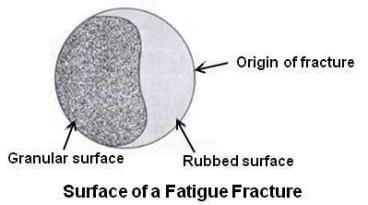
The appearance of a fatigue fracture surface is distinctive and consists of two portions. The smooth or burnished portion shows the progress of the fatigue crack up to the moment of final rupture, and the final granular zone due to fast fracture as shown in the figure given below.
Surface-of-a-Fatigue-Fracture.jpg


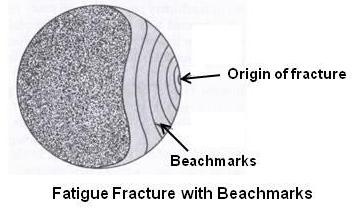
In case of materials that are used for a period of time, allowed to rest for an equivalent time period and then loaded again as in factory usage, the fatigue fracture surface shows Beachmarks as shown in figure given below.

Fatigue-Fracture-with-Beachmarks.jpg

Here is a picture of a textbook fatigue fracture:

Fig299_4.jpg


In your picture here:

IMG_0500.jpg


Almost the entire break looks like it's made up of beach marks, meaning crack propagation happened by successive cyclic loading. Failure started at the bottom of the hammer at the two thin points and continued upward over many cycles.

I can't see the top of the fracture with enough resolution but I would say a slow-propagation cyclic fatigue fracture is the leading theory at the stage :) It looks like it held up for quite a while after the initial cracks formed too.

From a design perspective, the bottom of those 2 "winged" areas where the fracture began should probably have been radiused.

My $.02 worth. (4th Mech Eng to weigh in? I still sometimes work in materials science and FMEA, though am begrudgingly finding myself a manager of people more and more).
 
exact same thing happened to my timney tavor trigger, exactly, on the first shot, hammer part sheared off, i laughed tossed it aside as a piece of total crap, returned it, got my money back, put original trigger back on, never looked back.
 
Well ain't that a B.

Return it, get a new one.

I wonder if its different tolerances for the American made tavor. American trigger, American tavor, know what I mean? Not American trigger, Israeli rifle.
 
so mine did the same thing so its not an odd fluke occurence. I wouldnt get another timney honestly. completely lost confidence in that company, slowy replacing all my timney triggers on my ars with wilson combats
 
Thanks for this, I hardly think to really inspect my trigger pack on disassembly I'll make sure I do. I shoot the hell outta my tavor, onto 3500+ and my geissele trigger and trigger pack are still running strong.

Also a machinist of 10 years and a crane inspector. I would bet it's a relief angle and hardening issue. Seen lots of beautiful parts go into an oven and into and quench only to blow up.
 
Last edited:
I doubt your the only Timmey Tavor trigger owner to have this happen and their probably looking and redesigning it as we speak. It looks like a lot of mass above where it's failed attached by the small amount of material in that area and it would not take much of a stress riser wether it's machining marks or heat treatment issues to cause it to fail. I'm sure they will come good for it and probably with an updated product.---Dieseldog!
 
Claven2 has the mechanism nailed. Fatigue originating from the corners of the thin webs at the back of the hammer:
Tavor2_zpsx5oznbz6.jpg


The two cracks grew towards the front and merged, creating the step front and center. The initiation of two independant cracks at separate locations with similar geometery make the idea of any material flaw quite unlikely. Instead it is highly probable that the geometry is the problem, creating a high stress location that just begs to initiate cracks.

The observation that the hammer seems to be overtravelling and hitting the housing on its backstroke is significant, as that action would be expected to impart a bending moment on the hammer that would put the back edge of the hammer in tension, while striking the firing pin would stress the hammer in the opposite direction, putting the back edge of the hammer in compression. The hammer would be much less likely to crack from the backside without that contact with the housing. Also fatigue where you have reversing loads is much more severe than simply having loading in one direction only, which helps explain why all this happened in only a couple thousand rounds.

I don't see anything that strongly suggests how the part was made, and the dimple-textured surface on unmachined areas could be the result of investment casting, forging or shot blasting/peening.

I am not a 5th mechanical engineer, but I do have this here metallurgical engineering degree, and did spend about a decade doing failure analysis. I hope that counts for something.
 
Back
Top Bottom