Bolt action rifles , resizing neck and case HELP

Dillybar87

Regular
Rating - 100%
12   0   0
Location
British Columbia
hi there im new to reloading , got into it because i have enfields that i love to shoot , so i accuired a LEE classic loader kit witch is a cheap way to start and i live in a condo so space is limited perfect fit for me!!! And a nice old guy i know gave me a bunch of old .303 brass so i am set!! Now the problem , the Lee loader only resises the neck and after doing more research i read that you can only neck size brass that has been fired out of your gun , now i have all this .303 brass i guess i cant use , if i find somone with a press and they resize the cases can i then use in my rifles and then resize the necks?? or is this not a big deal and as long as the case chambers in my rifle is it safe for me to reload and use?? , thanks!
 
If they chamber in your rifle they may have been fire formed in a larger chamber , should be alright to try. Make sure you don't use any force to close the bolt
 
the Lee loader only resises the neck and after doing more research i read that you can only neck size brass that has been fired out of your gun , now i have all this .303 brass i guess i cant use , if i find somone with a press and they resize the cases can i then use in my rifles and then resize the necks?? or is this not a big deal and as long as the case chambers in my rifle is it safe for me to reload and use?? , thanks!

Yes, and Yes. Try them with neck resizing only, and if they fit your gun, you should be fine to use them. If not finding someone to do a full length resize is a good plan. Still may not work, but is worth a try. Ideally you want to start with new brass fired in your gun only.
 
There is no short answer to your question. Excessive head space is often involved, so you have to know something about headspace. Headspace on a 303 is controlled by the rim on the cartridge, which is designed to hold the cartridge head against the bolt face. If things are well worn the cartridge may have a fair amount of room to slide back and forth in the chamber.
When the trigger is pulled, the strength of the firing pin hitting the primer will drive the cartridge full forward in the chamber.
Then the primer fires and ignites the powder.
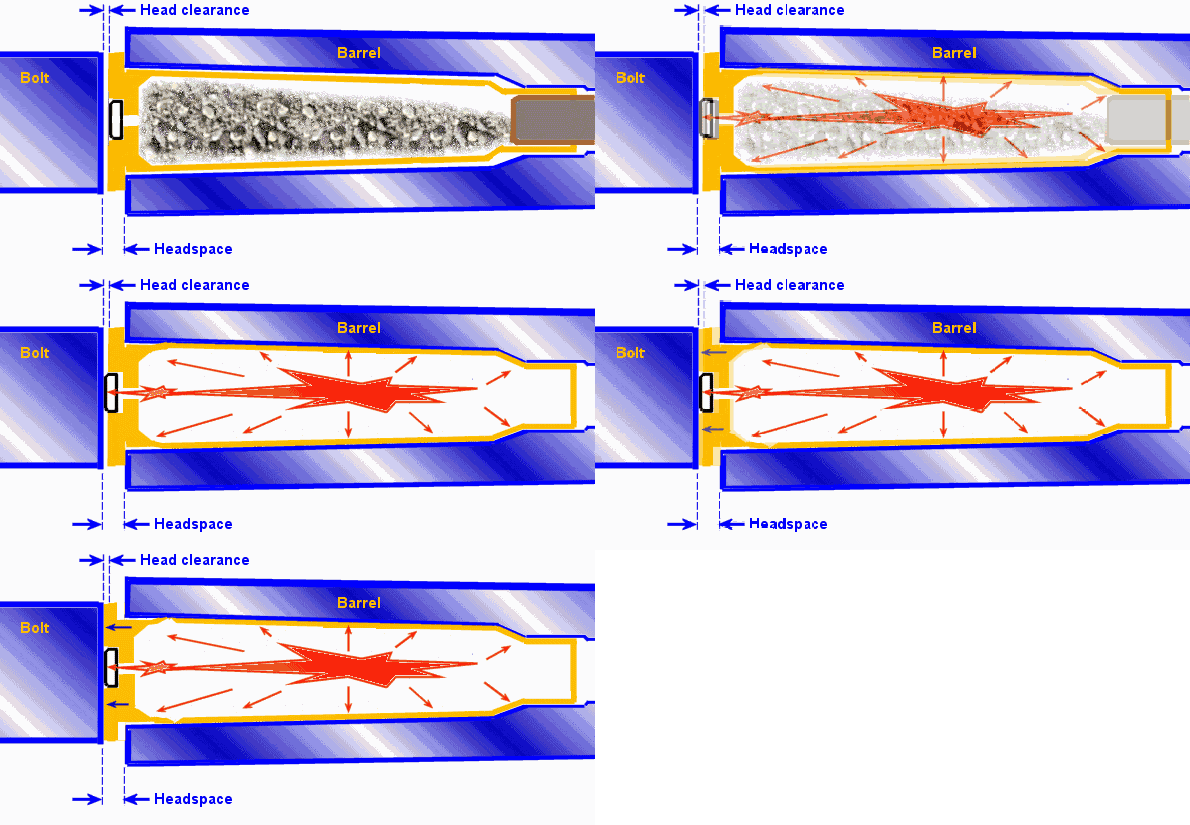
The pressure created stretches the case sideways and contacting the chamber walls, holds the case full forward, until the pressure against the head of the case pushes it back tight against the bolt face.
The result is the case has been badly stretched at its most vital area, just ahead of the so lid base, resulting in a shiny, weakened area, that seldom comes apart on the first firing, but may easily come, at least partially, apart on one, or a very few more firings. The result is that the first firing of the case has pretty well ruined that case for reloading.
Thus, many, if not all, of your fired cases you have are virtually not suitable for reloading.
Your most satisfactory solution would be for you to buy a box of 303 ammunition. You then have to devise a system of firing them, in order that your own rifle doesn't also stretch the cases on first firing, making them also useless for further reloading.
The usual solution is to put as small, O ring over the cartridge and of a size that will fit tight against the rim and when that cartridge is put in the chamber the bolt will close hard on it.
When it is fired, the cartridge will not be allowed to move forward on the strike of the firing pin and the empty case will be a perfect fit to your rifle.
Also, the shoulder of this fired case will have moved ahead to tightly fit the shoulder of the chamber. From here on in, you reload it to allow the tight fitting shoulder to control headspace and your simple Lee reloader should work great, by just neck resizing and your cases should last as long as they would in any other calibre rifle.

 
That is a clever solution. What might the o-ring be made of, and how small would it be?....would it be more like a shim washer?

Some hardware stores, or big automotive stores, like Lordco, have a great variety of O rings, made out of some type of non ridgid, softer material of some type, which are dirt cheap. Probably take an empty in with you and find one that just goes over the case to the rim.

Edited to say if you can find a mini rubber band, small enough to fit snuggly over the cas by the rim, it would be ideal.
 
Last edited:
hi there im new to reloading , got into it because i have enfields that i love to shoot , so i accuired a LEE classic loader kit witch is a cheap way to start and i live in a condo so space is limited perfect fit for me!!! And a nice old guy i know gave me a bunch of old .303 brass so i am set!! Now the problem , the Lee loader only resises the neck and after doing more research i read that you can only neck size brass that has been fired out of your gun , now i have all this .303 brass i guess i cant use , if i find somone with a press and they resize the cases can i then use in my rifles and then resize the necks?? or is this not a big deal and as long as the case chambers in my rifle is it safe for me to reload and use?? , thanks!

If the cases are too long to fit in your chamber the cases can be sized with a case forming and trim die. The case neck and body will not be touched and only the case shoulder will be bumped.

If at all possible never full length resize a .303 British case, these dies are much smaller than a Enfield chamber and you will end up with case head separations.

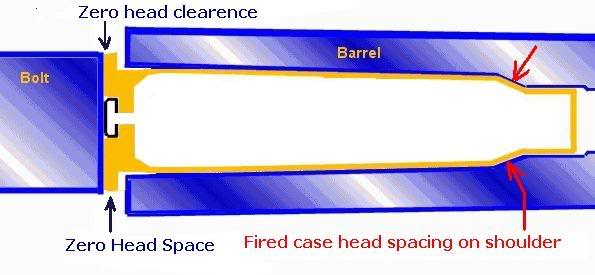
Below a neck sized case headspaces on the case shoulder and the case is held close to the bolt face and can not stretch.

fireformedzeroheadspace-1.jpg


Below a commercial case being fired in the longer and fatter Enfield chamber.

headspacestretch1-1.gif


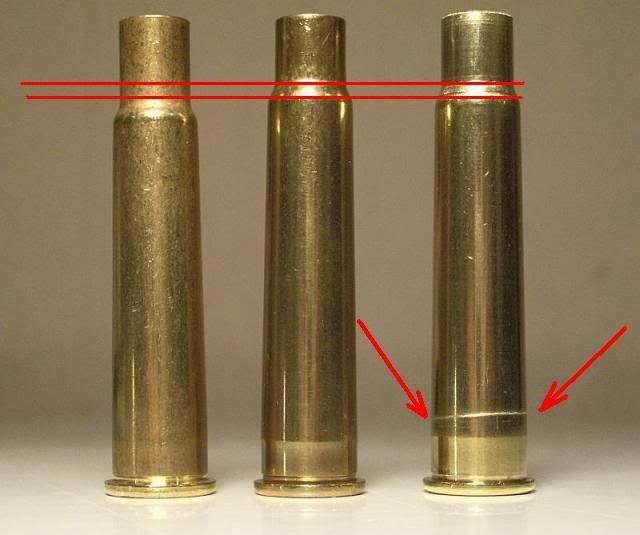
Below a .303 case that was full length resized twice and started to separate. The case on the far left is new and never fired and the shoulder is much shorter.

shouldera-1.jpg
 
Last edited:
So you do this just the first time you shoot the brass or every time?

Here is what I said about it, after using the O ring for the first firing of a factory load.

"From here on in, you reload it to allow the tight fitting shoulder to control headspace and your simple Lee reloader should work great, by just neck resizing and your cases should last as long as they would in any other calibre rifle."

The O ring is required only once, just on the factory load. After that just neck size it with your little Lee outfit.
Neck sizing often results in the case gradually lengthening, to the point where it may not go into the chamber. If that happens, you may have to borrow someone's 303 FL resizing die and JUST BARELY TOUCH THE SHOULDER BACK. Just to the point where the case will go into your rifles chamber.
 
Here is what I said about it, after using the O ring for the first firing of a factory load.

"From here on in, you reload it to allow the tight fitting shoulder to control headspace and your simple Lee reloader should work great, by just neck resizing and your cases should last as long as they would in any other calibre rifle."

The O ring is required only once, just on the factory load. After that just neck size it with your little Lee outfit.
Neck sizing often results in the case gradually lengthening, to the point where it may not go into the chamber. If that happens, you may have to borrow someone's 303 FL resizing die and JUST BARELY TOUCH THE SHOULDER BACK. Just to the point where the case will go into your rifles chamber.

If he only has a lee loader, he'll need to borrow a press with that FL die. (Not trying to give you a hard time, just explaining to the OP what he'll need)
 
Run you existing brass through your rifle and sort into 2 piles. Cases that the bolt closes and those that don't. Neck size the one that the bolt would close on. A little resistance is just fine.

Do not neck size the cases that would not chamber.

When you visit your buddy to FL size the brass, take the rifle with you.

Don't screw the die all the way down. Adjust it so it only sizes half way down the neck. You will easily see where it gets sized.

Then chamber the case and see if it chambers. It probably won't.

Turn the die in a half rev and try another case. Try to chamber and note how far the bolt turns down if it won't close.

Repeat until the bolt closes. Lock the die into position and size all the brass. The shoulder will be pushed back the minimum.
 
There is no short answer to your question. Excessive head space is often involved, so you have to know something about headspace. Headspace on a 303 is controlled by the rim on the cartridge, which is designed to hold the cartridge head against the bolt face. If things are well worn the cartridge may have a fair amount of room to slide back and forth in the chamber.
When the trigger is pulled, the strength of the firing pin hitting the primer will drive the cartridge full forward in the chamber.
Then the primer fires and ignites the powder.
The pressure created stretches the case sideways and contacting the chamber walls, holds the case full forward, until the pressure against the head of the case pushes it back tight against the bolt face.
The result is the case has been badly stretched at its most vital area, just ahead of the so lid base, resulting in a shiny, weakened area, that seldom comes apart on the first firing, but may easily come, at least partially, apart on one, or a very few more firings. The result is that the first firing of the case has pretty well ruined that case for reloading.
Thus, many, if not all, of your fired cases you have are virtually not suitable for reloading.
Your most satisfactory solution would be for you to buy a box of 303 ammunition. You then have to devise a system of firing them, in order that your own rifle doesn't also stretch the cases on first firing, making them also useless for further reloading.
The usual solution is to put as small, O ring over the cartridge and of a size that will fit tight against the rim and when that cartridge is put in the chamber the bolt will close hard on it.
When it is fired, the cartridge will not be allowed to move forward on the strike of the firing pin and the empty case will be a perfect fit to your rifle.
Also, the shoulder of this fired case will have moved ahead to tightly fit the shoulder of the chamber. From here on in, you reload it to allow the tight fitting shoulder to control headspace and your simple Lee reloader should work great, by just neck resizing and your cases should last as long as they would in any other calibre rifle.


Run you existing brass through your rifle and sort into 2 piles. Cases that the bolt closes and those that don't. Neck size the one that the bolt would close on. A little resistance is just fine.

Do not neck size the cases that would not chamber.

When you visit your buddy to FL size the brass, take the rifle with you.

Don't screw the die all the way down. Adjust it so it only sizes half way down the neck. You will easily see where it gets sized.

Then chamber the case and see if it chambers. It probably won't.

Turn the die in a half rev and try another case. Try to chamber and note how far the bolt turns down if it won't close.

Repeat until the bolt closes. Lock the die into position and size all the brass. The shoulder will be pushed back the minimum.

Thanks for your insight gentlemen. Your experience has saved me from learning the hard way.
 
The Enfield ain't great to reload for; it locks-up at the back of the bolt, so the action stretches everytime it fires. Should be less of a problem with a low-use Enfield; could be a big problem with an Enfield that's fired a lot of rounds. I've read about guys who got many uses from their brass, but consensus seems to be that they may start separating (like the picture) after as few as 5 or 6 reloads.

You might want to display your Enfields, and pick-up a .303 that locks-up at the bolt head. Like a Ross - or a P14.
 
Last edited:
Back
Top Bottom