Post annealing - change in bullet seating force

RonR

Regular
Super GunNutz
Rating - 100%
25   0   0
Location
Saskatoon
I’ve annealed a set of 10 cases and loaded for testing/auditing. I purchased this brass from a CGN member, have turned to match neck thickness of existing inventory and annealed.

There was a considerable increase in seating force but very consistent/solid. If I was to explain the increase it would be in the range of 20 to 30 %.

My question to those experienced annealer’s is, is this amount of increase in seating force normal? I’ve never loaded annealed cases before and the amount of difference and feel was unexpected. (It felt “better” and upon consideration I prefer it.:rolleyes:)

Aside: I understand the principle of returning the brass to a more malleable state translating into more “grip” for this situation but this amount of change really makes me wonder how much this impacts neck tension. I have no idea on how to quantify or predict a .002 neck tension on a 3x fired case vs. .002 neck tension on an annealed case but there is a definite difference in force that has to be explainable/predicted IMO. I need help with that.

Jerry, Yodave, Kelly, Rooster? Others that can offer some insight?

Regards
Ronr

Of note
- Lapua cases, 3x fired by previous owner
- First time loading annealed cases. Propane torch and Tempilaq 750 is the method
- Neck turned brass for process consistency and to eliminate nagging variability
- Dry lubricant application to inside of necks as per normal here
- Bullets were from an existing lot, left overs from fire forming and load development a couple of years ago
- 7mm-08 cartridge and Sierra 140 Prohunter's if that's of any value
- 3rd year reloader and loving it!
- *** edit using Lee Collet Die and neck measurements before and after neck sizing same as previous***
 
Last edited:
yes............

the reason is the brass is not springing back as much when you size the necks, you may be able to go up a bushing size after annealing
 
yes............

the reason is the brass is not springing back as much when you size the necks, you may be able to go up a bushing size after annealing

Noted. I will be testing this but...the seating pressure increase is likely to provide different results as the range?

S$%t, if that's the case I understand why, for the sake of consistency regarding neck tension, that annealing is such a consideration. Wow.

Regards Yodave.
Ronr
 
Noted. I will be testing this but...the seating pressure increase is likely to provide different results as the range?

S$%t, if that's the case I understand why, for the sake of consistency regarding neck tension, that annealing is such a consideration. Wow.

Regards Yodave.
Ronr

2 things.......annealing...........and bushing neck sizing dies.........2 more things to try and 2 more things to keep you up all night wondering.....what if.....what if......what if......
 
Is this the first time using Lapua brass?

What were you shooting before if not Lapua?

Jerry

Jerry I've got some new Lapua brass for the same rifle, fired 3x that has not been annealed and is very different at the moment regarding seating force. (My son's rifle headstamp is PRVI from yourself and it works REALLY well, but I haven't annealed it yet. After 3x fired the bullet seating force is relatively close to "new" condition IIRC...but after this experience I've got more questions than answers regarding how I can somehow control this outside of annealing frequently. It's just too much difference to ignore.)

I've got experience with Federal brass that's not been very positive at all. Am I missing something with the brass quality here?

Thanks for weighing in.

Regards Jerry,

Ronr
 
Last edited:
2 things.......annealing...........and bushing neck sizing dies.........2 more things to try and 2 more things to keep you up all night wondering.....what if.....what if......what if......

Ahhh...S$%t again. LMAo. Nailed it.

Best Regards
Ronr
 
Jerry I've got some new Lapua brass for the same rifle, fired 3x that has not been annealed and is very different at the moment regarding seating force. (My son's rifle headstamp is PRVI from yourself and it works REALLY well, but I haven't annealed it yet. After 3x fired the bullet seating force is relatively close to "new" condition IIRC...but after this experience I've got more questions than answers regarding how I can somehow control this outside of annealing frequently. It's just too much difference to ignore.)

I've got experience with Federal brass that's not been very positive at all. Am I missing something with the brass quality here?

Thanks for weighing in.

Regards Jerry,

Ronr

all brass is different, keep notes and treat them all as separate lots, you may have to anneal the federal more often, or perhaps even less often as the others, this is where mixing brass is a bad idea when your trying to get into a repeatable routine, ammo boxes with numbers....what stage they are at....twice fired....trimmed....annealed.....foulers....match.....mystery......what was this one......who's is this......did I wild cat this???
 
all brass is different, keep notes and treat them all as separate lots, you may have to anneal the federal more often, or perhaps even less often as the others, this is where mixing brass is a bad idea when your trying to get into a repeatable routine, ammo boxes with numbers....what stage they are at....twice fired....trimmed....annealed.....foulers....match.....mystery......what was this one......who's is this......did I wild cat this???

Roger that. Sound experienced advice there. I keep the headstamps, lots and how many times fired separated via zip lock bags. Each manufacturer and from lot to lot will have some variation ergo the reason why I've made the effort. I've got labels with notes on each bag to accompany re trimming etc.

I've given up on the F-C brass and I've got a bit of em, at least by my standards. Way too much inconsistency from pockets, to weight, to you name it. Cull rate was through the roof and I figured times better spent with what the experienced guys are suggesting...when it comes to longevity and the amount of OCD to try and be as consistent as possible. The "WTF" pile was big. Lapua and PRVI don't have a bag with that label yet.

Regards
Ronr
 
Last summer I purchased an Annealeaze unit.

I noticed a wide margin of seating force required when using brass that had not been annealed. Not so with the stuff that has been.

Now I clean, anneal, size and trim in that order after each firing. It is always followed up by a good polishing afterwards, because I take pride in having clean and shiny ammunition.

On my F-Class loads, I'm seeing a exreme velocity spread of about 6-10 fps when my brass is prepped this way. It was as much as 70 fps without annealing, which resulted in a less accurate round.

I have also found that consistency between brass that has been fired once is the same as brass that has experienced 5-10 firings. It seems to be the "fountain of youth" for brass cases.
 
Different brass makes = different brass amounts + different brass hardness + different brass thickness = different brass neck sizing AND different brass capacity!

Even within makes (such as Lapua), different lots may have slightly different tolerances.

Since you are sizing from outside with the Lee collet, the end result will be an exterior neck size of whatever the collet applies, less a tiny bit for metal springback, but the internal neck size will be the external neck size - 2 x wall thickness. The thicker the wall, the less room for the bullet, the higher the neck tension.

As an aside, I found that the Lee deprime / collet neck size die can be inconsistent. The downward handle pressure when using it has to be applied as consistently as possible. It loads great ammo with care in use and I still use it for gong plinking ammo, but now reload my target ammo in a Redding turret press with Redding competition dies (neck bushing die, full length resizing die, seating die) and a Forster shoulder bump die without a neck bushing installed. If I fire and have no sticky or hard extraction they get cleaned, inspected, and the neck size and shoulder bump to chamber size - 0.002". If I have even the slightest difficulty closing the bolt on a live round or extracting after firing, that entire lot gets cleaned well, a visual inspection for any sign of imminent failure, a measurement for potential bulging of the web area, full length resize with shoulder bump, neck size, trim to length, and another follow-up visual inspection.
 
RonR

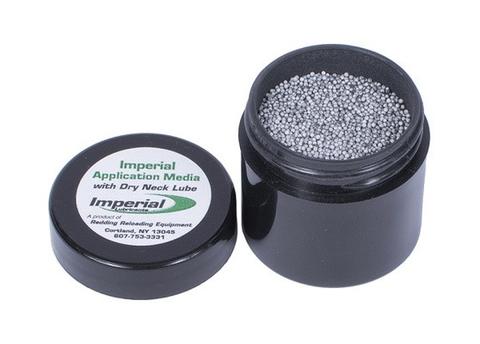
At AccurateShooter.com I remember that many people after annealing ran a copper bore brush inside the freshly annealed case necks. This was to remove any templac residue and oxidation and ease seating. I would also dip the case necks in Imperial dry neck lube to further ease seating force.

CH3epH9.jpg
 
The Lee Collet die sizes the neck with a mandrel. This is not adjustable. The mandrel is undersized to allow for the spring back of the brass and to provide the correct neck tension. If your die is set up correctly the two lots of cases will be sized the same. The difference will be in the brass itself, specifically its maximum point of elastic deformation. We anneal brass to increase its ductility. Hard brass is less ductile. It should not be surprising that freshly annealed brass is more ductile than brass that has been fired even once. The new brass may even have started off less ductile.

For those interested in a more in depth understanding, here is a good explanation.

http://bisonballistics.com/articles/the-science-of-cartridge-brass-annealing

The Factory crimp die will help reduce SD between loads using different brass lots but sorting and separating is also a good practise.
 
I noticed a wide margin of seating force required when using brass that had not been annealed. Not so with the stuff that has been.

On my F-Class loads, I'm seeing a exreme velocity spread of about 6-10 fps when my brass is prepped this way. It was as much as 70 fps without annealing, which resulted in a less accurate round.

More variation in force with cases at different levels of hardness vs. more consistent force with cases that have been annealed...translating to measured results at the range while indicating the relationship of ductility to neck tension.

Right on! Thanks Freedom. By the way the spread is SMALL. Wow.

Regards
Ronr
 
Different brass makes = different brass amounts + different brass hardness + different brass thickness = different brass neck sizing AND different brass capacity!

Even within makes (such as Lapua), different lots may have slightly different tolerances.

Since you are sizing from outside with the Lee collet, the end result will be an exterior neck size of whatever the collet applies, less a tiny bit for metal springback, but the internal neck size will be the external neck size - 2 x wall thickness. The thicker the wall, the less room for the bullet, the higher the neck tension.

As an aside, I found that the Lee deprime / collet neck size die can be inconsistent. The downward handle pressure when using it has to be applied as consistently as possible. It loads great ammo with care in use and I still use it for gong plinking ammo, but now reload my target ammo in a Redding turret press with Redding competition dies (neck bushing die, full length resizing die, seating die) and a Forster shoulder bump die without a neck bushing installed. If I fire and have no sticky or hard extraction they get cleaned, inspected, and the neck size and shoulder bump to chamber size - 0.002". If I have even the slightest difficulty closing the bolt on a live round or extracting after firing, that entire lot gets cleaned well, a visual inspection for any sign of imminent failure, a measurement for potential bulging of the web area, full length resize with shoulder bump, neck size, trim to length, and another follow-up visual inspection.

Thanks Rick
Ronr
 
RonR

At AccurateShooter.com I remember that many people after annealing ran a copper bore brush inside the freshly annealed case necks. This was to remove any templac residue and oxidation and ease seating. I would also dip the case necks in Imperial dry neck lube to further ease seating force.

CH3epH9.jpg

Hey Ed, I never thought about the wire brush inside the neck to remove oxides. I scotch brite'd the outside to do that just never considered the inside. ( I tried tempilaq inside the necks but it wasn't telling me anything over outside the necks/shoulder body, so I've gone away from applying inside. I have a previous post on the findings) Thanks for that.

I use the forster motor mica white dry lubricant in a home made dip and brush system to eliminate any bridging and to try and create a consistent film. I won't lie though, the imperial system you've posted seems a little neater and likely works a bit better. The increase in force to seat seemed to be irrelevant to dry lube or not which really surprised me...ergo this post.

I appreciate the tips knowing you likely don't have the need/purpose to anneal.

Best Regards
Ronr
 
The Lee Collet die sizes the neck with a mandrel. This is not adjustable. The mandrel is undersized to allow for the spring back of the brass and to provide the correct neck tension. If your die is set up correctly the two lots of cases will be sized the same.

Well stated MacD! Exactly the occurrence here...for clarity.

It should not be surprising that freshly annealed brass is more ductile than brass that has been fired even once. The new brass may even have started off less ductile.

Not a surprise regarding ductility, what was the surprise was the amount of increase in seating force with the change in ductility. Interesting thought regarding the new brass may have been harder at the start before annealing. I was arriving at that conclusion and after this I am apt to believe that this is not only probable, but likely.

D$%n, I've got this urge now to get all the inventory to this state...great!:mad::d

For those interested in a more in depth understanding, here is a good explanation.

http://bisonballistics.com/articles/the-science-of-cartridge-brass-annealing

Good read, plain English on strength of materials of brass and how it relates to shooting. Wish I was into reloading back while in classes...would have had a real life example to test in the lab. (When the sample yields it makes a hell of a bang!)

Thanks MacD for weighing in and providing some further clarity.

Regards
Ronr
 
Back
Top Bottom