Odd Occurrence? Help!

jnewing

Member
Rating - 100%
12   0   0
Location
Ontario
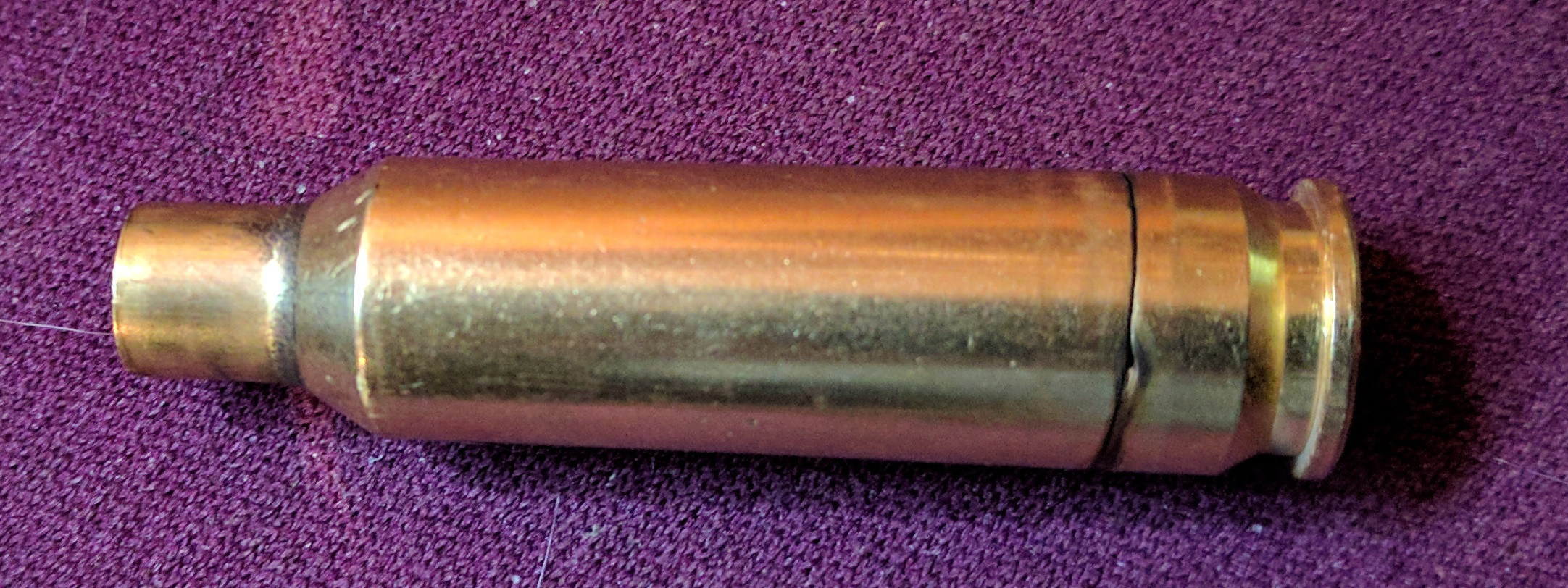
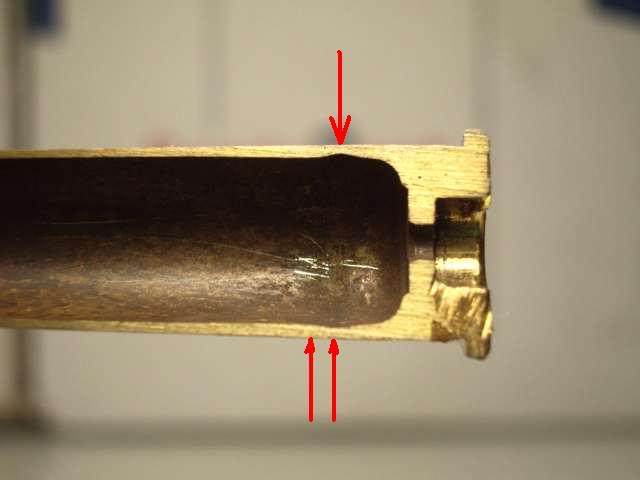
Hey all, so I have to say I'm fairly new when it comes to re-loading I've only been at it for about a year. I've never had any issues whatever so ever until recently. I was loading for my 6.5 Creedmoor and was running my usual load of 42g of H4350 with Berger 140gr hybrid projectile (have shot maybe 700+ rounds of this load though my rifle) then this one case / issue happens?

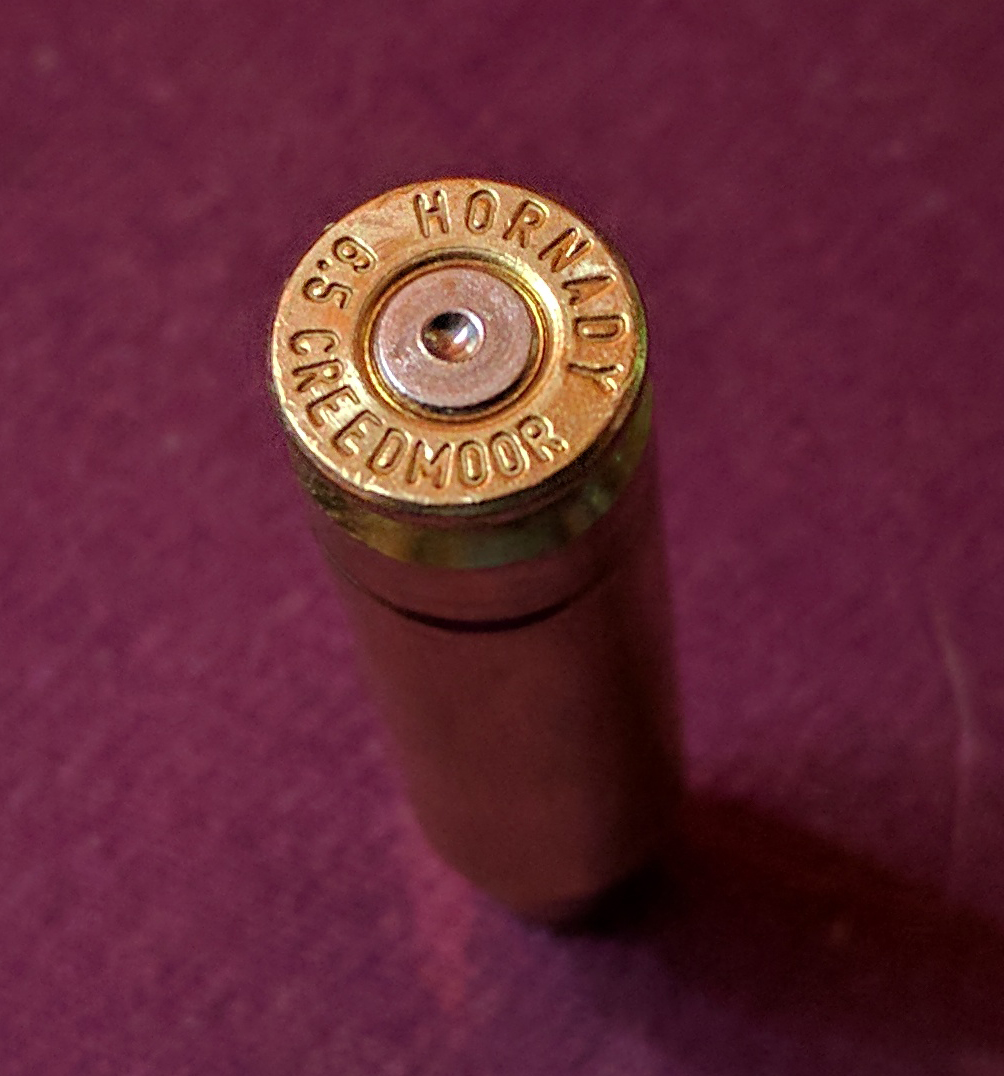
Would you say this is due to excess pressure? or is this just a case with a defect? I've never gotten any obvious signs of too much pressure with this load before, no sticky bolts, or stuck cases, primers all look about like this one.

Case:
Cf5U0N3.jpg


Primer:
doRhLMW.jpg


Should I back the load off? or again is this just a weird case? ** Side note case has been fired 4 times.
 
Yes I do full length resize, but all my other cases seem fine. How can I check to see if my shoulder is being bumped back too much?
 
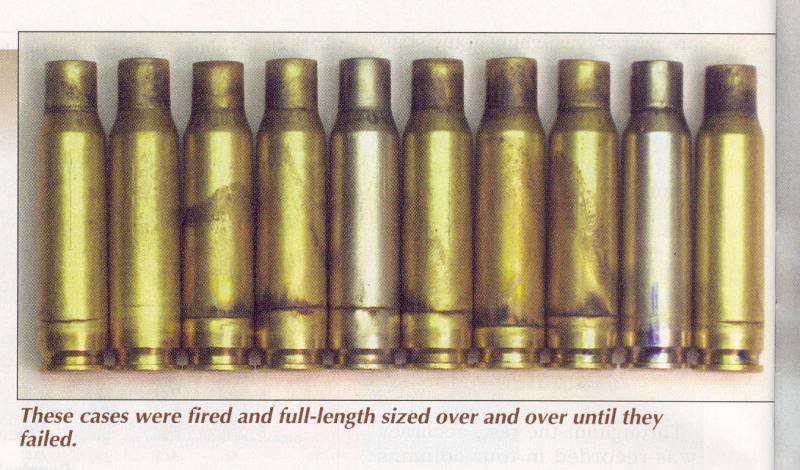
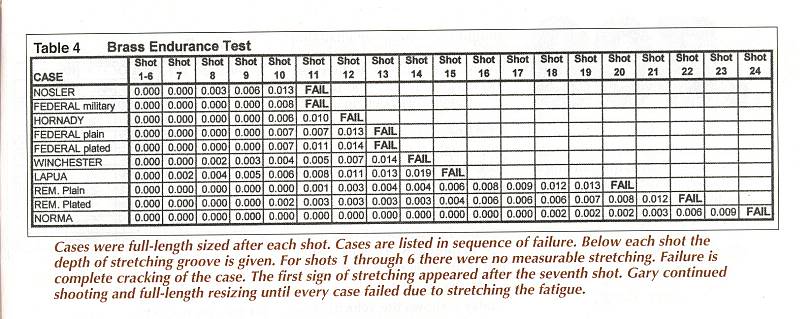
That is what happens when you full length resize every reload. You are creating excess headspace and your case stretches to fit the chamber every time it is fired. Where you observe the fracture is where the cases stretches the most each firing and pretty soon presto......you have no brass left to stretch and it separates.
The solution is to back your sizing die out until sized cases just fit your chamber with slight resistance as you close your bolt, just so you can feel the bolt tighten up as you rotate into battery, the last little bit. This is a standard flaw done by most new reloaders who have been taught you must full length size every case, every time.
I set my FL die so that I'm sizing about 80-90% of my neck, one can see the line on the neck where the die has stopped sizing. I then try it in my rifle, if it fits and the bolt closes then I load them up knowing that the case headspace has not been changed and they should fit the chamber perfectly causing minimal case stretch. If they do not chamber and the bolt closes with too much force, I then work my sizing die in about 1/16 turn and try again and I keep doing this until the bolt closes with only slight resistance. If I go too far and the bolt closes with no resistance I back the die out a few thou until I get the "FEEL" I want when I close the bolt. This is called partial sizing and works very well and still keeps your case and neck properly aligned, which I have found neck sizing dies do not.
Doing your sizing this way will give you maximum case life. If you intend to hunt with this rifle then be sure to try every cartridge you take hunting in the rifle before hand. I have had problems when partial sizing cases that have been fired at significantly different pressure levels, as in test loads. If you happen to set up your die with a case that was fired at a relatively low pressure level, when you size the higher pressured cases they tend to spring back more and will not chamber.
When I set up to size 100 or 200 cases with this partial sizing method I will size 10 or 15 cases and then try them all in the rifle, if they all fit the way I like then I carry on and do them all unless I have a case that feels particularly tight in the die, and I will then check it in the rifle as well. Sometimes I will get 5-10 or so cases that do not fit when tried because they were pressured up more than the rest. I set these aside and when I'm finished my run, I reset the die for these cases so they too fit the rifle and then run them......now everybody is ready to trim and load.
Reloading has a lot to do with "FEEL", when sizing or seating bullets the "FEEL" should be consistent over and over and over.......If you encounter either a dramatic reduction or increase in the amount of effort to size or seat then one needs to investigate. Set these cartridges aside and deal with them after you finish your run. If the bullet seating goes too easy you may have a split neck you didn't see, if it is extra tough maybe a cases neglected when turning necks, or a different make of brass got mixed in or maybe the chamfer got neglected........anytime it just doesn't "FEEL" right reject that cartridge and investigate later.
Just a couple tips.......hope they help.
 
Yes I do full length resize, but all my other cases seem fine. How can I check to see if my shoulder is being bumped back too much?

The proof you are bumping your shoulder back too much is right in front of you.......you have a separated case, this is the definitive answer, the result of excess headspace.

If all your loads were sized and prepared the same way and shot in the same rifle, the same number of times, then they are all toast.....sorry. The one you show in the photo just happened to be the thinnest of the lot. The rest will all be stretched the same amount and be on the verge of separation. I would not load or fire any of them again, as you risk damage to the rifle chamber.
 
Last edited:
The proof you are bumping your shoulder back too much is right in front of you.......you have a separated case, this is the definitive answer, the result of excess headspace.

If all your loads were sized and prepared the same way and shot in the same rifle, the same number of times, then they are all toast.....sorry. The one you show in the photo just happened to be the thinnest of the lot. The rest will all be stretched the same amount and be on the verge of separation. I would not load or fire any of them again, as you risk damage to the rifle chamber.

X2. Trash the rest of that brass, or pull your pills, but don't shoot them.
 
The proof you are bumping your shoulder back too much is right in front of you.......you have a separated case, this is the definitive answer, the result of excess headspace.

If all your loads were sized and prepared the same way and shot in the same rifle, the same number of times, then they are all toast.....sorry. The one you show in the photo just happened to be the thinnest of the lot. The rest will all be stretched the same amount and be on the verge of separation. I would not load or fire any of them again, as you risk damage to the rifle chamber.

X3....do not shoot any more of that batch...All that brass is now suspect. D.
 
An easy way to check your brass for the onset of head separation is to take a stiff wire (paper clip)...Bend a short 90 degree tip on one end...Insert the wire into your brass and feel your way up and down the inside of the case...If you feel a bit of a ring indent down around the head area of the case your brass is near kaput and is close to catastrophic failure.

I full length size each time I reload but make sure that I only bump the shoulder back a thou or 2...I get many reloads from the same brass and no sign of head separation when doing this and usually have to discard the brass because of enlarged primer pockets long before any signs of head separation appear.

If you feel any sort of indent down around the head of the case best to be safe and discard that brass.
 
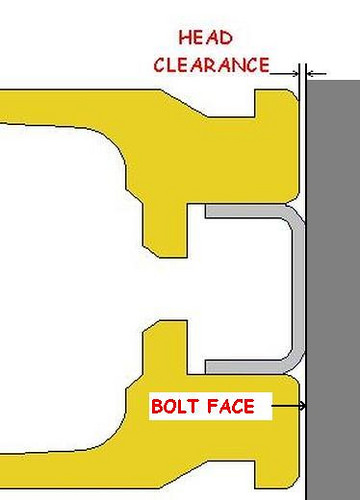
Your amount of shoulder bump when full length resizing is your head clearance when the cartridge is chambered. This head clearance or air space between the rear of the case and the bolt face is how far the case must stretch when fired. Recommended shoulder bump for a bolt action is .001 to .002, and this is within the elastic limits of the brass. Meaning the brass can stretch and spring back without stretching and thinning.

HK76WCp.jpg


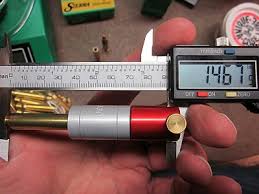
Below a .223/5.56 fired case in my Hornady cartridge case headspace gauge. And for my AR15 I adjust the die to bump the shoulder back .003 from its fired length. The best thing about the Hornady gauge is it allows you to accurately measure the fired length of the case and then adjust the die for minimum shoulder bump.

OJqNmQH.jpg


Chambers and dies vary in headspace length and the majority of full length dies will push the shoulder back too far if the die contacts the shell holder.

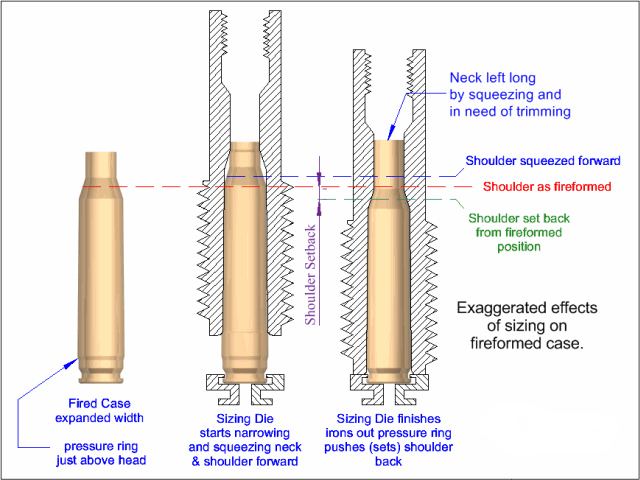
Below is a exaggerated illustration of full length resizing and the effects on the brass case. The desired amount of shoulder bump is .001 to .002 below the red dotted line. And if the shoulder is pushed back too far it allows the case to stretch and thin resulting in a case head separation.

wm05ArY.gif


Below is a "ball park" example of full length resizing of .308 cases, the die was set up per the instructions making hard contact with the shell holder. "BUT" the article did not say how much shoulder bump or head clearance the cases had.

TDwPD1Q.jpg


XEuny9C.jpg


As you can see above cartridge cases can vary in the quality of the brass used and how the case is manufactured.

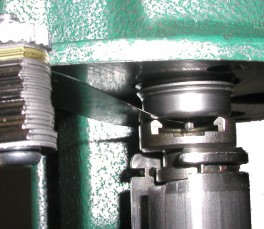
If you don't buy the Hornady case gauge you can place feeler gauges between the die and shell holder. Start at .020 and work down until the case chambers easily without resistance closing the bolt. This is the same basic method as explained by c-fbmi in his very good postings.

7FfXhJ7.jpg


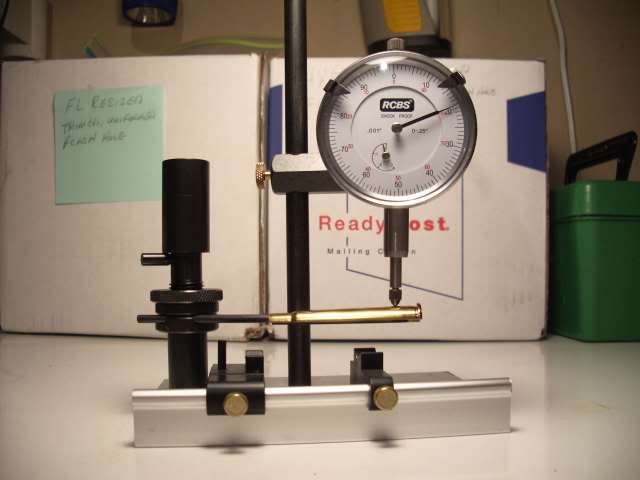
I bought the RCBS case mastering gauge below after getting my first Enfield rifle and my first partial case head head separation. As used below it is nothing more than the bent paper clip method of checking for case stretching and thinning. ($100.00 bent paper clip that reads in .001 of an inch) :d

jDCS39v.jpg


Below is the same case as above, it is a once fired factory loaded Winchester .303 British case that stretched .009 on its first firing.

YoV80b4.jpg


Bottom line, the instructions with your full length resizing dies are to make sure the resized case will fit in any chamber. And you can adjust the die so that the case is a custom fit in your chamber and not stretch.

Understanding Headspace — What You Need to Know
http://bulletin.accurateshooter.com/tag/headspace/

Tech Line & Tips (FAQs)
Create A “Custom Die” With A Simple Shellholder Change!
http://redding-reloading.com/tech-line-a-tips-faqs/144-create-a-custom-die-with-a-simple-shellholder-change


 
Last edited:
Yeah that's what I'm talking about...Excellent detailed explanation Big Ed.

This is what happens when your retired with nothing to do and all day to do it.;)

And c-fbmi also gave a excellent reply so lets not forget his postings or the other posters. (they might have to still work for a living):cheers:
 
Last edited:
One way to check your brass is to straighten out a paper clip then put a 90 degree bend on one end just enough to get it into the case. Stick the clip into the case as far as it will go and using the tip you bent over slowly feel for a ring close to the base. If you can feel anything at all, trash the case.
 
But bigedp51.........you have such a greater expertize with the diagrams and internet than I. I always read your posts as there is always good information coupled with cool diagrams which make it easy to understand. I know what I want to say but sometimes it just doesn't come out in an easy understandable flow........I am indeed envious of your internet expertize.......
 
If your 6.5 is a bolt action, no need to full-length resize the case. After first firing, just neck-resize it; the body of the case is fire-formed to your chamber and will fit perfectly from now on, you should get up to 50 reloads per case.
 
If your 6.5 is a bolt action, no need to full-length resize the case. After first firing, just neck-resize it; the body of the case is fire-formed to your chamber and will fit perfectly from now on, you should get up to 50 reloads per case.

Even neck sizers have to bump the case shoulder back sooner or later. So why not let the OP learn to full length resize 'correctly". Once he gets good at it he might even join the "rat turd in the violin case" club.

Y3IiYL5.jpg


How to deal with rats that poop in your violin case...........:evil:

Thompson40.jpg
 
Last edited:
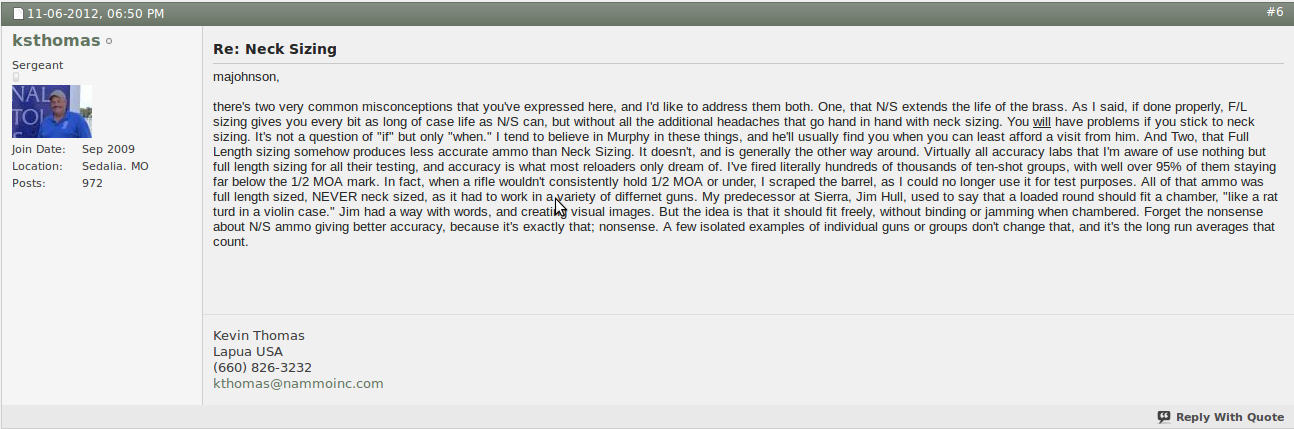
So, who do you believe? The guy from Lapua or the folks who claim Full Length sizing will cause case head separation? Lee Enfields are notorious for this regardless how you size them. I've had a few do this. With my F/L sized .308 brass not once, ever.
 
FL sizing makes sense for competition shooters who have custom cut chambers to min specs, or custom made dies for minimum shoulder set back....ie the case​ is barely getting touched either way.
If you FL size with standard​ dies in a production rifle you get early head separation like OP had.
Yes you can play around with standard off the shelf FL dies to just bump the shoulder for a tight fit in a production rifle, but that involves lubing, trimming, checking cases to make sure they fit, a lot of work for plinking or hunting. For these applications, neck sizing works just fine, it's faster, brass does last longer in larger production chambers then FL sizing, and accuracy I have not been able to see any difference between FL and NS ammo in production rifles in 20 years of reloading. If a rifle shoots good it shoots good with FL and NS ammo with the same load.
Neck sizing dies are $20-$40 for entry level stuff like Lee/Redding/Forster/RCBS. Not a huge investment for the time savings and extra brass life.


 
So, who do you believe? The guy from Lapua or the folks who claim Full Length sizing will cause case head separation? Lee Enfields are notorious for this regardless how you size them. I've had a few do this. With my F/L sized .308 brass not once, ever.

Sir;

You obviously do not understand the term "Full length sized" as used in this context. Full length sizing for any case fired in any rifle is as I described it in my first post......some call this partial sizing but in reality it is not partial sizing when one must touch the shoulder back a bit..........it is full length sizing for that rifle and chamber. I don't personally advocate neck sizing, others do, but I have seen a lot of atrocious run out on cartridges loaded after neck sizing only. I like to know my case body is being supported in line with the case neck when being sized, which is why I partial size or full length size all my brass.
Do not confuse "full length sizing" with returning brass to factory specs, they are not the same. Some people will return their cases back to factory ammo specs, especially if they, as the gentleman from Lapua says, need to use the loaded ammo in several different rifles. This of course makes sense in this circumstance, but does not make sense when loading for only one rifle and wish to get the greatest number of loads from your cases.
There are huge tolerance differences between chamber reamers and die manufacturers reamers, so the blanket statement to always run your shell holder up hard to your die bottom makes no sense at all. It is up to us as reloaders to set this up correctly for each chamber and the cases fired in them.......Why would anyone size a case and intentionally create excess headspace, when it is so simple to adjust the die a little and go with the absolute minimum headspace for that chamber and longest case life possible.

Oh ya, us guys who claim the case separation is caused by over sizing a case happen to know what we are talking about........The guy from Lapua doesn't have to pay for his cases as the rest of us do.
 
Last edited:
Sir;

You obviously do not understand the term "Full length sized" as used in this context. Full length sizing for any case fired in any rifle is as I described it in my first post......some call this partial sizing but in reality it is not partial sizing when one must touch the shoulder back a bit..........it is full length sizing for that rifle and chamber. I don't personally advocate neck sizing, others do, but I have seen a lot of atrocious run out on cartridges loaded after neck sizing only. I like to know my case body is being supported in line with the case neck when being sized, which is why I partial size or full length size all my brass.
Do not confuse "full length sizing" with returning brass to factory specs, they are not the same. Some people will return their cases back to factory ammo specs, especially if they, as the gentleman from Lapua says, need to use the loaded ammo in several different rifles. This of course makes sense in this circumstance, but does not make sense when loading for only one rifle and wish to get the greatest number of loads from your cases.
There are huge tolerance differences between chamber reamers and die manufacturers reamers, so the blanket statement to always run your shell holder up hard to your die bottom makes no sense at all. It is up to us as reloaders to set this up correctly for each chamber and the cases fired in them.......Why would anyone size a case and intentionally create excess headspace, when it is so simple to adjust the die a little and go with the absolute minimum headspace for that chamber and longest case life possible.

Oh ya, us guys who claim the case separation is caused by over sizing a case happen to know what we are talking about........The guy from Lapua doesn't have to pay for his cases as the rest of us do.

Doug, I support your statement 100%. You need to adjust your FL sizing die for the individual chamber of the rifle you are using. I accomplish this in several rifles of the same chambering by buying a die-set for each rifle, and adjusting
the FL die to just touch the shoulder enough that I feel a very slight drag as I close the bolt on a newly sized case. This is now adjusted for that specific chamber, and will not likely work properly for any other rifle so chambered. I have cases
for a 6mm Remington that have been reloaded 20+ times, and no separation issues. D.
 
Back
Top Bottom