Is the 150gr bullet the ultimate weight for a hunting bullet out of a 308win

at the risk of being seen to be hijacking the thread, seems like there's lots of knowledgeable guys watching so...I'm a pretty new hunter, only since 2012. I've taken 2 deer, both with a browning BLR in 308. I hunt thick bush..the kind the 30-30 or 45-70 is always purported to specialize in. Most shots are gonna be close...longest shot would be 100yds but I'd be surprised if it's ever past 50. I crave the "bang flop" effect because when they run off they're running into thick stuff and I don't wanna lose them. First year I hunted with this gang a guy got a doe...it ran 50 yds or so but it took while to find her...no blood trail that I ever saw. I've taken 2.
First was last year. Hornady SST 180gr. at 30yds. Through and through, high shot broadside hit both lungs and liver. He ran 50 to 100 yds. I decided I wanted to increase my chances of a dead right there...so this year's deer was taken with a 180gr hornady RN. Was both lungs and liver again at like 15yds...ran 50yds again.
Is there some bullet type that would increase my chances of the effect I want? Hollowpoints? (I'm only half kidding...I honestly don't know, that's why I'm asking). Both bullets were my reloads and shoot better than I do at 50yds with my reddot scope.
 
A quicker opening bullet like the Hornady SST is probably what you want for quicker kills, however, an exit hole also helps you blood track and find a shot deer. I have used a lot of Nosler Partitions for deer and a bunch of bigger game. If there is a more reliable bullet that both opens easily and penetrates reliably enough to often give an exit wound, I have not found it. Accubonds are probably as good, but not better. In my opinion the 180 grain Hornady RN is a pretty good choice for the deer hunting that you describe, but perhaps a bit better suited to bigger critters like moose elk and bear.
I don't worry about dropping a deer in its tracks, but if I did I'd probably choose a .308 bullet in 150 grain weight. The extra speed helps. That said, I still prefer the 165's for everything.
 
...I crave the "bang flop" effect because when they run off they're running into thick stuff and I don't wanna lose them...

I always endeavor not to let my quarry bugger off into the thickets when shot. A 1 shot DRT kill is always my objective when hunting.

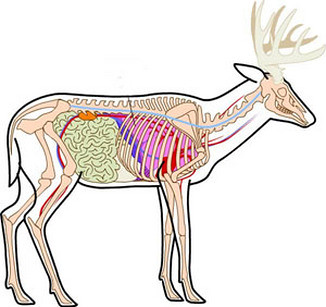
So if the Deer is more or less broadside aim with your .308 for the shoulder about where the spinal chord runs (shown in blue) to sever it to get a 1 shot DRT kill.

I find that with bigger high speed calibers (e.g. 416) the shot can be off a bit and hit lower on the shoulder even on Elk and Moose and still result in a 1 shot DRT kill out to intermediate ranges due to the tremendous shock of the wider and heavier high impact speed bullet that typically shoots clear through.

24123936567_a72915f0c3.jpg
 
Last edited:
168gr is pretty well rounded, and has excellent ballistics. I have heard it’s the ultimate bullet, but to me the ultimate bullet is the one your rifle shoots the best so 155 is my magic number. Probably depends on twist as well.
 
I always endeavor not to let my quarry bugger off into the thickets when shot. A 1 shot DRT kill is always my objective when hunting.

So if the Deer is more or less broadside aim with your .308 for the shoulder about where the spinal chord runs (shown in blue) to sever it to get a 1 shot DRT kill.

I find that with bigger high speed calibers (e.g. 416) the shot can be off a bit and hit lower on the shoulder even on Elk and Moose and still result in a 1 shot DRT kill out to intermediate ranges due to the tremendous shock of the wider and heavier high impact speed bullet that typically shoots clear through.

24123936567_a72915f0c3.jpg

I totally disagree with this... aim for the center of the lungs, it gives you the largest margin for error and assures a clean kill (blood-letting not required)... the animal may run a few yards, but you will have a good blood trail leading to a very dead animal... unless you have a goat standing on the edge of a cliff there is little reason to be neurotic about the animal falling in it's tracks.
 
For dropping deer in their tracks I've had the best luck using the 06 with 150 gr Remington core lokts. After getting this rifle I only shot 3 deer using the core lokts before I started reloading. They were about 125 yds, 150 yds and a little over 200 yds and not one took a step after hitting them. When starting to reload I used 165 gr Hornady SST's. I shot 1 buck with him at a distance of 15 yds (double lung shot) and he dropped right there,although it was a small exit hole. I put it off at being so close as to why the bullet didn't open. I then went to 150 gr ssts. I hit 2 bucks with them. First was about 150 yds and body wise the biggest buck I had ever shot. We trailed him for 500-600 yds with next to no blood trail on to neighbors property and did find although so had the neighbor and he claimed he had shot him. Looking at the buck before letting the neighbor take him (decided not to argue over a tough old buck) the sst never opened at all and pencil holed through. The next year I shot another buck about 100 yds and tracked another sparse blood trail for about 400 yds before finding him with another pencil hole entry and exit hole.
After that I pulled the SST's from 3 boxes of loaded ammo and will never use again. Don't know if I just got a bad batch or what but my experience with Hornady SST's was very bad. I've now went to a 150 gr soft point lead. Unfortunately due to medical problems I haven't been able to hunt the last 2 years so can't give any comments on them.
 
When funds were low, I used 165's in both the .308win and ol`paws .308NM.
Good results.
Now the wee brudder gits the 150's and when I run out of 165's, the NM will
git 180's.

Good read with a bit oh banter'in.........................:popCorn:
 
When funds were low, I used 165's in both the .308win and ol`paws .308NM.
Good results.
Now the wee brudder gits the 150's and when I run out of 165's, the NM will
git 180's.

Good read with a bit oh banter'in.........................:popCorn:

Win @ 150 & NM @ 180 is a well balanced combo....

Especially if you go 150 cup & core and 180 bonded.... covers everything.
 
On deer this year, I took 2 with 140 TTSX'S out of a 7 rem mag at very close range (35 yards) both lung shot. One went about 3 feet and the other about 50 feet.
Also took one with a 165 GMX out of a 30-06 at around 100 yards, this was a bang flop and again a lung shot but angling to also catch some of the off shoulder.
Very little meat damage to all 3 bucks.
 
All great input. Hoyts input that maybe I shouldn't be so focused on drt is valid too but there's something I can do to make it more likely I will.

The problem with focusing on a "Bang Flop," is that you bring a host of potential issues into play... the targets body posture not the least of these... the margin of error is MUCH greater. Just kill them the old fashioned and safest way, center the lungs... over a hunting career, you will save yourself much grief.

P.S - this whole "Bang Flop" fixation seems to parallel the rise in the use of internet forums.
 
A desirable result?

38100936315_778f69e7fc_z.jpg

Ha ha ha... that makes me laugh!

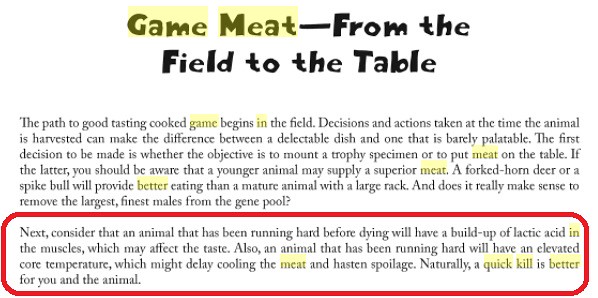
A double lunged animal CANNOT run enough to get any lactic acid going in the muscle fiber, long before that happens the lack of oxygen has shut it down completely.

But I guess if you are desperate to hang on to your theory throwing a "red herring" into the mix might serve to confuse the opposition.
 
Ha ha ha... that makes me laugh!

A double lunged animal CANNOT run enough to get any lactic acid going in the muscle fiber, long before that happens the lack of oxygen has shut it down completely.

But I guess if you are desperate to hang on to your theory throwing a "red herring" into the mix might serve to confuse the opposition.

lactic acid forms in the muscle during anaerobic effort. Lung shot animals enter the anaerobic stage faster than healthy ones.

As our bodies perform strenuous exercise, we begin to breathe faster as we attempt to shuttle more oxygen to our working muscles. The body prefers to generate most of its energy using aerobic methods, meaning with oxygen. Some circumstances, however—such as evading the historical saber tooth tiger or lifting heavy weights—require energy production faster than our bodies can adequately deliver oxygen. In those cases, the working muscles generate energy anaerobically. This energy comes from glucose through a process called glycolysis, in which glucose is broken down or metabolized into a substance called pyruvate through a series of steps. When the body has plenty of oxygen, pyruvate is shuttled to an aerobic pathway to be further broken down for more energy. But when oxygen is limited, the body temporarily converts pyruvate into a substance called lactate, which allows glucose breakdown—and thus energy production—to continue. The working muscle cells can continue this type of anaerobic energy production at high rates for one to three minutes, during which time lactate can accumulate to high levels.
A side effect of high lactate levels is an increase in the acidity of the muscle cells, along with disruptions of other metabolites.
 
Back
Top Bottom