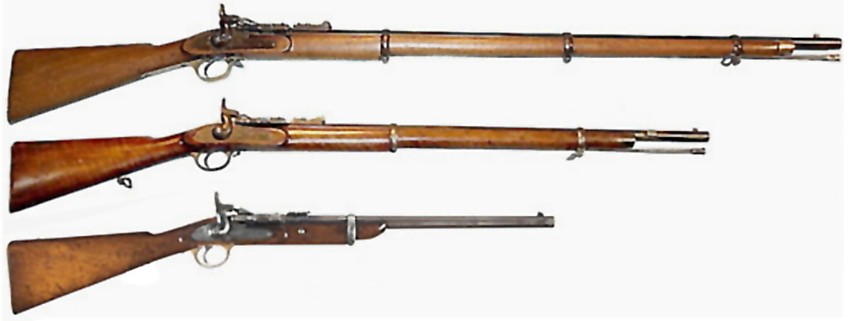
The Snider-Enfield is the quintessential Canadian military firearm of the 19th Century, being our standard-issue military rifle for at least 30 years! First issued in the same year as Confederation, the entire Militia being re-armed with them within a year, with no general replacement coming along until 1897 when we started issuing the Magazine Lee-Enfield rifle ("Long Lee-Enfield") ... some Militia units didn't get their Sniders replaced until about 1905 ...
Lots of good Sniders are available in Canada ... The least expensive you are likely to run across will be "cadet carbines", which are a uniquely Canadian thing, being 3-band infantry rifles cut down to the general configuration of a cavalry carbine (third one above.) A good cavalry carbine is likely to be the most expensive Snider you will see, whereas "cadet carbines" bring the
least money, so you have to be carereful and know what you are getting. The Militia Department started issuing Snider cavalry carbines to school cadet units early in the 20th century - that being a handy size for boys to drill with - but soon ran out of those (only a few thousand ever having been acquired) so in 1905 they had a large number of 3-band rifles cut down to the same length and general appearance for issue to cadet units. Cadet carbines are generally fully functional, but still have the full-lemgth rear sight of the 3-band rifle but only a small shotgun-bead type of front sight on the much-shortened barrel, so they are not particularly accurate shooters, and in any event will print very high because of the lack of a foresight of proper height.
Whether the 3-band or 2-band rifle is the more accurate is open for debate ... accuracy of any particular rifle being dependent largely on the condition of its bore, and also on developing a load that particular rifle "likes". I would repeat the recommendation to use a relatively short solid-based bullet which starts out at or above the groove diameter (i.e. .590" to .600"). Any attempts to duplicate the original loads - which used an under-bore-size bullet relying on expansion of a hollow base - are most likely doomed to failure. Back then the War Department were carrying over, into their very first breechloading cartridge, the concept of an under-zize hollow-base bullet, as had ben used in the muzzle-loading Enfield and other military rifles of the day, which needed to expand into the rifling upon being fired. It simply doesn't work all that well ... and of course it eventually became obvious that the bullet loaded into a breechloading cartridge could be of sufficient diameter to effectively engage the rifling without needing to expand first. Much more consistent and reliable! Using lots of a good black-powder lubricant is also critical.
If your interest tends toward military history, and possibly re-enactment, the choice of 3-band or 2-band rifle should be based on type of unit, and rank: generally speaking, in the British Army, the 3-band rifle was issued to regular infantry, whereas the 2-band "short rifle" (together with its distinctive sword bayonet) was issued to Sergeants of Infantry, and also to
all ranks of Rifles units. (It is actually a bit more complicated than that for Canada, since to start with only a limited number of "short rifles" were acquired, and thus they tended to be issued to only Sergeants of either Infantry or Rifles, with all other men getting the 3-band 'long rifle", but as more "short rifles" were acquired the practice moved more toward the British practice.)