gunsmith a snider enfield

NB.nagantsniper

CGN frequent flyer
Rating - 100%
362   0   0
Location
northern nb
looking at / thinking on getting a snider. any common problems to watch out for, or advise on fixing / making sure its shootable ?

any advise on the topic most welcomed . trying to avoid problems .
 
Try and get a MkIII - all-newly made with a steel barrel, rather than a conversion of a P53, as can be seen stamped on the barrel near the breech. It will also have a spring-latched catch on the breech-block, rather than the rear-of-breech detent of the earlier marks. A three-band rifle will have a three-groove barrel, and a short rifle usually five. Carbines may also have five-grooves, but are not very user-friendly if you are recoil shy.

Just about all the moving parts of the mechanism are available, at least here in UK, where Peter Dyson has a ton of them.

As ever, I 100% recommend Rob's excellent series on Youtube under his channel, britishmuzzleloaders. Brass, in the form of converted 24g brass, as well as the correct size bullet mould, can be gotten from Martyn at X-Ring Services in spokane WA, although no doubt there are Canadian suppliers, too.
 
Try and get a MkIII - all-newly made with a steel barrel, rather than a conversion of a P53, as can be seen stamped on the barrel near the breech. It will also have a spring-latched catch on the breech-block, rather than the rear-of-breech detent of the earlier marks. A three-band rifle will have a three-groove barrel, and a short rifle usually five. Carbines may also have five-grooves, but are not very user-friendly if you are recoil shy.

Just about all the moving parts of the mechanism are available, at least here in UK, where Peter Dyson has a ton of them.

As ever, I 100% recommend Rob's excellent series on Youtube under his channel, britishmuzzleloaders. Brass, in the form of converted 24g brass, as well as the correct size bullet mould, can be gotten from Martyn at X-Ring Services in spokane WA, although no doubt there are Canadian suppliers, too.

I purchased a Mk2 which was supposed to be a "shooter" according to the seller, I neglected to press the firing pin down until getting it back home and found that only the top part was there. Oh well, need to source the $80 part but still happy with my purchase.
Got a sporterized version for 1/3 the price of one in full military configuration. it's okay, and the history as indicated by the regimental, and rack, # is fascinating to me, even though its been bubba-ed.

Everything tacfoley said, about all I can add would be to check this forum out (If you haven't already) :
https://www.tapatalk.com/groups/bri...orum-f2/?sid=052531a415ac4ec60de85f5c9243eccf
 
Try and get a MkIII - all-newly made with a steel barrel, rather than a conversion of a P53, as can be seen stamped on the barrel near the breech. It will also have a spring-latched catch on the breech-block, rather than the rear-of-breech detent of the earlier marks. A three-band rifle will have a three-groove barrel, and a short rifle usually five. Carbines may also have five-grooves, but are not very user-friendly if you are recoil shy.

Just about all the moving parts of the mechanism are available, at least here in UK, where Peter Dyson has a ton of them.

As ever, I 100% recommend Rob's excellent series on Youtube under his channel, britishmuzzleloaders. Brass, in the form of converted 24g brass, as well as the correct size bullet mould, can be gotten from Martyn at X-Ring Services in spokane WA, although no doubt there are Canadian suppliers, too.

I don't know if this applies to the mark 3 but from what I read online the 3 grooves have a 1 in 78 twist and the 5 grooves have 1 in 48 3 groove barrels like short conical's and round balls while the 5 groove will stabilize just about anything
 
thanks good info so far any common things to watch out for, meaning problems common to the snider? or jusy general things a person hould be aware of ?

To my knowledge, based on around forty years of shooting Sniders, there are NO issues. After all, it was in military service for over fifty years, and most military don't keep stuff that doesn't work. Remember it was based on a design from the 1840's that only changed with the conversion to the Snider, and then from iron to steel.

Just don't dry-fire it without a nipple-protector. If you REALLY feel that's something you have to do, that is.

Basically it's a long tube with a fancy stopper at the back end. I'm still on the original volute springs of all of mine, and firing pins, too. Me, I think you are fretting over nuttn'.
 
I neglected to press the firing pin down until getting it back home and found that only the top part was there. Oh well, need to source the $80 part but still happy with my purchase.

if just the tip of the pin is broken off, you can probably silver solder an extension back on. If you are making a complete pin use drill rod and make a series of hollow end mills to turn the various diameters. The pin is long and thin enough that if you try to turn the pin on a lathe, even with a center in the end of the work, there is a good chance of bending it beyond salvange

cheers mooncoon
 
Pretty tough made all around as others have said.

Just pick out a nice one, as there are plenty to choose from here in Canada.

I read different accounts over the years from memoirs that the MK II ** was best for competition back in the day compared to the Steel MKIII

Kind of like why the DCRA guys hung onto their Enfield actioned .308 heavy barrelled rifles, but that goes back a bit.

Short rifle seemed to be the most accurate but competition was always with a 3 bander.

As ever, I 100% recommend Rob's excellent series on Youtube under his channel, britishmuzzleloaders. Brass, in the form of converted 24g brass, as well as the correct size bullet mould, can be gotten from Martyn at X-Ring Services in spokane WA, although no doubt there are Canadian suppliers, too.

I agree, 100% as I have used everything over my lifetime of shooting Sniders, (about 45 yrs, since I was 15,,,, D@m, going to be 61 this year) and I find the .600 cast bullets from Xring Services to be the best.

(Facebook - "Snider Enfield") or British Militaria Forums have information from shooters all over the world.
 
Last edited:
The Snider-Enfield is the quintessential Canadian military firearm of the 19th Century, being our standard-issue military rifle for at least 30 years! First issued in the same year as Confederation, the entire Militia being re-armed with them within a year, with no general replacement coming along until 1897 when we started issuing the Magazine Lee-Enfield rifle ("Long Lee-Enfield") ... some Militia units didn't get their Sniders replaced until about 1905 ...

eN3FXP.jpg


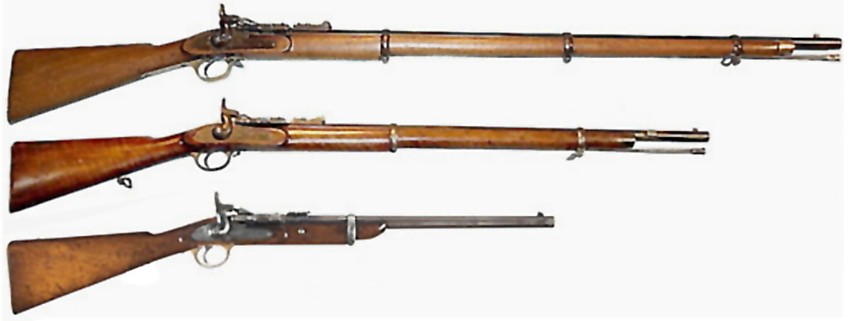
Lots of good Sniders are available in Canada ... The least expensive you are likely to run across will be "cadet carbines", which are a uniquely Canadian thing, being 3-band infantry rifles cut down to the general configuration of a cavalry carbine (third one above.) A good cavalry carbine is likely to be the most expensive Snider you will see, whereas "cadet carbines" bring the least money, so you have to be carereful and know what you are getting. The Militia Department started issuing Snider cavalry carbines to school cadet units early in the 20th century - that being a handy size for boys to drill with - but soon ran out of those (only a few thousand ever having been acquired) so in 1905 they had a large number of 3-band rifles cut down to the same length and general appearance for issue to cadet units. Cadet carbines are generally fully functional, but still have the full-lemgth rear sight of the 3-band rifle but only a small shotgun-bead type of front sight on the much-shortened barrel, so they are not particularly accurate shooters, and in any event will print very high because of the lack of a foresight of proper height.

Whether the 3-band or 2-band rifle is the more accurate is open for debate ... accuracy of any particular rifle being dependent largely on the condition of its bore, and also on developing a load that particular rifle "likes". I would repeat the recommendation to use a relatively short solid-based bullet which starts out at or above the groove diameter (i.e. .590" to .600"). Any attempts to duplicate the original loads - which used an under-bore-size bullet relying on expansion of a hollow base - are most likely doomed to failure. Back then the War Department were carrying over, into their very first breechloading cartridge, the concept of an under-zize hollow-base bullet, as had ben used in the muzzle-loading Enfield and other military rifles of the day, which needed to expand into the rifling upon being fired. It simply doesn't work all that well ... and of course it eventually became obvious that the bullet loaded into a breechloading cartridge could be of sufficient diameter to effectively engage the rifling without needing to expand first. Much more consistent and reliable! Using lots of a good black-powder lubricant is also critical.

If your interest tends toward military history, and possibly re-enactment, the choice of 3-band or 2-band rifle should be based on type of unit, and rank: generally speaking, in the British Army, the 3-band rifle was issued to regular infantry, whereas the 2-band "short rifle" (together with its distinctive sword bayonet) was issued to Sergeants of Infantry, and also to all ranks of Rifles units. (It is actually a bit more complicated than that for Canada, since to start with only a limited number of "short rifles" were acquired, and thus they tended to be issued to only Sergeants of either Infantry or Rifles, with all other men getting the 3-band 'long rifle", but as more "short rifles" were acquired the practice moved more toward the British practice.)

 
Buying tips;

Look on the left side around the back of the barrel for cracks in the wood. They seem susceptible to cracking if the barrel is not stocked up well. Many of these rifles in Canada have been mixed and are pure mismatched components.
If not bedded correctly, as can happen with a random action in a random stock, the 'breech plug' (I know, its not a breech plug) as it hammers into the stock, things can crack under recoil. It always seems to manifest itself there on the left hand side of the stock in the corner by the plug, adjacent to the side nails.

Also look at the left side of the wood below the opening tab. You are looking for bruising on the wood, and markings on the metal for hammer marks where somebody pounded the breech open and were not very accurate in swinging the hammer, or bayonet hilt, or rock...

Look at the back face of the breech opening for gouge marks in the shoe from where the firing pin has scraped past on opening due to not being retracted enough (weak spring, dirt, gum, rust, extruded primer, piece of brass from a pierced primer), hence the pounding on the breech block to get it open., the block being pinned closed by the striker nailed stuck in the primer.
If it happens often, there will be a track worn in the shoe face.
Push on the end of the firing pin so the tip pokes out of the breech face and inspect the tip. It should be a nice rounded end.
Look at the striker hole in the breech block face. If overly worn, potential primer probs as mentioned.

Look for a loose shoe. Some are a rattling fit. The hinge should not have a huge amount of slop. Look for end play with the block closed. It should not visibly move forwards and back. If it does, that indicates wear and much use.
It will still work, still safe, but worn is never a first choice.

When deployed, the extractor bears upon and slides along the edge of the shoe metal behind the hinge. If things are worn, the extractor will slip and drop the rim after not moving very far.
Pull the block back half an inch and see how much play there is with the extractor. With very worn rifles (worn hinge, worn pin, worn extractor), the extractor might even come adrift and can be pull up and rotated. The field work around is to open the block and pull back keeping thumb on extractor pressing it down.

And take a good look at the sights. Bubba just can not seem to leave them alone. The V notches in the rear sight are a 90 degree angle set at 45 degrees. Bubba often tries to improve the sighting by deepening the V with use of a triangular file. Triangular file is 60 degrees not 90.
 
Last edited:
While there are lots of Sniders with excellent bores out there, ammunition is probably more important than bore condition as far as accuracy is concerned. Look for a decent bore with good rifling right to muzzle but don't be put off by a few pits further down. My most accurate example is a rather beat up Webley commercial 3 band that seems to love .60 bullets. I would rate it's bore as fair at best. You also need to know that even with .59 and .60 slugs accuracy doesn't necessarily come easily. The best shotsI know all add large amounts of soft lube on the bullet nose to get best results. The British knew that adequate lubrication would be a problem with groove diameter bullets and chose to go with the sub-bore minies. With Boxer's ammo you could fire hundreds of rounds without loss of accuracy.
I
Milsurpo
 
thanks everyone my sgt model snider should arrive in a few days / a week, i plan to give it a once over cleaning to learn things, then plan to re do the cut down stock back to a close resembance of what it should be in military dress. found good info from the british militaria forum as well ( worth joining / looking at for victorian era firearms / gear and history!)
 
got my new to me 2 bander cut down wood by great uncle bubba. my big problem the breech block has a bolt/ log in its rear that locks the bolt closed. it is frozen by rust or grease or ?? in the open position and so far its not moving ANY ADVISE.
I AM SOAKING IT IN PENATRATING OIL a couple day now, and did try the advise of using a little heat on it to get things loose.

any other ideas ?
 
update have a few bits coming by mail, the bolt lug is still soaking / siezed into the breech block. i did apply heat and no movement yet. other wise things seem in very good condition ( outside and in the bore. )
 
I had one I soaked for about a week. I decided to take a wooden hammer to it and gently tap it. Freed up nicely. Once free I kept spraying it with rust check. Took it part and cleaned everything. That one was bought as a parts gun, bubbad. Shoots decent.
 
STILL soaking may apply a ittle heat in a day or 2 followed by more tap tap tapping ...........parts on the way did good barrel cleaning seems in excellent shape for a 1870s era firearm.
 
Back
Top Bottom