I have lots of full length bushing dies, there the worst option in my opinion.
Learn something new everyday on here.













































I have lots of full length bushing dies, there the worst option in my opinion.
1-Annealing. If your brass has been fired many times, it gets hard and tend to spring back under specs. Hard brass will not expand gently around the soft copper jacket.
2-VLD chamfer tool.
Nerver had any shavings after that.
Learn something new everyday on here.
First you do not use a mandrel ..a mandrel is made to uniform the inside of neck - push high spot out - to allow outside neck turning.
If you do not turn your neck..forget it. If you want to control neck tension use a bushing die. I use Redding competition die- bushing die with a carbide floating inside neck ball and my TIR on loaded rounds end up to .001 and below.
Do not flare the neck - this is only needed if you load lead bullet. (We are talking rifle here } and the very good advise of using a Vld chamfer tool if you use vld bullet.
My guess is that your shaving come from using a mandrel...improper use of your resizing die and not enough chamfering or none.
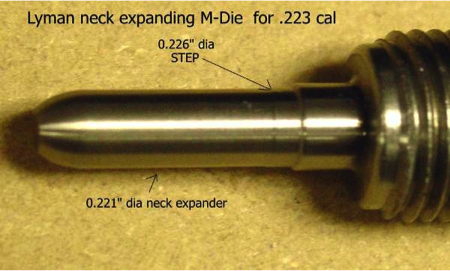
I use half of a chainsaw file(it broke in half when I dropped it on my garage floor) to slightly bevel the edge of each case mouth.It works great??? If this is bad, someone tell me because I am very new to rifle reloading.
This is brand new lapua brass. Never fired, first loading. Otherwise I would completely agree with you. In my opinion brass should be annealed after every firing.
I am going to try the VLD chamfering tool for sure
New 6BR. Lapua brass from factory has an excessive amount of neck tension IMO,as do most other brands.I run them lubed up an expander or turning mandrel,or just over the button on a sizer die to reduce tension then chamfer inside mouth.
I've never had shavings doing this.I use an Arbour press with Wilson dies and you definitely can feel the difference seating bullets.






















