Copper shavings when seating bullets

1-Annealing. If your brass has been fired many times, it gets hard and tend to spring back under specs. Hard brass will not expand gently around the soft copper jacket.
2-VLD chamfer tool.

Nerver had any shavings after that.

This is brand new lapua brass. Never fired, first loading. Otherwise I would completely agree with you. In my opinion brass should be annealed after every firing.

I am going to try the VLD chamfering tool for sure
 
Learn something new everyday on here.

Thats my opinion anyways. They don't size the entire neck, the bushing has room to move in the die so the neck doesn't always end up being concentric with the case body.

A full lengrh sizing die that has the neck custom honed to the required size is far better than full length bushing die and produces much more concentric brass.
 
First you do not use a mandrel ..a mandrel is made to uniform the inside of neck - push high spot out - to allow outside neck turning.
If you do not turn your neck..forget it. If you want to control neck tension use a bushing die. I use Redding competition die- bushing die with a carbide floating inside neck ball and my TIR on loaded rounds end up to .001 and below.


Do not flare the neck - this is only needed if you load lead bullet. (We are talking rifle here } and the very good advise of using a Vld chamfer tool if you use vld bullet.

My guess is that your shaving come from using a mandrel...improper use of your resizing die and not enough chamfering or none.
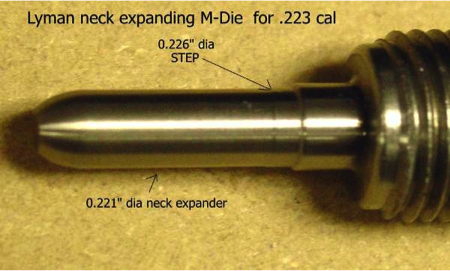
Please do not take this the wrong way, but there is nothing wrong with using a mandrel expander die. With a standard sizing die the expander expands the neck on the downstroke of the ram and pulling up on the case neck and if the expander is tightened down off center you will induce neck runout. And with an expander die you are expanding the case neck on the upstroke of the ram and pushing down on the case in the shell holder. Meaning the expander die greatly reduces the chances of the expander causing neck runout when sizing.

I wet tumble many of my cases and this can peen the case mouth and if not trimmed and deburred with a VLD deburring tool I will get brass shavings.

If you have copper shavings it is my experience the bullet is not centered in the case neck when seating, meaning the bullet is tilted and scraping the case mouth.

I'm going to post the photo of the Lyman type "M" expander for the .223 rifle again to make a point. This expander gives you .003 bullet grip of neck tension that is more the a standard expander will. The .226 section of the expander is used to make the case mouth .001 larger than bullet diameter after brass springback. This allows the bullet to be started straight into the case mouth and greatly reduce any scraping from deburring the inside of the case mouth. This also greatly reduces case neck and bullet runout because the bullet is straight and inline with the case neck.

ohIUcpd.png


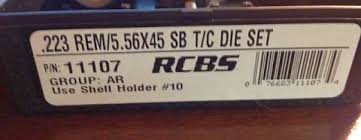
Below the RCBS AR Series dies have a taper crimp and "if" needed the case mouth can be reduced in diameter for proper feeding.

rlWf7Uw.jpg


Bottom line the Lyman type "M" expander is a cheat to keep from scraping brass or copper by opening the case mouth .001 and aid in straight inline seating. Without using this type expander the VLD deburring tool will greatly reduce scraping. And I would also check the seater plug to make sure it is not letting the bullet tilt during seating and scraping the case mouth.
 
I use half of a chainsaw file(it broke in half when I dropped it on my garage floor) to slightly bevel the edge of each case mouth.It works great??? If this is bad, someone tell me because I am very new to rifle reloading.

I won't say it's bad but it's not the tool for the job,get a chamfer tool ,VLD type works well.Try to keep it square to the case mouth for an even bevel all the way around,couple turns is all that is needed you don't want an edge like a knife.
Knocking the burrs off the outside of the case neck edge won't hurt either.
 
This is brand new lapua brass. Never fired, first loading. Otherwise I would completely agree with you. In my opinion brass should be annealed after every firing.

I am going to try the VLD chamfering tool for sure

New 6BR. Lapua brass from factory has an excessive amount of neck tension IMO,as do most other brands.I run them lubed up an expander or turning mandrel,or just over the button on a sizer die to reduce tension then chamfer inside mouth.
I've never had shavings doing this.I use an Arbour press with Wilson dies and you definitely can feel the difference seating bullets.

 
New 6BR. Lapua brass from factory has an excessive amount of neck tension IMO,as do most other brands.I run them lubed up an expander or turning mandrel,or just over the button on a sizer die to reduce tension then chamfer inside mouth.
I've never had shavings doing this.I use an Arbour press with Wilson dies and you definitely can feel the difference seating bullets.


I do this same process with an expander mandrel as the turning mandrel is not the correct size. Than chamfer and than load with an arbor press and wilson hand dies.
 
Back
Top Bottom





























































