ES and SD opinion

DA07

Member
Rating - 0%
0   0   0
I tried out a ladder test for velocity only with my 223 HB. Found a node with Varget and loaded up 15 rounds.

I got an ES of 60 fps, and a SD of 20.5 fps.

Is this a reasonable indication of good combustion?

My groups were over an inch with 53gr VMAX at 0, .005” and .010” off the lands (3 - 5 shot groups).

Should I proceed to work the seating depth, or find another node with better ES/SD?

Strictly a varmint gun BTW.
 
I gave Benchmark a try. Had an ES of 88. Groups were bigger than my Varget ones. 100fps faster though. Might have to try another node there. Thought I’d see what I could get out of Varget for now as I have lots on hand.
 
60 FPS is pretty high.

You have sorted by brass weight already...so rule that out.

Are you using approximately the same amount of time between shots? ... get the barrel up to a temperature and keep it there for the string of shots that your are testing?

For developing new loads I like to warm up my gun with about 5 shots in 30 second intervals. ... then I start to record velocities of the rounds that I want to test in intervals of about a minute apart.

Second thing to consider... do you trust the consistency/repeatability of your chronograph ?

If I had this much ES in any of my test strings, then I would be looking at my scale as the culprit.
 
Last edited:
I tried out a ladder test for velocity only with my 223 HB. Found a node with Varget and loaded up 15 rounds.

I got an ES of 60 fps, and a SD of 20.5 fps.

Is this a reasonable indication of good combustion?

My groups were over an inch with 53gr VMAX at 0, .005” and .010” off the lands (3 - 5 shot groups).

Should I proceed to work the seating depth, or find another node with better ES/SD?

Strictly a varmint gun BTW.

I recently watched a video from Erik Cortina. Conclusion: your ES and SD being too high, you should work on combustion which means powder load, primers.... You should aim at single digits for your SD. It is only when your SD is low and you have 'big' groups that you should work on seating depth.
 
I tried out a ladder test for velocity only with my 223 HB. Found a node with Varget and loaded up 15 rounds.

I got an ES of 60 fps, and a SD of 20.5 fps.

Is this a reasonable indication of good combustion?

My groups were over an inch with 53gr VMAX at 0, .005” and .010” off the lands (3 - 5 shot groups).

Should I proceed to work the seating depth, or find another node with better ES/SD?

Strictly a varmint gun BTW.

I recently watched a video from Erik Cortina. Conclusion: your ES and SD being too high, you should work on combustion which means powder load, primers.... You should aim at single digits for your SD. It is only when your SD is low and you have 'big' groups that you should work on seating depth. This means you can get better groups if you wish. Now what is good accuracy for varmint loads? If you consider it is 1.5 moa then you are already good.
 
try a LEE factory crimp die. It cut the ES in half in my 223 loads

I have read this in other places about the FCD lowering ES/SD.
I have a hard time getting my head wrapped around how this would work..... is the rationale that it lowers ES by making the neck tension more consistent ?
 
I have read this in other places about the FCD lowering ES/SD.
I have a hard time getting my head wrapped around how this would work..... is the rationale that it lowers ES by making the neck tension more consistent ?

Crimping the bullet allows the combustion and pressure to increase before the neck releases the bullet.

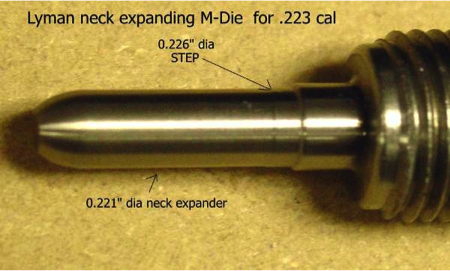
You could do the same thing by using a smaller diameter expander and increasing bullet grip. Or if you are using a bushing die and using smaller bushings.

I have a Winchester 94 Trapper Model with a 16 1/2 inch barrel and I put a good healthy crimp on all my ammo. If I didn't I would not get good combustion and have unburnt powder.

Below is a Lyman type "M" expander for the .223/5.56 and it has .003 bullet grip.

ohIUcpd.png


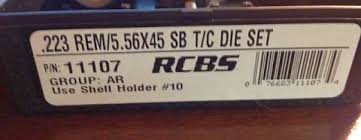
Below the RCBS AR series .223/5.56 die has a taper crimp.

rlWf7Uw.jpg
 
I recently watched a video from Erik Cortina. Conclusion: your ES and SD being too high, you should work on combustion which means powder load, primers.... You should aim at single digits for your SD. It is only when your SD is low and you have 'big' groups that you should work on seating depth. This means you can get better groups if you wish. Now what is good accuracy for varmint loads? If you consider it is 1.5 moa then you are already good.

I watched the same video. I thought it all made logical sense. I’m just not at that level so was wondering what I could get away with or where I should be spending my time.
 
I watched the same video. I thought it all made logical sense. I’m just not at that level so was wondering what I could get away with or where I should be spending my time.

I would try one or two different primers with the best powder load first.
 
Using CCI 400’s.

Thought about trying a different brass just to rule this out absolutely. Lapua or Hornady perhaps.

Try the CCI450 magnum primer if you can find some. In my testing they are superior to the CCI400 for SD/ES with all powders, hot or cold weather
 
Has anyone mentioned the way the powder is measured?? Digital / Beam scale? Your charges may not be identical which can give you those spreads - when I went from digital to a beam scale I got more consistent numbers - just saying not to rule this out.
 
Has anyone mentioned the way the powder is measured?? Digital / Beam scale? Your charges may not be identical which can give you those spreads - when I went from digital to a beam scale I got more consistent numbers - just saying not to rule this out.

I use a Hornady beam scale. Measure every load. I have a cheaper cabelas electronic scale and never trusted it. The zero seemed to drift so I discontinued use. I have the time to weigh each load and don’t mind doing so. Don’t know how you can beat a beam scale for consistency.

As for the chronograph, I use a Shooting Chrony Beta I believe. Blue metal folding body/box. I don’t have any evidence as to it’s unreliability. Just trusting it.
 
My thoughts would be to improve your ignition. My "summer load" for my 6.5 with Lapua small primer brass is consistently under 10 fps SD in spring, summer and fall, but jumps to mid-teens in cold weather.
I switched to weight-sorted Hornady brass with large primers and my SD dropped immediately to single digits again.
A magnum primer might do the trick for you.
Crimping even slightly may help too. My 32 Special loads benefited greatly from a mild crimp, SD and ES numbers dropped considerably.
So, the guys have you on the right track.
Or, it may simply be that the powder/bullet combination you're working with isn't a good match.
 
The 223 being a small case is more sensitive to any changes than larger calibers.
For example, a .2 grain powder variation in a 223 is like a .4 grain variation in a 308.
Other variations are there as well, such as case wall thickness and expansion ratios compared to larger. Percentage of bullet diameter variation etc.

So you need to keep all this in the back of your mind and consider that everything you do to hand load for the 223 needs to be just that much more precise.

The first thing you want to do is forget about what most guys on the internet will tell you and use your own head to decide what is good advice or bad.

Dont expect new or full length resized brass to perform as well as brass that has been fired in your rifle. The more you manipulate the brass after firing it, the more damage you are doing to consistency. So minimal shoulder bump only and minimal neck resize.

Weighing powder needs to be super accurate. If you dont have a high end scale, then cut a piece of hanger wire to match the weight of the pan plus the powder charge. To verify your powder weight, alternate between the hanger and the pan to ensure that you get the same weight between them. Or, just get a more accurate scale.

Jump has alot to do with velocity spread. Too much jump will cause wild spreads as well as too little. Work back from hard jam until you find the sweet spot.

Dont expect best results in cold weather and what you develop in the cold is not likely best once the weather warms up.

Neck tension... The less neck tension you have, the less variation in neck tension you will have. Try using a neck sizing bushing that is too large and size all the necks. Use a bullet as a go gae and sort the ones where a bullet can be pushed in from those that cannot. Then reduce the bushing by 0.001 and resize all the loose ones again. Eventually you will have them all sorted to just enough tension to hold a bullet. You can reduce this variation by neck turning and further control by running a tight neck chamber, but thats probably more than you will want to do at this point.

You should be able to get down to about 20 FPS ES. Anything outside that is cause for refinement of your process.

 
Back
Top Bottom