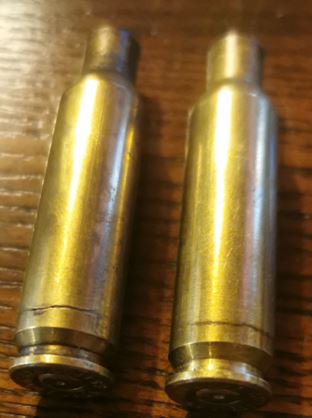
Well, I definitely think it's case head separation. Upon checking my brass, they are all within spec, except the two I trashed. They were 0.0005 bigger than spec. One difference though between the head separation I was reading about and my case, what I read was "classic head separation starts with a light ring around the case", in my case the ring is darker than the rest of the case.













































You are using an out of date browser. It may not display this or other websites correctly.
You should upgrade or use an alternative browser.
You should upgrade or use an alternative browser.
Looking for help
- Thread starter Wilcoroger
- Start date
Just had an idea, I have some never fired new Hornaday brass here, when measuring, all dimensions are below my resized brass. That is to say, my resized brass is bigger than the never fired. Which makes me think I'm not bumping them back to far. I think I will try a lighter load and see what happens. I want to thank all you guys for the help so far. By all means if you think of anything else feel free to chime in.

Well, I definitely think it's case head separation. Upon checking my brass, they are all within spec, except the two I trashed. They were 0.0005 bigger than spec. One difference though between the head separation I was reading about and my case, what I read was "classic head separation starts with a light ring around the case", in my case the ring is darker than the rest of the case.
You have severe case head separation issues caused by excessive head space maybe caused by a chamber a little on the loose side combined with brass being repeatedly oversized and being used in an overcharged ( read too hot) load.
Last edited:
Just had an idea, I have some never fired new Hornaday brass here, when measuring, all dimensions are below my resized brass. That is to say, my resized brass is bigger than the never fired. Which makes me think I'm not bumping them back to far. I think I will try a lighter load and see what happens. I want to thank all you guys for the help so far. By all means if you think of anything else feel free to chime in.
Yes, the new brass will be smaller than your fire formed brass because the new brass is meant to fit ALL chambers, this tells you nothing about your chamber. Trust me, you are oversizing the brass and yes, by all means try a lighter load. Even if your load is a little hot, case head separation would not occur. Case head separation is the result of one thing and that is excessive head space, a warm load will just accelerate it.
Last edited:
Well I have spent the better part of this morning trying to figure out how to measure the chamber without a gauge. The closest gauge to me will be 2 weeks away, shipping is brutal here, is there anyway I can mark the case, insert it in the chamber and when I take it out it will give me a measurement. I did measure headspace before with an empty case and bullet. The listed oal was too long for my rifle at 2.800". I had to start seating my bullets at 2.750" to get the bolt to close. If there's no way to check I guess I'll have to order a gauge and wait.
Case head separation starts as a crack on the inside of the case. Straighten out a paperclip and bend a 1/16 inch lip on one end. Use this to feel the inside of the case where you would expect a crack. If you feel a ridge, pitch the case.
As above, the combination of hot loads and excessive resizing is fatiguing your brass. As a reloader you can remedy this by:
a) Sizing the case less. Back out your die in 1/8 turn increments, size a case,check your brass for chamber fit. At some point the brass wont chamber. Turn your die in 1/8 turn and record the setting for further use. This technique is called partial resizing. You can achieve the same effect by using a neck sizing die... An additional benefit is increased accuracy.
b) Reduce your loads, for reasons stated previously. Play around with COAL to get the bullet closer to the lands, once you become more proficient. There are ways to do this without using fancy gauges...
BTW - Headspace has nothing to do with the position of the bullet (ie COAL). It refers to the axial clearance between the brass case and the chamber, measured at the shoulder.
As above, the combination of hot loads and excessive resizing is fatiguing your brass. As a reloader you can remedy this by:
a) Sizing the case less. Back out your die in 1/8 turn increments, size a case,check your brass for chamber fit. At some point the brass wont chamber. Turn your die in 1/8 turn and record the setting for further use. This technique is called partial resizing. You can achieve the same effect by using a neck sizing die... An additional benefit is increased accuracy.
b) Reduce your loads, for reasons stated previously. Play around with COAL to get the bullet closer to the lands, once you become more proficient. There are ways to do this without using fancy gauges...
BTW - Headspace has nothing to do with the position of the bullet (ie COAL). It refers to the axial clearance between the brass case and the chamber, measured at the shoulder.
Last edited:
Well I have spent the better part of this morning trying to figure out how to measure the chamber without a gauge. The closest gauge to me will be 2 weeks away, shipping is brutal here, is there anyway I can mark the case, insert it in the chamber and when I take it out it will give me a measurement. I did measure headspace before with an empty case and bullet. The listed oal was too long for my rifle at 2.800". I had to start seating my bullets at 2.750" to get the bolt to close. If there's no way to check I guess I'll have to order a gauge and wait.
I do not think you have to get hung up on that yet. First off, head space and OAL are 2 entirely different things, not related in the least. Secondly, stop worrying about measuring anything right now until you fully understand what you are measuring and why, you need to do some research and reading. Just size your brass properly so it will be properly head spaced to your chamber, reduce your way overcharged load and shoot. You are over thinking and over complicating this. If this does not work THEN worry about your gun as very rarely a gun will be manufactured with excessive head space and will need attention. What gun is this anyway?
- Location
- Western Manitoba
My experience is same as past few posters. I have been playing with some non-standard cartridges - no gauges available or needed - I do not measure anything. I set parent brass into shell holder - that one has neck much too large for what I want to end up with - set the full length die what I can see is much too high - run a case through - take that case and try to chamber that empty case into the chamber in my rifle - bolt will not close. So turn in the die a 1/4, 1/8/, 1/16 of a turn - re-lube and resize that case - repeat until the bolt does close, whereas it would not close 1/16 or so of a turn previous. Tells me that newly re-formed case is snuggly fitting and "headspaced" into my chamber with the bolt closed. At that point I do not know or really care what the "headspace" measurement is - I know that brass snuggly fits that chamber in that rifle - there will not be any "case head separation" possible, with sane pressure loads.
As mentioned above - with a case previously fired in your rifle - colour up neck and shoulder on a fired case with a Jiffy marker - then again start with die set in press too high - run that case in - when you pull it out, you will see where die has scraped that marker off the brass neck - shows how far you have sized down that case neck. If you can re-chamber that brass into your rifle, then want to bring that scrape mark about 95% or so down the neck - do not need to go all the way to the shoulder. If that brass is too tight for your preference to chamber - will want to "bump" that shoulder - so a little bit more - to just so get marks on the colouring that you did on the face of the shoulder. Nothing was ever measured - you use your chamber in your rifle as the "gauge". Has all been mentioned in other posts above - maybe another version makes sense to you?
Be aware the "tight to chamber" can be caused by other than your shoulder dimension. Some chambers are larger diameter, at the rear, than what your sizing die can do - so case feels tight - sometimes can not even go all the way in - but is hanging up at the rear end of the case, not that the front. Nothing to do with "headspace" - often will need a Small Base sizing die for that chamber. Or something. Can discover the issue again by marking up case with jiffy marker and look for where it got scraped off. Tells you where the "tight" is.
Maybe I am old, maybe too fussy, maybe just doing it wrong, but I re-set the sizing die into the press - re-chambering the empty cases into my rifle - every time that I sit down to reload for that rifle. After a bit, does not take more than a couple of minutes to do - then I know that die is properly set for that chamber, and proceed to do up the rest of the batch - and I do periodically check to make sure nothing has moved on me. I have no experience with progressive presses - still putter away with single stage press for sizing, powder volume thrown onto the scale pan, trickle up powder to "0" on the beam scale, find the lands for each batch that I am doing up, and set my seating die to get the "jump" that I want - I redo that every session...
As mentioned above - with a case previously fired in your rifle - colour up neck and shoulder on a fired case with a Jiffy marker - then again start with die set in press too high - run that case in - when you pull it out, you will see where die has scraped that marker off the brass neck - shows how far you have sized down that case neck. If you can re-chamber that brass into your rifle, then want to bring that scrape mark about 95% or so down the neck - do not need to go all the way to the shoulder. If that brass is too tight for your preference to chamber - will want to "bump" that shoulder - so a little bit more - to just so get marks on the colouring that you did on the face of the shoulder. Nothing was ever measured - you use your chamber in your rifle as the "gauge". Has all been mentioned in other posts above - maybe another version makes sense to you?
Be aware the "tight to chamber" can be caused by other than your shoulder dimension. Some chambers are larger diameter, at the rear, than what your sizing die can do - so case feels tight - sometimes can not even go all the way in - but is hanging up at the rear end of the case, not that the front. Nothing to do with "headspace" - often will need a Small Base sizing die for that chamber. Or something. Can discover the issue again by marking up case with jiffy marker and look for where it got scraped off. Tells you where the "tight" is.
Maybe I am old, maybe too fussy, maybe just doing it wrong, but I re-set the sizing die into the press - re-chambering the empty cases into my rifle - every time that I sit down to reload for that rifle. After a bit, does not take more than a couple of minutes to do - then I know that die is properly set for that chamber, and proceed to do up the rest of the batch - and I do periodically check to make sure nothing has moved on me. I have no experience with progressive presses - still putter away with single stage press for sizing, powder volume thrown onto the scale pan, trickle up powder to "0" on the beam scale, find the lands for each batch that I am doing up, and set my seating die to get the "jump" that I want - I redo that every session...
Last edited:
Take your time and read the loading portion in your manuals. If no manuals read it on the internet. Read it enough times that you understand head space. If you knew what was going on you wouldn’t be asking. Dangerous situation, loading without understanding head space.
You asked, several have given you advice, like I said, "class dismissed". Good luck.
I don't understand. I'm asking for help and it seems you have a hostile tone. I never intended to ruffle any feathers just asking questions and giving answers to what I know, whether that be right or wrong I don't know. Thanks for the answers and advice you have given.
Carry on. You've made a few rookie mistakes, advice has been offered. Hopefully, this will point you in the right direction. If you know someone local to you with reloading experience, you might want to get them to mentor you a bit.
This. Your headspace is probably fine. You are oversizing your brass and using an over pressure load. Potashminer’s description of how to set up a die for your rifle is right on. A rookie reloader using an over pressure load is the same as a “rig pig” putting a big programmer on his new diesel pickup. Next comes blown transmission and “why me?”You have severe case head separation issues caused by excessive head space maybe caused by a chamber a little on the loose side combined with brass being repeatedly oversized and being used in an overcharged ( read too hot) load.
This. Your headspace is probably fine. You are oversizing your brass and using an over pressure load. Potashminer’s description of how to set up a die for your rifle is right on. A rookie reloader using an over pressure load is the same as a “rig pig” putting a big programmer on his new diesel pickup. Next comes blown transmission and “why me?”
Yes the headspace of his firearm is probably within spec, I never said it was not, but by oversizing his brass this creates an excessive headspace condition when that oversized case is chambered in his gun, that is what causes the head separation. Cosmic hit the nail on the head, the OP needs a mentor.

I don't understand. I'm asking for help and it seems you have a hostile tone. I never intended to ruffle any feathers just asking questions and giving answers to what I know, whether that be right or wrong I don't know. Thanks for the answers and advice you have given.
Not hostile in the least, just direct. I am not a teacher, just trying to help out a fellow shooter / re-loader.
Here's a pic of Wilcoroger casing.
Hope that helps a bit.
Just try what several of us have suggested, trust me it will solve your issue.
Well I don't understand how it's anymore dangerous. Obviously it fits my rifle better than factory brass if my cases measure longer than unfired cases.
I'm just asking questions and making observations here guys. I don't see any need for the rig pig comment, or ganging up here. How is someone supposed to learn like that. Honestly I felt like deleting this thread because I thought I was being a #### or something. But then I realized that asking questions is the natural way to learn.
I'm just asking questions and making observations here guys. I don't see any need for the rig pig comment, or ganging up here. How is someone supposed to learn like that. Honestly I felt like deleting this thread because I thought I was being a #### or something. But then I realized that asking questions is the natural way to learn.






















