Looking for help

Here's a pic of Wilcoroger casing.
Hope that helps a bit.
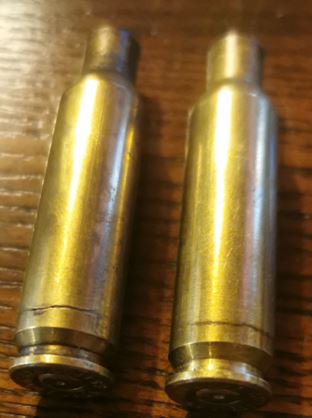
11uorQ9.jpg

Thanks so much for the help.

 
Just try what several of us have suggested, trust me it will solve your issue.

That will be the very next step for me. I will set my die to far out, run the brass through, and try it in my rifle to see how it seats. I'll keep going until I find that sweet spot. Thanks a lot for the help.

 
Potashminer may have explained it better, he is a better teacher than me, but the reason we know this stuff is that we all made these same mistakes when we were learning.

I agree he did have a better technique. The marker on the case will give a great indication as it can be seen and doesn't rely on feel.
 
Forget the bullet, OAL & measuring anything, just concentrate on how to get the case sized to properly fit your chamber with minimum headspace and you will do fine.
 
Forget the bullet, OAL & measuring anything, just concentrate on how to get the case sized to properly fit your chamber with minimum headspace and you will do fine.

I will admit that I originally thought the die would size the brass exactly as it should be. But I know now that isn't the case, literally. Thanks a lot for your help. It is greatly appreciated.

I started out with .223 for my wk180c. I had so much empty brass lying around that it was, in my opinion, worth it to start reloading. I was sitting at the kitchen table, wife wasn't to happy about this but has learned to live with it haha, running the brass through the die, and all of sudden we could hear this big crunch. She yelled and said " my god your going to blow us up" hahaha. That's how I learned about berdan primers. It has nothing to do with this thread but I thought I'd put it in here for a laugh. I'm always learning I guess.
 
I will admit that I originally thought the die would size the brass exactly as it should be. But I know now that isn't the case, literally. Thanks a lot for your help. It is greatly appreciated.

I started out with .223 for my wk180c. I had so much empty brass lying around that it was, in my opinion, worth it to start reloading. I was sitting at the kitchen table, wife wasn't to happy about this but has learned to live with it haha, running the brass through the die, and all of sudden we could hear this big crunch. She yelled and said " my god your going to blow us up" hahaha. That's how I learned about berdan primers. It has nothing to do with this thread but I thought I'd put it in here for a laugh. I'm always learning I guess.

Carry on and learn as you go.
 
Well I don't understand how it's anymore dangerous. Obviously it fits my rifle better than factory brass if my cases measure longer than unfired cases.

I'm just asking questions and making observations here guys. I don't see any need for the rig pig comment, or ganging up here. How is someone supposed to learn like that. Honestly I felt like deleting this thread because I thought I was being a #### or something. But then I realized that asking questions is the natural way to learn.

The purpose of the case is to seal the pressure caused by the burning powder. A case separation like yours can cause high pressure gas to leak out of the breech, with the potential to cause serious damage to the rifle and the shooter.
So you have to size the case to limit the amount of expansion that occurs upon firing, such that you dont unduly stress the cases. You were sizing the cases with too much clearance at the shoulder, which led to case separations.
Now you have a bunch of cases that have been weakened, but dont show a crack from the outside. They are vulnerable to failure on the next firing, with the potential to do serious damage. I hope you understand the severity of this issue.
BTW - People are getting their shorts in a knot because you seem to be missing some fundamental knowledge that any reloading manual contains. Learning by internet is a poor substitute. Again, is there anyone you know that can mentor you?
 
Last edited:
Well. Using the magic marker I can see that the shoulder of the case is contacting when the bolt is closed. There is a ring right around the whole shoulder where some of the marker has been taken off from contact. On the unfired brass the ring is much higher on the shoulder, almost at the neck. It's a finer line as well. On my resized case the line is in the center of the shoulder, and is almost an 1/8th of an inch wide.
 
I will admit that I originally thought the die would size the brass exactly as it should be. But I know now that isn't the case, literally. Thanks a lot for your help. It is greatly appreciated.

I started out with .223 for my wk180c. I had so much empty brass lying around that it was, in my opinion, worth it to start reloading. I was sitting at the kitchen table, wife wasn't to happy about this but has learned to live with it haha, running the brass through the die, and all of sudden we could hear this big crunch. She yelled and said " my god your going to blow us up" hahaha. That's how I learned about berdan primers. It has nothing to do with this thread but I thought I'd put it in here for a laugh. I'm always learning I guess.

Yep. I started in this in late 1970's. In a very small town Saskatchewan. Way before an Internet or U-tube. No one else that I knew did that - was looked at kind of "sideways" as being unsafe, by guys from the mine, where I worked, who worked with dynamite and blasting caps most every day!!! So, had reloading manuals and instruction sheets. And made many mistakes, but never actually blew anything up. Bought a lot of highly touted "toys" that turned out to be useless, or they did stuff that could easily and more cheaply be done another way. I have seldom had an "original" thought about reloading cartridges - read it from someone else, in almost all cases.

At last count, there are over 20 sets of reloading dies in the drawer, here - a couple I no longer own a rifle for; some I never did own - needed a part or something of a particular size from that sizing die set for another purpose. For several, I have multiple rifles - each one gets it own cases - and each seems to want it's own set-up for the dies, so there is no "locked down" dies here - getting adjusted and re-set constantly. Very, very possible to make a generic round that fits and goes bang in any one of the two 308 Win and three 7.62 NATO. Both cartridges perform better with a 308 Win load in the 308's, and a 7.62 NATO load in the 7.62's. But appears that each one of them does "best" with cases sized for them, and bullets selected and seated for them - individually.

Has been mentioned in other posts - I bought 140 x previously fired Weatherby brand brass - three separate purchases - at like 10% or 25% of new Weatherby brand brass cost. Of course, previously fired in someone else's rifle. I could not chamber any of those fired cases into my rifle. Did a "normal" full length resize to the whole batch - not a single one would allow the bolt to close on my rifle. (300 Wby Mag) With jiffy marker, identified that the "tight" was the area about 1/16" ahead of the belt - where "normal" sizing dies can not reliably re-size. The other guy's chamber, at that point, was larger than my chamber, at that same point, and normal sizing die would not get it. I ended up choosing to buy a Larry Willis collet sizing die that only does anything on that exact area in the front of a belt, on a belted case. Allowed excellent fit into my chamber - saved me from spending many hundreds dollars to buy "new" Weatherby or Norma brand brass for that rifle. And, turns out to be no other use that I have found for the special die, nor the Extreme Pressure grease that I bought to use with it, but no other tool has been found that would do that one task. And notice - I never, ever measured a thing.
 
Last edited:
Yep. I started in this in late 1970's. In a very small town Saskatchewan. Way before an Internet or U-tube. No one else that I knew did that - was looked at kind of "sideways" as being unsafe, by guys from the mine, where I worked, who worked with dynamite and blasting caps most every day!!! So, had reloading manuals and instruction sheets. And made many mistakes, but never actually blew anything up. Bought a lot of highly touted "toys" that turned out to be useless, or they did stuff that could easily and more cheaply be done another way. I have seldom had an "original" thought about reloading cartridges - read it from someone else, in almost all cases.

At last count, there are over 20 sets of reloading dies in the drawer, here - a couple I no longer own a rifle for; some I never did own - needed a part or something of a particular size from that sizing die set for another purpose. For several, I have multiple rifles - each one gets it own cases - and each seems to want it's own set-up for the dies, so there is no "locked down" dies here - getting adjusted and re-set constantly. Very, very possible to make a generic round that fits and goes bang in any one of the two 308 Win and three 7.62 NATO. Both cartridges perform better with a 308 Win load in the 308's, and a 7.62 NATO load in the 7.62's. But appears that each one of them does "best" with cases sized for them, and bullets selected and seated for them - individually.

Has been mentioned in other posts - I bought once fired Weatherby brand brass - at like 10% or 25% of new Weatherby brand brass cost. Of course, previously fired in someone else's rifle. I could not chamber any of those fired cases into my rifle. Did a "normal" full length resize to the whole batch - not a single one would allow the bolt to close on my rifle. (300 Wby Mag) With jiffy marker, identified that the "tight" was the area about 1/16" ahead of the belt - where "normal" sizing dies can not reliably re-size. The other guy's chamber, at that point, was larger than my chamber, at that same point, and normal sizing die would not get it. I ended up choosing to buy a Larry Willis collet sizing die that only does anything on that exact area in the front of a belt, on a belted case. Allowed excellent fit into my chamber - saved me from spending many hundreds dollars to buy "new" Weatherby or Norma brand brass for that rifle. And, turns out to be no other use that I have found for the special die, nor the Extreme Pressure grease that I bought to use with it, but no other tool has been found that would do that one task. And notice - I never, ever measured a thing.

Thanks for the guidance. I am a tradesman and I get hung up on measurements. Everything I do at work involves measurements. I was thinking that when dealing with thousandths of inches, it would be critical to be on the mark. Guess I can get that out of my head haha.
 
Thanks for the guidance. I am a tradesman and I get hung up on measurements. Everything I do at work involves measurements. I was thinking that when dealing with thousandths of inches, it would be critical to be on the mark. Guess I can get that out of my head haha.

Well, probably thousands of an inch are critical in reloading - but for some things, we do not actually need to know what that number is. So bolt won't close on a re-sized case. Die has got 14 threads per inch - someone could work out how many thou in one turn, etc. But objective is to get snug fit of that case in chamber - do not need to know a number. So turn die in a "smidgeon" more - say less than 1/16" in - now the bolt closes - so you know where "too long" is, and where "snug" is - objective was to fit that case to that chamber - measurement things are supposed to help get to there - not sure I understand why necessary to know a number in this case.

Foregoing was presuming that the case shoulder location that was the issue. Jiffy marker trick tells you where the actual "tight" is actually occurring. Measurements can deceive, sometimes - can measure a die - run a brass in there - can check outside of die - it did not "expand" when brass inserted, but I believe some cases - especially harder alloys or work hardened - have "spring back" - so what you measure on exterior of the case that you resized is not the size of the die interior...

I presume commercial manufactures need to rely on measurements. SAAMI publishes minimum lengths and diameters for a cartridge chamber - some might be larger up to a maximum length or diameter. They also publish cartridge dimensions and tolerances - so longest, fattest ammo must fit into shortest skinniest chamber; shortest skinniest ammo must fire and work in longest, fattest chamber. So must be within tolerances to make a round that will fit and go bang in any SAAMI compliant chamber. We tend to go further, I think - to fit our case, to our chamber - and not really too worried about a precise number? And gets very wonky when playing with a chamber that does not meet or have a SAAMI spec, like which pre-dates SAAMI by 30 or 40 years.
 
Last edited:
Well, probably thousands of an inch are critical in reloading - but for some things do not actually need to know what that number is. So bolt won't close on a re-sized case. Die has got 14 threads per inch - someone could work out how many thou in one turn, etc. But objective is to get snug fit of that case in chamber - do not need to know a number. So turn die in a "smidgeon" more - say less than 1/16" in - now the bolt closes - so you know where "too long" is, and where "snug" is - objective was to fit that case to that chamber - measurement things are supposed to help get to there - not sure I understand why necessary to know a number in this case.

Foregoing was presuming it that case shoulder location that was the issue. Jiffy marker trick tells you where the actual "tight" is actually occurring. Measurements can deceive, sometimes - can measure a die - run a brass in there - can check outside of die - it did not "expand" when brass inserted, but I believe some cases - especially harder alloys or work hardened - have "spring back" - so what you measure on case that you resized is not the size of the die interior...

Thank you very much for the tips. When I finish the rest of my brass, this is way I will set my die. Once set it will remain there for that rifle.
 
"bullet jump" can be similar - gizmos sold to get a number within chamber, then another gizmo used to measure on your load. Or - take cases that chamber - empty - then seat a bullet much too long. Colour up that bullet front with Jiffy marker - try to close bolt - will see marks of start of rifling. New case and new bullet but seated slightly deeper - repeat - still marks - so you know is still too long. Eventually get where no marks - so no longer touching lands - so now you know where it was touching and were it was not touching - so can fine tune that within the tolerances / variation in bullet shape - You know where it touches, but do not know a number. Count threads or turns on your seating stem to get .015" or .020" or whatever "jump" you want to try. Within variation of the bullet's shape, you will be there. If you think that is important thing, then should re-do every time you load. Use your bullet puller to pull the ones that were too long and use them.

There is good evidence that the beginning of the lands erode with firing - is a question of how fast is that occurring - bench rest guys call that "chasing the lands" - if important to you about "jump" distance, pretty much have to re-establish where that is every time you do up a batch. Do not need to buy gizmos to tell you stuff that is not important - you want a particular jump of the bullets you are using, with the dies that you are using, in that chamber of your rifle - there is likely no other combination like that anywhere.

You might get to the point where your notes say to turn in the seating stem 720 degrees (two full turns) from minimal contact. You will not know what the number is, but can exactly repeat it any time that you want to.

Many of us own and use rifles whose lands are so far out that no hope at all of making contact with a cartridge that fits into the magazine - was a thing with early Weatherby "boomers" to have long free-bore - is used in other rifles over the years - a way to bleed off or limit "peak pressure". Still scratching my head over those, but I think the load's concentricity and perhaps the bullet's fit into that free-bore area become more important? And, so far as I know - those last two things do require good quality measuring tools, that are calibrated, and correct user techniques to get useful numbers.
 
Last edited:
I'm not sure what your marker test has achieved. Both pieces of brass were known to chamber before you started. On the Savage, the ejector pin will put some forward pressure on the case when closing the bolt - enough to cause the case to hit the shoulder, which you have witnessed.
The marker test helps you when a case wont chamber. So now you have to do a series of trials with the die turned incrementally to establish where the go and no/go point is.
 
You might be correct. Last batch I re-loaded was 20 factory new Weatherby brand brass - 160 Nosler Partitions, RL-25 Powder, Fed 215 primers. Was a "pressure series" from Nosler 9 manual - 2 each from Start level by .5 grain steps up to .5 grains over their Max - fired in a Weatherby Mark V rifle. I loaded those brass as they were taken out of the factory package. All went okay, except one factory new brass, when loaded, would not chamber - a new Weatherby case into a Weatherby rifle chamber, would not allow bolt to close. Will be using jiffy marker, which I did not have with me, to find where the "tight" is.

As far as the cartridge chambering - was exactly my issue with the 9.3x57. It would chamber and bolt would close on initially formed brass with a .013" or maybe .015" round shim behind the case head - shoulder needed to be moved forward, or ripe to get case head separation, I still think - so process described elsewhere - expand case neck out to pretty well straight wall case - then adjust sizing die in stages to bring correct sized neck and a "false shoulder" back down until bolt is just able to close. Did not measure - was about whether bolt would close or not and how "snug" did I want final fit - still did not measure anything - was no place for jiffy marker in any of that.
 
Last edited:
I'm not sure what your marker test has achieved. Both pieces of brass were known to chamber before you started. On the Savage, the ejector pin will put some forward pressure on the case when closing the bolt - enough to cause the case to hit the shoulder, which you have witnessed.
The marker test helps you when a case wont chamber. So now you have to do a series of trials with the die turned incrementally to establish where the go and no/go point is.

Well, it showed me that a lot of the shoulder of the case was in contact. I hadn't thought of that, but it's a good trick for a case that won't chamber as you said.
 
Last edited:
I'd like to thank everyone for their input. I sat at the press today for 4 hours straight. Any cases that showed even a hint of discoloration were put into the recycling pile. I loaded 220 rounds at the minimum suggest load which was 39.9 grains for staball 6.5. I ran out of that powder and loaded the rest with the minimum recommended load of superformance at 42.6 grains. I will try this setup and increase .5 grains on the powder until I find an accurate load. Hopefully somewhere before I reach the max load lol. Thanks for all your help. I'm sure I will have more questions in the future, and this forum is very useful for that.


 
Back
Top Bottom




























































