Here's a pic of Wilcoroger casing.
Hope that helps a bit.
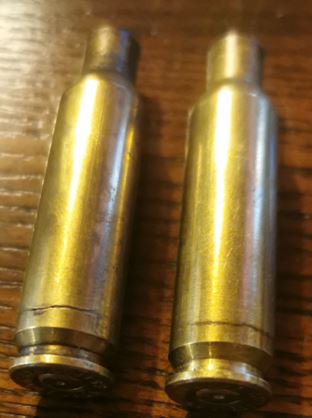
Thanks so much for the help.













































Here's a pic of Wilcoroger casing.
Hope that helps a bit.
Just try what several of us have suggested, trust me it will solve your issue.
https://youtu.be/ldtbsym650k
I found this video. I think it is essentially what your telling me to do, except this guy changes shell holders for his adjustments
Potashminer may have explained it better, he is a better teacher than me, but the reason we know this stuff is that we all made these same mistakes when we were learning.
Forget the bullet, OAL & measuring anything, just concentrate on how to get the case sized to properly fit your chamber with minimum headspace and you will do fine.
I will admit that I originally thought the die would size the brass exactly as it should be. But I know now that isn't the case, literally. Thanks a lot for your help. It is greatly appreciated.
I started out with .223 for my wk180c. I had so much empty brass lying around that it was, in my opinion, worth it to start reloading. I was sitting at the kitchen table, wife wasn't to happy about this but has learned to live with it haha, running the brass through the die, and all of sudden we could hear this big crunch. She yelled and said " my god your going to blow us up" hahaha. That's how I learned about berdan primers. It has nothing to do with this thread but I thought I'd put it in here for a laugh. I'm always learning I guess.
Well I don't understand how it's anymore dangerous. Obviously it fits my rifle better than factory brass if my cases measure longer than unfired cases.
I'm just asking questions and making observations here guys. I don't see any need for the rig pig comment, or ganging up here. How is someone supposed to learn like that. Honestly I felt like deleting this thread because I thought I was being a #### or something. But then I realized that asking questions is the natural way to learn.
I will admit that I originally thought the die would size the brass exactly as it should be. But I know now that isn't the case, literally. Thanks a lot for your help. It is greatly appreciated.
I started out with .223 for my wk180c. I had so much empty brass lying around that it was, in my opinion, worth it to start reloading. I was sitting at the kitchen table, wife wasn't to happy about this but has learned to live with it haha, running the brass through the die, and all of sudden we could hear this big crunch. She yelled and said " my god your going to blow us up" hahaha. That's how I learned about berdan primers. It has nothing to do with this thread but I thought I'd put it in here for a laugh. I'm always learning I guess.
Yep. I started in this in late 1970's. In a very small town Saskatchewan. Way before an Internet or U-tube. No one else that I knew did that - was looked at kind of "sideways" as being unsafe, by guys from the mine, where I worked, who worked with dynamite and blasting caps most every day!!! So, had reloading manuals and instruction sheets. And made many mistakes, but never actually blew anything up. Bought a lot of highly touted "toys" that turned out to be useless, or they did stuff that could easily and more cheaply be done another way. I have seldom had an "original" thought about reloading cartridges - read it from someone else, in almost all cases.
At last count, there are over 20 sets of reloading dies in the drawer, here - a couple I no longer own a rifle for; some I never did own - needed a part or something of a particular size from that sizing die set for another purpose. For several, I have multiple rifles - each one gets it own cases - and each seems to want it's own set-up for the dies, so there is no "locked down" dies here - getting adjusted and re-set constantly. Very, very possible to make a generic round that fits and goes bang in any one of the two 308 Win and three 7.62 NATO. Both cartridges perform better with a 308 Win load in the 308's, and a 7.62 NATO load in the 7.62's. But appears that each one of them does "best" with cases sized for them, and bullets selected and seated for them - individually.
Has been mentioned in other posts - I bought once fired Weatherby brand brass - at like 10% or 25% of new Weatherby brand brass cost. Of course, previously fired in someone else's rifle. I could not chamber any of those fired cases into my rifle. Did a "normal" full length resize to the whole batch - not a single one would allow the bolt to close on my rifle. (300 Wby Mag) With jiffy marker, identified that the "tight" was the area about 1/16" ahead of the belt - where "normal" sizing dies can not reliably re-size. The other guy's chamber, at that point, was larger than my chamber, at that same point, and normal sizing die would not get it. I ended up choosing to buy a Larry Willis collet sizing die that only does anything on that exact area in the front of a belt, on a belted case. Allowed excellent fit into my chamber - saved me from spending many hundreds dollars to buy "new" Weatherby or Norma brand brass for that rifle. And, turns out to be no other use that I have found for the special die, nor the Extreme Pressure grease that I bought to use with it, but no other tool has been found that would do that one task. And notice - I never, ever measured a thing.
Thanks for the guidance. I am a tradesman and I get hung up on measurements. Everything I do at work involves measurements. I was thinking that when dealing with thousandths of inches, it would be critical to be on the mark. Guess I can get that out of my head haha.
Well, probably thousands of an inch are critical in reloading - but for some things do not actually need to know what that number is. So bolt won't close on a re-sized case. Die has got 14 threads per inch - someone could work out how many thou in one turn, etc. But objective is to get snug fit of that case in chamber - do not need to know a number. So turn die in a "smidgeon" more - say less than 1/16" in - now the bolt closes - so you know where "too long" is, and where "snug" is - objective was to fit that case to that chamber - measurement things are supposed to help get to there - not sure I understand why necessary to know a number in this case.
Foregoing was presuming it that case shoulder location that was the issue. Jiffy marker trick tells you where the actual "tight" is actually occurring. Measurements can deceive, sometimes - can measure a die - run a brass in there - can check outside of die - it did not "expand" when brass inserted, but I believe some cases - especially harder alloys or work hardened - have "spring back" - so what you measure on case that you resized is not the size of the die interior...
I'm not sure what your marker test has achieved. Both pieces of brass were known to chamber before you started. On the Savage, the ejector pin will put some forward pressure on the case when closing the bolt - enough to cause the case to hit the shoulder, which you have witnessed.
The marker test helps you when a case wont chamber. So now you have to do a series of trials with the die turned incrementally to establish where the go and no/go point is.
























