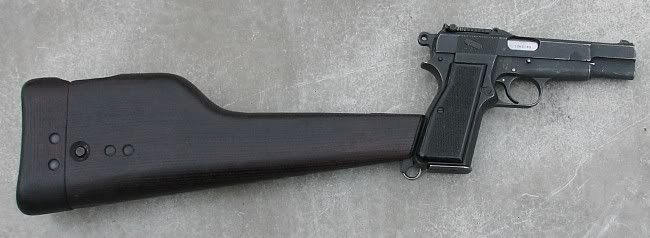
Pistol gurus: Browning HP: some info? *pics up*

Buy the gun.

If in doubt about the in the "white" comments look up the Inglis diamond and the pubs put out by Blake Stevens by Historical Arms Press. I can send some scans of the Stevens book if you want.

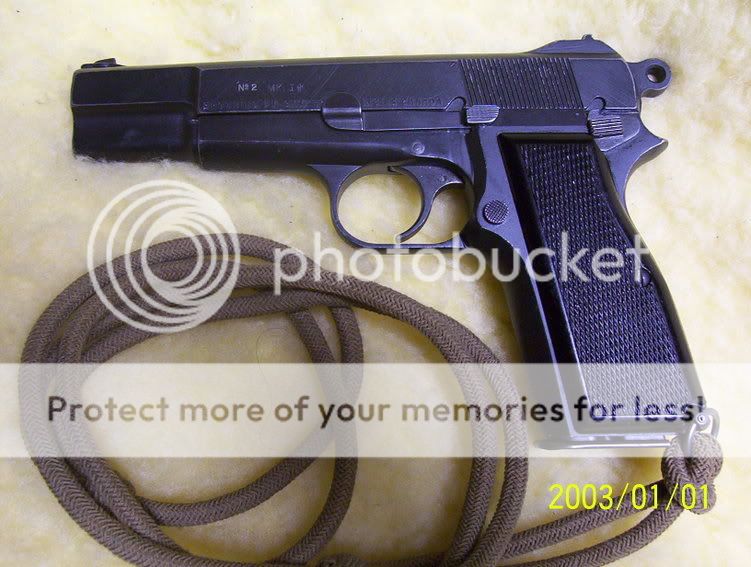
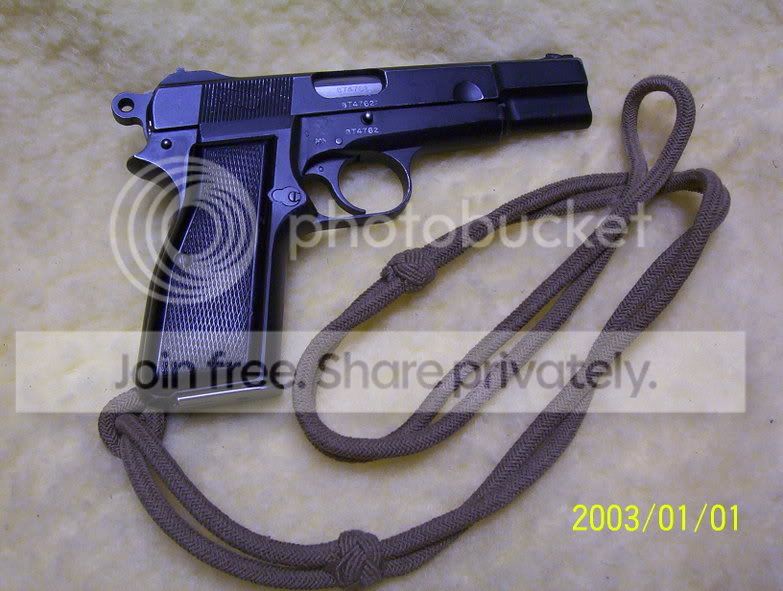
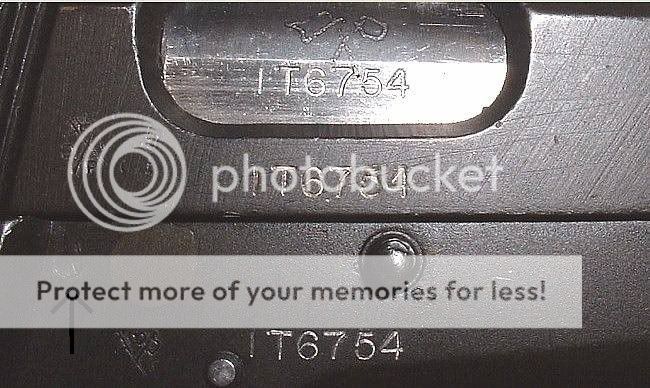
It should be all markings in the white not just the ser#'s so the pic of the left side of "your" gun shows that is has been re-finished.

Still fetching $600 here on the board at least in the condition you show.

Incorrect
The left side markings were roll-stamped before the finish, the serial numbers were pantographed after.
I've got the books, and I think they applied chalk to the left side marks so they would stand out for photos.
Heres one of my No 2 Mk I* Inglis in which the "No2" was added after the finish, poor photos but you can clearly see what is "in the white"
I stand by my comment that your gun is still wearing its original finish and is a vey nice example of an Inglis HP - number 41,2?? to roll off the assembly line (in the T series)
000_0030.jpg

[
000_0050.jpg
 
Wrong Way,

Have you tried posting this on hipowertalk.com, forums.1911forum.com or forum.m1911.org? The latter two have separate Browning forums and all three have knowledgeable members who specialise in HPs. The forums have a lot of information covering all topics for the HP, including info on serial numbers.

Good shooting.
 
canuck,
I only have the Steven's book so that is all I have to go off of, I assume the two books differ in information.

At any rate, I'm not about to argue with you as I freely admit that you have more knowledge about collecting.
 
I believe Canuck is correct. Page 13 of the Stevens book explains why the serial numbers are in the white (note to Sunray, not painted white but 'white' metal showing through the parked finish where the sn was engraved). It does not make any mention of all engravings on the pistol being done this way.

You might be confused by the photos in the book, they rubbed white crayon or chalk in to the engravings to enhance them for the photos.
 
Ollie is correct, if you try to force 14 rounds into a CF "JI" mag you will deform the mag lips. Not sure about current issue mags, I suspect they are normal commercially available 13 rounders.

Dingbat, all the Inglis BHP's I've seen have the dimple.
 
The dimple in front of the ejection port on the right side of the slide was machined there to make it easier to remove the slide stop for taking the gun apart. When you pull the slide all the way back and lock it in that position with the safety for disassembly, the dimple is right under the slide catch pin. Makes it easier to push out!

Scott
 
Incorrect
The left side markings were roll-stamped before the finish, the serial numbers were pantographed after.
As an aside, modern Hi-Powers are still marked this way. The serial numbers are etched after the finish has been applied while all other rollmarks are stamped before the finish.
 
I would def buy if the opportunity arose would see if i could wiggle the slide but a loose slide should not be an issue if its finish is still original

BTW
the Sig 225 and 226 are much easier to field strip
 
Wrong Way:

These Canadian-built High Power pistols were produced by the John Inglis Company in toronto, in 1944-45, in two configurations. The production came about because China (pre-Communist, of course) had adopted the Browning P'35 High Power pistol, as produced by FN in Belgium. However, when Belgium was occupied by the Germans, they took control of the fN manufacturing facilities to produce weapons for themselves, and China could no longer get the pistols. They kept after the Allies for production of the pistol to be re-commenced in one of the allied nations, and that job ultimately fell to Inglis (which was already turning out Bren guns and lots of other ordnance.)

Inglis literally "reverse-engineered" all the necessary production specifications and drawings from six FN-made pistols provided by the Chinese. (They did such a good job that parts will interchange with that model of pre-war FN High Power.)

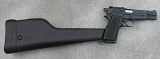
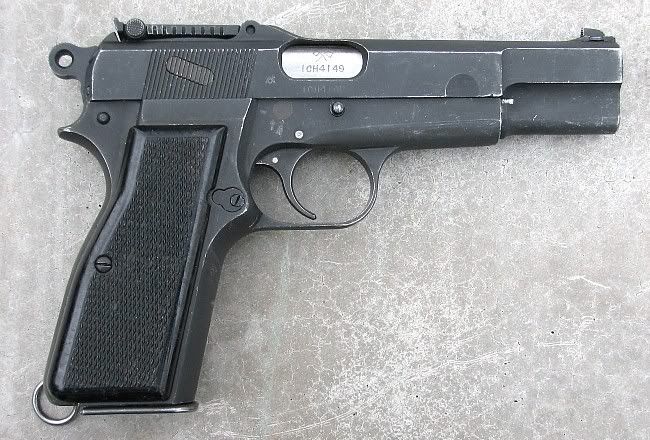
The first configuration of Inglis pistol, referred to as "Pistol No. 1", was the model adopted by the Chinese - which had a tangent-adjustable long-range rear sight calibrated to an incredibley optomistic 500 meters, and was slotted on the rear of the gripframe for attachment of a wooden holster/shoulder stock. No. 1 pistols have "CH" serial numbers.

The second "model" of Inglis, as adopted by Canada and for limited purposes by the UK, was the "No. 2" pistol, of which yours is an example. As you are aware, it has a much simpler, non-adjustable rear sight and no stock-attachment slot on the gripframe. No. 2 pistols have "T" serial numbers, as a result of a WWII directive that Canadian-produced small arms have the place of manufacture coded into the serial number - "T" signifies Toronto.

Here are images of my No. 1 pistol, for comparison .... (click to enlarge) -

My No. 2 pistol ... (click ...)

The "JI" stamp on your magazine confirms that it was produced by the John Inglis Co.

The crossed flags you have enquired about are a Dominion of Canada Proof mark ... in full form, the intials "D", "C" and "P" appear in the left, right and lower quadrants formed by the crossed flagstaffs, with a crown in the upper quadrant ....

dcproof.jpg

The crossed flags mark was electropenciled in simplified form on Inglis pistol barrels .... I believe because the metal composition or degree of hardness precluded stamping. Here are close-ups of the markings on the above two pistols. Note the "C-Broadarrow" stamp on each. (These stamps are often not cleanly and completely struck, as you may have noticed.)

c_broadarrow_frame.jpg
inglsmk4.jpg
 
Back
Top Bottom