Reloading 6.5x55

Odinson

CGN Ultra frequent flyer
Rating - 100%
10   0   0
Hi folks,
I am fairly new to reloading rifle ammunition and currently I am doing some 6.5x55. Using 140 Gr Speer Hot-cor, Privi Partisan brass and IMR 4064 Federal Large Rifle Primers.
The big question is ..... How much variance is allowable with the powder that I'm using. I1/10 of a grain ok? It seems to amount to about 1 or 2 granules of powder.
Am I over thinking this?

Thanks!
 
I'm guessing hunting rounds? If so, as long as the accuracy is "minute of vitals" at whatever range you expect to hunt, I wouldn't sweat it.
A powder charge variance of +- .1 grains likely won't matter.
 
Me usually 0.5 gr
I used to do 0.3gr. The difference is too small If you don't use premium bullet. Bullet is the biggest factor in accuracy.
 
Thanks for the replies. The only hunting that I am doing these days is hunting for the center of the Bullseye in the paper target ...... and so far unsuccessfully, I might add. Thanks again!
 
As per some coaching that I am doing here - get really fussy "bang on" with some, get 0.1 grain variation - too much and too little - with some more. Shoot two groups at range - probably 5 shots each - more per group is likely more certain - can even shoot "round robin" one shot from one batch at one target, then next shot from next batch at other target, then repeat - will likely equalize out barrel fouling, barrel heat, lighting, wind and other esoteric issues. If you can see a difference, then you answered your own question for your shooting and your rifle. If you can not see a difference, then you also answered your question.

I am trying to encourage a learner to do reloading stuff that he can see makes difference on targets with his shooting skill and his stuff - might make a difference for someone else, with their ability and their stuff, but is not worth his time, unless he can show - to himself - how it makes a difference for him. For example - load up 10 identical rounds - shoot 5. Then "glass bed" that rifle - a week later come back and fire off the other 5 rounds - did the group get smaller? If yes, then was worth it - if no, then was not worth doing - if group got worse, maybe suggests that the process that was used needs work?

Load some rounds with .030" jump, and then some more with .020" jump - did that make a difference for groups on target, for shooter and his rifle? If not, is not worth fussing about - although might want to try that again in a year and see if it does, then.

Also need to appreciate there is "difference" and "statistically significant difference" - so fire a 2" 10 shot group at 100 yards - almost inevitably, in that group, will find two or three holes that are .250" apart. If you only shot those two or three - was "chance" that led you to claim 1/4 MOA - but you and that rifle are really 2 MOA - you more or less demonstrated that with your 10 shot 2 MOA group.

 
Last edited:
It might matter, it might not. You could do up a ladder test of several increments around your accuracy load and see what difference there is in dispersion if any. Sometimes you'll see a quite forgiving range of charges that shoot to the same spot and group consistently. If that variation falls into the tolerance of your powder measure then you're off to the races. Factory hunting loads are rarely within 1/10 a grain of each other.
 
It takes around 22-25 granuals of 4064/3031/4350 to equal 0.5grains, and you’re loading 40 + grains of powder.
Quit your worrying, just go shooting.
 
For more than 20 yrs I shot my M38 in local turkey shoots. Won a lot of birds. My load and the only one I ever used in that rifle was 35.0 grs of 4064 and a 140 gr Horn SP. This is a mid range load but proved more than accurate enough to take home some birds from most matches. Sadly the days of the local turkey shoots are all but gone in my part of Ont.

Always check "internet" loads in at least one manual.

Enjoy your 6.5x55. A very accurate choice.
 
It takes around 22-25 granuals of 4064/3031/4350 to equal 0.5grains, and you’re loading 40 + grains of powder.
Quit your worrying, just go shooting.
\

I'm trying to be within granual, that seems to make a difference on my scale. I'm running 34 grains of 4064, that is more or less "starting" according to my Lyman book. I like to try to be as precice as possible, thats just me I guess.
 
For more than 20 yrs I shot my M38 in local turkey shoots. Won a lot of birds. My load and the only one I ever used in that rifle was 35.0 grs of 4064 and a 140 gr Horn SP. This is a mid range load but proved more than accurate enough to take home some birds from most matches. Sadly the days of the local turkey shoots are all but gone in my part of Ont.

Always check "internet" loads in at least one manual.

Enjoy your 6.5x55. A very accurate choice.

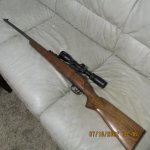
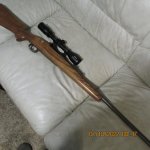
I picked this 6.5x55 at a gunshow a few years ago. Tested it and my buddy quickly noticed that the brass was messed up ...... fire formed into something not useable so, I contacted Tradex back then and they had a brand new barrel for the Husquvarna M-38 in stock, not even blued. So I picked it up, took the gun to Jason at Gunco and I now have an essentially "new" rifle. So, I contacted Brownells to get a new stock. I thought they would send me a chunk of rough cut 2x6 ....
What I got was a really nice piece of Walnut that needed just a bit of fitting. It is all good now, not bad for my first attempt at fitting a stock. One of these days I'm going to research the glass bedding process. With the Privi Partizan ammo it seems to be very accurate and consistent.
The biggest feature for me is the low recoil, old age, arthritis and a torn rotator cuff don't play well together with heavy recoil.
Thanks for all the information folks!
 
Don't get the impression that precision has no value. Being as precise as possible at every stage of the reloading process is likely to net "some" benefit... the problem is that sometimes the rifle itself or the goof behind the trigger are the weak link and the results of precise ammo don't show up. My personal opinion is to eliminate and/or control as many variables as possible in order to get the bullet exactly where it needs to go, whether that is through the center lungs on a bull elk or the center bull on paper.
 
Don't get the impression that precision has no value. Being as precise as possible at every stage of the reloading process is likely to net "some" benefit... the problem is that sometimes the rifle itself or the goof behind the trigger are the weak link and the results of precise ammo don't show up. My personal opinion is to eliminate and/or control as many variables as possible in order to get the bullet exactly where it needs to go, whether that is through the center lungs on a bull elk or the center bull on paper.

This "goof" has been "behind the trigger of plenty of firearms over the last 60 or so years, fairly good at it too. The rifle itself is pretty much new except for the receiver. All I was looking for was opinions on the tolerance, the plus or minus normally allowed by most competent shooters. The original question stated that I was questioning whether 1/10 of a grain would make a difference.
 
IMG_0634.jpgIMG_0635.jpg

Here it is. First attempt at "building" a firearm.
 

Attachments

  • IMG_0634.jpg
    IMG_0634.jpg
    82.6 KB · Views: 75
  • IMG_0635.jpg
    IMG_0635.jpg
    78.6 KB · Views: 75
\

I'm trying to be within granual, that seems to make a difference on my scale. I'm running 34 grains of 4064, that is more or less "starting" according to my Lyman book. I like to try to be as precice as possible, thats just me I guess.

That's a bit of a rabbit hole to go down. Yes it can (somewhat) make a difference but a few things come into play. Volume of powder being used - 1/10 of a grain is infinitely less important in a load with 40 + grains vs. a load of 18 grains. As mentioned, type of shooting. Minute of deer/moose/elk is more forgiving than making small holes in paper. Bench rest/target shooter types are more particular on load consistency and accuracy in every step. You can get a scale that reads to .01 grains if it concerns you. It's up to you how much you want to spend and how much time you want to take doing it. Some guys are happy to churn out loads on a progressive press and blast away, others take time to ensure consistency looking for the one hole group. Nothing wrong with being in either group - it's all up to what you want.

This "goof" has been "behind the trigger of plenty of firearms over the last 60 or so years, fairly good at it too. The rifle itself is pretty much new except for the receiver. All I was looking for was opinions on the tolerance, the plus or minus normally allowed by most competent shooters. The original question stated that I was questioning whether 1/10 of a grain would make a difference.

As others have said there are a lot of variables including the "goof" behind the trigger. Certainly doing all you can to ensure consistency in your loads will help. Fit of the stock, placement of scope, trigger weight (with arthritis in my hands I have a hard time with a trigger over 2 lbs on cold days) all have some effect on the final results - making one hole groups or not.


 
Back
Top Bottom