newbie question about scopes

chezboy

Member
EE Expired
Rating - 0%
0   0   0
I'm looking at buying my first scope for a .22lr rifle. I was wondering what the numbers(bad choice of word but I can't think of a better one) for scopes mean as well as some of the abbrevaitions

examples 3 - 9 X 40 , FOV at 100 yards 17.3 / 6,
eye relief (in.) ER - 3
 
Convention is that the power of magnification be shown first, then the size of the objective lens. In your example the scope magnifies the image of the object being viewed by 3 times or 9 times or anything in between according to the adjustment you make. That's the "3-9" part. The number after the multiplication symbol "x 40" in your example tells the size of the objective lens, i.e. 40 mm. (If it were a fixed power of magnification like my Weaver K4 scopes it would be described as 4x38, or on the little Tasco rimfire scope on my 22lr, 4x20.) Often you will see variable power scopes incorrectly described as 3x9x40.

FOV is the Field Of View, the width of the area that will be seen through the scope, given in yards or metres. In your e.g. it is telling you that if you look at an object at a range of 100 yards, the area pictured in your scope will be 17.3 yards wide when you set it on 6x magnification. (At a lower magnification it will be showing you something wider than 17.3 yards, at a higher magnification it will show you less than 17.3 yards.)

Eye relief is the distance your eye needs to be from the ocular lens of the scope to see the full picture. In your e.g. the correct full picture will be seen if your eye is 3 inches from the lens. Sometimes the eye relief will be a range, e.g 3 to 4 inches. If you are too close or too far from the lens the picture closes up, eventually disappearing altogether.
 
Last edited:
Convention is that the power of magnification be shown first, then the size of the objective lens. In your example the scope magnifies the image of the object being viewed by 3 times or 9 times or anything in between according to the adjustment you make. That's the "3-9" part. The number after the multiplication symbol "x 40" in your example tells the size of the objective lens, i.e. 40 mm. (If it were a fixed power of magnification like my Weaver K4 scopes it would be described as 4x38, or on the little Tasco rimfire scope on my 22lr, 4x20.) Often you will see variable power scopes incorrectly described as 3x9x40.

FOV is the Field Of View, the width of the area that will be seen through the scope, given in yards or metres. In your e.g. it is telling you that if you look at an object at a range of 100 yards, the area pictured in your scope will be 17.3 yards wide when you set it on 6x magnification. (At a lower magnification it will be showing you something wider than 17.3 yards, at a higher magnification it will show you less than 17.3 yards.)

Eye relief is the distance your eye needs to be from the ocular lens of the scope to see the full picture. In your e.g. the correct full picture will be seen if your eye is 3 inches from the lens. Sometimes the eye relief will be a range, e.g 3 to 4 inches. If you are too close or too far from the lens the picture closes up, eventually disappearing altogether.


thank you.
 
I'm looking at buying my first scope for a .22lr rifle. I was wondering what the numbers(bad choice of word but I can't think of a better one) for scopes mean as well as some of the abbrevaitions

examples 3 - 9 X 40 , FOV at 100 yards 17.3 / 6,
eye relief (in.) ER - 3

TheTooner's post pretty well said it all. I'll only add that the FOV 17.3 / 6 numbers correspond to the field of view at the lowest and highest setting on the variable power. In your example 3X has a FOV of 17.3 ft, and 9X has a FOV of 6 ft, when measured at 100yds.
 
Last edited:
Guys like The Tuner is what makes this site so good, he very clearly gave advise to on a strait forward question. newbie Chezboy asked and he promptly replied to Tuner with a thank you.
Well done Tuner your a class act
 
Or maybe a few. X2 on that. When all is said and done it really takes someone who understands a particular technology very will to explain it in simple terms. And he did it in 2 short paragraphs. We are fortunate to have a lot of people like Tooner who are generous with their knowledge. Maybe we should all chip in and get him a beer eh? That is the joy of this site and it makes us better shooters in the long run. Much thanks to all who contribute.
Thanks for being part of the learning curve. You are all appreciated.:)
 
I have two points to add for a 22 scope. First, since you will often be aiming at targets less that 100 yards away, a fixed power scope might work for you. I have a fixed 2.5 power scope on my own 22 rifle.
Second point, also due to you aiming at less than 100 yards most of the time. Some scopes will not focus properly at less than 50 yards. Check this before you buy. This is especially likely with scopes with higher magnifications, intended for use at 200 yards or more.
A scope that is labeled for use on a rimfire rifle will probably be optimized for use at 50 to 75 yards.

APG
 
Thanks for all the kind words. Jethunter's version of the FOV sounds as plausible as mine - while writing well may make me seem knowledgeable, on this I was only repeating what I remember being told, which could be wrong, or both could be right. There is no law or regulation that I know of laying down how the makers describe these things, just convention, as I said.


I will add this on lens size, which also applies to binos and spotting scopes:

The larger the objective lens, the more light that can be gathered, so in principle, bigger is better. But there is such a thing as too big, because it is possible to gather more light than can be used effectively and to have the scope so big that it becomes cumbersome and outweighs the benefit of brightness. And the quality of glass and number and type of lens coatings can also add or detract from the brightness of the image, so sometimes these qualities can compensate enough that a very good scope of a certain size may give a brighter image than a lower quality scope with bigger numbers.

The size of the objective lens divided by the magnication gives a number called the exit pupil, which describes the size of the light image being projected into the user's eye. The human eye opens its pupil to see better in darkness, up to a maximum of about 7mm for a typical young adult, but as we get older our maximum gets smaller, e.g. 4-5 mm is thought to be typical around my age (40s.) So if your optic is producing more than 7mm of exit pupil, it is wasted. The magic numbers for the brightest scopes would be 4x28, 6x42, 7x50, 8x56, etc. But remember other factors also count. Glass quality and/or lens coatings can make things better or worse, and when you get older, a 7x35 binocular's 5mm exit pupil may be all the light you can use, so a 7x50 of equal quality is just extra weight and bulk for a wasted ideal 7mm exit pupil.

It is also traditional wisdom that magnification over 7x makes the natural unsteadyness (in most people) of a freehand hold so apparent that you will tire your eyes quickly with prolonged viewing. So when using magnification greater than 7x, it is worth trying to ensure you will normally have a tripod for a spotting scope or solid rest for your binos or scoped rifle.


And lastly, remember that no matter how big and close your optics make the target appear, whether you hit it or not is still entirely dependent on your shooting technique and the performance of the rifle. If you aren't producing a tight group at 25 yards with iron sights, it isn't going to get better at 250yards no matter how well a 10x scope lets you see the distant target.

E.g. I normally hunt deer with a 4x scope on a Lee-Enfield No4 .303British. My shooting ability (lack of practice) + the rifle's performance + ballistics = If a 4x scope doesn't show the target well enough, I, for one, shouldn't be shooting at it.

 
Last edited:
i was in the camera business for years ,and you've summed it up VERY WELL- most folks don't get the exit pupil thing and as a result, get a scope that's far too powerful for low light- unless you're varminting, or long range target, there's really no need to go much beyond 10x- or 12 if you're running a variable- when i first started, i liked a 3x9- now because of my old eyes, i shoot a 4x12, all in 40 mm- my binocs are 8x40 as well-
my 22s run typically a 4x or a 3x7 but they're RIMFIRE SCOPES- your typical rimfire scope will be adjusted for parallax free at 50 yards,unless you have an adjustable parallax model
 
Last edited:
I have to add my thanks to Tooner for this explanation. And thank god for the search function!

 
Some awesome explanations here of all the technical stuff...

If you would like a scope that's great value for the money get the Bushnell 3-9 x 32 with turret mounts & adjustable objective. Adjustable Objective simply means that you can get clear focus right down to 7 meters (why you would need a scope at that range I do not know but you can...). It's under $100 and it's a GREAT starter scope. It's robust enough to use on centerfire rifles too so it'll last you as your collection expands.

Just my 2 cents. :D
 
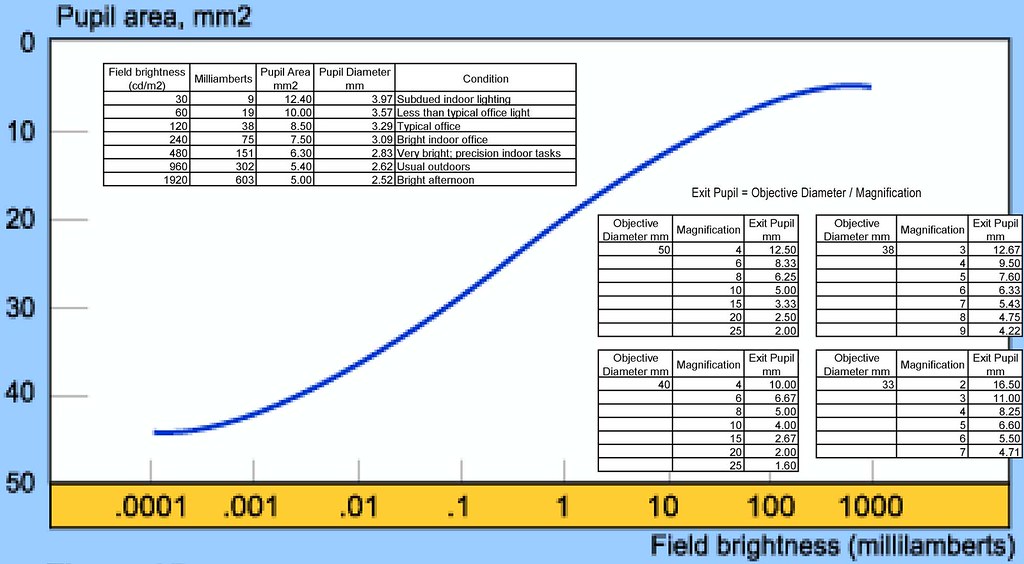
Here's a little graph I marked up on exit pupil....

2978234489_3d71f41174_b.jpg


Basically in outdoor conditions other then night time your pupil diameter will be between 2.5 to 4 mm, that means for a typical 40mm objective diameter scope magnifications below 10 power will be casting extra light on your iris, not hitting the retina. Unless you are running massive magnification for target or varminting your optics dollars are best spent on smaller diameter high quality glass, they will give the same aparent brightness and weigh less.
 
Last edited:
Back
Top Bottom