Thanks for all the kind words. Jethunter's version of the FOV sounds as plausible as mine - while writing well may make me seem knowledgeable, on this I was only repeating what I remember being told, which could be wrong, or both could be right. There is no law or regulation that I know of laying down how the makers describe these things, just convention, as I said.
I will add this on lens size, which also applies to binos and spotting scopes:
The larger the objective lens, the more light that can be gathered, so in principle, bigger is better. But there is such a thing as too big, because it is possible to gather more light than can be used effectively and to have the scope so big that it becomes cumbersome and outweighs the benefit of brightness. And the quality of glass and number and type of lens coatings can also add or detract from the brightness of the image, so sometimes these qualities can compensate enough that a very good scope of a certain size may give a brighter image than a lower quality scope with bigger numbers.
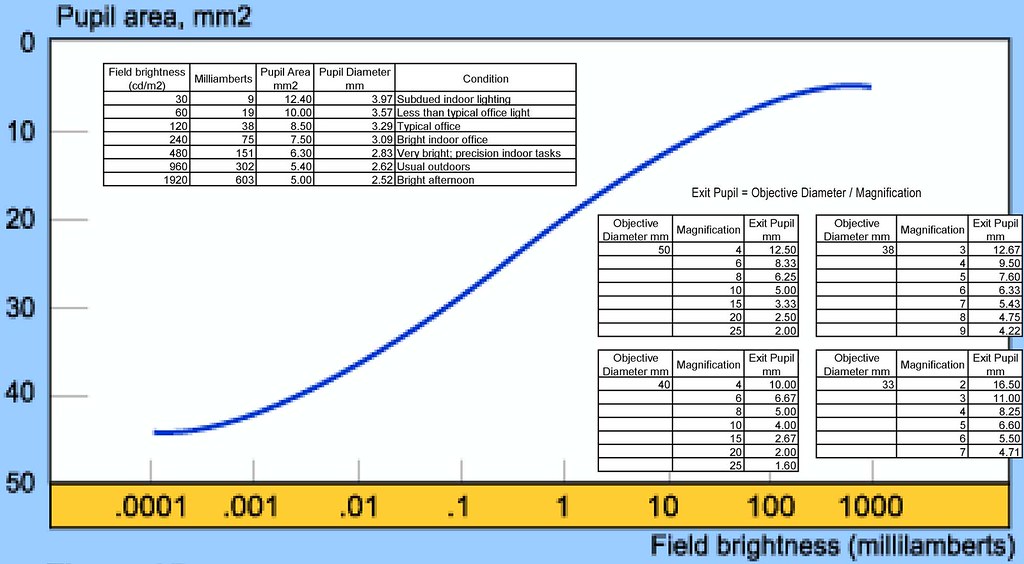
The size of the objective lens divided by the magnication gives a number called the exit pupil, which describes the size of the light image being projected into the user's eye. The human eye opens its pupil to see better in darkness, up to a maximum of about 7mm for a typical young adult, but as we get older our maximum gets smaller, e.g. 4-5 mm is thought to be typical around my age (40s.) So if your optic is producing more than 7mm of exit pupil, it is wasted. The magic numbers for the brightest scopes would be 4x28, 6x42, 7x50, 8x56, etc. But remember other factors also count. Glass quality and/or lens coatings can make things better or worse, and when you get older, a 7x35 binocular's 5mm exit pupil may be all the light you can use, so a 7x50 of equal quality is just extra weight and bulk for a wasted ideal 7mm exit pupil.
It is also traditional wisdom that magnification over 7x makes the natural unsteadyness (in most people) of a freehand hold so apparent that you will tire your eyes quickly with prolonged viewing. So when using magnification greater than 7x, it is worth trying to ensure you will normally have a tripod for a spotting scope or solid rest for your binos or scoped rifle.
And lastly, remember that no matter how big and close your optics make the target appear, whether you hit it or not is still entirely dependent on your shooting technique and the performance of the rifle. If you aren't producing a tight group at 25 yards with iron sights, it isn't going to get better at 250yards no matter how well a 10x scope lets you see the distant target.
E.g. I normally hunt deer with a 4x scope on a Lee-Enfield No4 .303British. My shooting ability (lack of practice) + the rifle's performance + ballistics = If a 4x scope doesn't show the target well enough, I, for one, shouldn't be shooting at it.