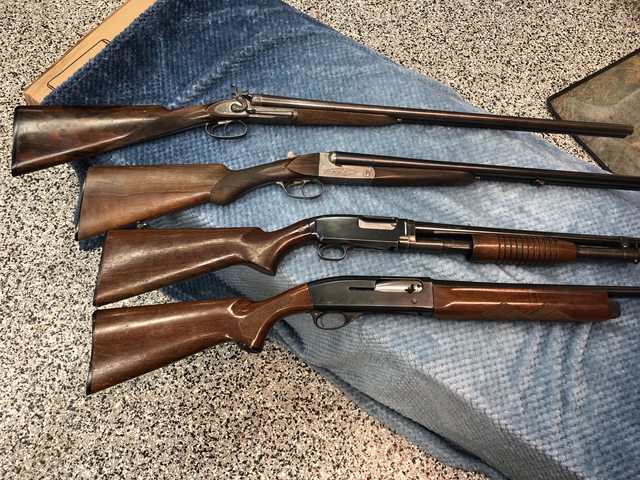
16 Gauge Shotguns Selection, Ballistics, History, and More

Big Bad

CGN Ultra frequent flyer
Rating - 100%
1   0   0
Location
In Little Syria.
From a new-to-me upland hunting magazine I'm trying out for a year. Probably too long to post in one go but I may get ambitious and break it in two. A 16 gauge was my starting out shotgun.

16-Gauge Shotguns – Selection, Ballistics, History, and More

JUNE 2, 2023

16-gauge shotgun

A.J. DEROSA

A.J. DeRosa founded Project Upland in 2014 as an excuse…

Take a look at the history, culture, and availability of the 16-gauge shotgun

One of history’s most famous 16-gauge shotguns was known as “The Little Gun.” It was built by Parker Bros in 1889 and “was billed to Mr. D. W. Parker, then treasurer of the Parker Company.” In 1893, it went to Everel Harnden, the grandfather of the famous “godfather” of ruffed grouse hunting, William Hardnen Foster. Foster would shoot his first grouse on the wing with it at 12 years old in 1898 before he went on to write the iconic classic, New England Grouse Shooting, published in 1942.

For the most part, the 16-gauge probably garnered its popularity in the United States by pellet counts. Classic American manufacturers like Parker Bros, A.H. Fox, L.C. Smith, and others helped the gauge gain familiarity and popularity. The gauge peaked in American culture in the 1940s and 1950s when almost a quarter of all shotguns sold were 16-gauges. The 12-gauge accounted for just over 50 percent of shotguns sold at that time, according to author Layne Simpson of Shotguns & Shotgunning.

In the 2023 North American Upland Hunting Survey, the 16-gauge came in as the fourth most popular gauge, with 10.63 percent of modern upland hunters citing it as their preferred gauge. It was bested by the third-place 28-gauge by only half a percent. Among Millenials, it is the third most popular gauge, beating out the 28-gauge.


After researching this gauge, it’s hard to make a solid case for what came first — the chicken or the egg. Was it shotgun ammo manufacturers that made the availability of 16 gauges hit the shelves of Walmart? Or was it the cult following of Browning A5 that resurrected the “Sweet 16” at the right time? Who knows, but it happened.

Two 16 gauge shotgun side bi side on a bird hunt.
16-Gauge Bore Diameters
Cylinder .662”
Skeet .658″
Improved Cylinder (IC) .665″
Light Modified (LM) or Skeet II .652″
Modified (MOD) .647″
Improved Modified (IM) .642″
Full .633″

The 16-Gauge Load and Ammunition

During the advent of the modern shotgun in the late 1800s, the standard 16-gauge load was 2 ½ drams, 1 oz shot, with a 2 ½ cartridge length. Today, both 1 oz and 1 ⅛ oz 2 ¾” loads are commonly found at gun shops. Despite what some people may tell you, the standard 1 oz 16-gauge load is not a “square load.” The discussion of “square loads” is more accurately a discussion between length and diameter ratio of the shot column in a load. Note that this differs from the black powder ratio, which accounts for both powder and shot.

Walking into your local sporting goods store and finding a box of 16-gauge shells was a rarity not five years ago; now, Walmart sells them along with most other ammo retailers. According to Cabela’s website in May of 2023, the store offers 12 types of 16 gauge ammo (not including shot size). In contrast, they offer 83 options for 12 gauge and 37 options for 20 gauges.

Regarding sub-gauges, the 16-gauge is by far the best patterning load. The L/R of a 16-gauge load is 1.41. Comparable, the 20-gauge is 1.68. Pattern efficiency is about seven percent greater than the 20-gauge and about nine percent better than the 28-gauge.

The iconic purple 16-gauge shotgun shells
Using 1 oz. Federal Game Loads as a baseline for lead ammunition, a box of No. 6 16 gauge shells comes in at $20.99. That’s eight bucks more expensive than the 12-gauge equivalent, which is about $0.30 more per round. The velocity (FPS) comes in at 1165 compared to the 12-gauge’s 1290.

One of the greatest disadvantages of the 16-gauge is certainly ammunition selection. You can expect to pay a lot more when shopping for steel shot. Federal Speed Shok #2 comes at $37.99 for 16-gauge loads compared to the same ammunition for the 12-gauge at $20.99. Luckily, Kent Bismuth prices do not fluctuate as much as steel. 16-gauge #5 Kent Bismuth comes in at $59.99 versus its 12-gauge counterpart at $53.99.

Three-inch shells are virtually nonexistent for the 16-gauge. Some folks, myself included, would argue that’s a good thing. Remember our discussion of the length/diameter ratio? A 3” shell means more shot is packed in, resulting in pattern deformity and inferior patterns.


Modern Built 16-Gauge Shotguns
Just a decade ago, people were writing articles about the decline of the 16-gauge; that’s no different than what W.W. Greener wrote in 1897. However, these writers provide evidence that the 16-gauge’s popularity depending on performance, nostalgia, or a little of both, is timeless. The gauge has some handicaps; for example, it’s not recognized in skeet classes. Additionally, the cost of ammunition is high in some cases, yet the gauge still carries on. Despite these disadvantages, modern shotgun manufacturers have embraced the trend and increased the availability of 16-gauges.

Best Side-by-Side 16-Gauge Shotgun Models
The 16-gauge is most popular in the form of side-by-side shotguns. There is no doubt the side-by-side renaissance has helped its case. From vintage side-by-sides to modern builds, there are some great options to get into 16-gauges at various levels.


... next post
 
... continued and concluded.

16-gauge RFM Zeus by Upland Gun Company
The Upland Gun Company RFM Custom Built Zeus 16-Gauge
Most shotgun enthusiasts are not used to seeing the words “custom built” alongside affordable price tags like the Upland Gun Company Zeus. This Italian-built 16-gauge side-by-side starts at $1,999. It’s built to your measurements with fixed chokes you get to choose from, mono-bloc barrels, double triggers, a pistol grip, and a coin finish. The add-on options are endless, although the base build is a wonderful shotgun. You can add a straight stock for $200 and your initials for only $150. Change to a single trigger, or maybe upgrade the wood; many options exist.

16-gauge RFM Venus by Upland Gun Company
The Upland Gun Company RFM Custom Built Venus 16-Gauge
Starting at $3,299, Venus 16-gauge comes in at six pounds, making it a fine grouse gun for those looking to shave off every ounce. Like the Zeus, it comes built to your dimensions, with the base model having an English straight stock.

16-gauge CZ USA Sharp-tail
CZ Sharp-Tail 16-Gauge Side-by-Side Shotgun
Although CZ USA no longer lists the CZ Sharp-Tail 16-gauge as being in production, it is still available in many locations. They are becoming increasingly difficult to find, but they hover around $1,099 when you can find one. The 28-inch barrel, single trigger, pistol grip 16-gauge comes in at 7.3 pounds.

While you might be saving money initially, overall, you will pay for this purchase in both weight and long-term performance. I have had issues with the safety loosening and firing pin issues, but that was after shooting a solid thousand rounds. However, it’s something to remember based on how much you expect to use your CZ Sharp-Tail.

Best Over-and-Under 16-Gauge Shotguns
From the Stevens 555 to the Franchi Instinct line, the 16-gauge gets plenty of love in the over-and-under realm as manufacturers offer various price and quality levels to those hunting for their next 16-gauge shotgun.

16-gauge Stevens Model 555
Stevens 555 16-gauge Over/Under Shotgun
The Stevens 555 16-gauge was a big hit when it was first released. The Silver model starts at $749.99, followed by the Stevens 555 E at $849.99. The Silver comes in at 6 lbs, 6 ounces. The Stevens 555 E 16-gauge shotgun comes in at 6.45 lbs. Both are advertised as ambidextrous and chambered for 2 ¾” rounds. For those looking for the most affordable 16-gauge over/under shotgun, the Stevens 555 is the way to go.


Franchi Instinct 16-gauge Over/Under Shotguns
I have a soft spot for the Franchi Instinct line. It was the first over/under shotgun I bought and the only one I have not sold off. Coming in at 5.8 lbs, the Franchi Instinct SL makes for an excellent grouse gun. With an MSRP of $1,799, it is more expensive than the Stevens, but the overall quality of this shotgun is higher. The 16-gauge is also available in the Instinct Sideplate model (MSRP $2,399) and the Instinct SLX (MSRP $2,249).

16-gauge RFM SK Field by Upland Gun Company
The Upland Gun Company RFM Built Sk Field Over/Under 16-gauge Shotgun
Upland Gun Company released their over/under options in 2022. The SK Field is custom-built to your measurements and has many custom options. The base model comes in at $2,199 and can even have two triggers when you build it online. The shotgun weighs roughly 6.5 lbs in the 16-gauge option and can be a great upland hunting shotgun with endless custom options.

Best Semiautomatic 16-Gauge Shotguns
The availability of 16-gauge shotguns is most limited regarding semiautomatic actions. Browning is the dominant manufacturer of a semiauto 16-gauge. However, TriStar offers an affordable, entry-level option. Interestingly enough, one could argue the most recent revival of the nostalgic 16-gauge shotgun has been driven by the Browning A5 “Sweet 16” that won over the generation that missed the 16-gauge shotgun hay day.

16-gauge Browning A5 often called the "Sweet 16"
Browning A5 Semiautomatic 16-Gauge Shotgun
Coming in various options, the Browning A5 16-gauges start at $1,679.99 and go as high as $2,149.99, based on which of the A5 “hump back” models you are interested in. Some models weigh under six pounds, and others are roughly over that mark. From classic wood finishes to various camouflage patterns, many options are available. The Browning A5 is most known for its recoil-operated Kinematic Drive System. Their recoil-operated shotguns dominated the market before the Italian-built Inertia designs took over.

16-gauge TriStar Viper G2
TriStar Viper G2 Semi Automatic 16-gauge Shotgun
In contrast to the Browning A5, the TriStar Viper G2 is built as a gas-operated action and weighs 6.5 lbs. Coming in at an MSRP of $639, the TriStar is known for its entry-level prices. As a result, one can expect to sacrifice performance, and I would be wary of anyone looking for heavy use of this 16-gauge shotgun model.

16-gauge Browning BPS pump shotgun
16-Gauge Pump Shotgun Options
The only modern large production 16-gauge pump shotgun is the Browning BPS. Weighing 7.1 lbs, the Browning BPS 16-gauge starts at an MSRP of $729.99. If vintage pump guns are your thing, the Winchester Model 12 and the Ithaca Model 37 are worthy 16-gauge shotguns. One can expect to pay a wide range of prices based on the condition, but they are frequently available.

Looking Back on the 16-Gauge Shotgun in History
I assumed the 16-gauge was very popular at some point in history. I dug as far back as the London Gun Trials of 1879, and the 16-gauge never surpassed the 12-gauge in popularity. Sure, it enjoyed times of more significant popularity, but there was never a moment that set it well ahead of the 12-gauge. Curiously, in those very trials, the final “figure of merit” on the best shotgun made was, in fact, a 16-gauge with a score of 266.52 points. This score was calculated using a combination of patterns, pattern deviation, recoil, and velocity. The 20-gauge beat out the 12-gauge by only 1.68 points.


Record of the 1879 Gun Trial in the book The Gun and its Development.
In W.W. Greener’s 1897 book The Gun and its Development, he writes, “The 16-BORE GUN was at one time a favorite with Continental sportsmen, who now for the most part, prefer the 12-bore; for use in England probably not one gun in five hundred is made 16-bore.” It’s also important to note the lack of popularity of the 20-gauge at that time: “The 20-BORE has been strenuously advocated by writers in the sporting papers, but there are very few sold — the proportion is perhaps one 20-bore to twenty of 16-bore,” wrote Greener.

A 16 gauge fox sterlingworth side by side shotgun
In Modern Shotguns, Greener wrote that “a 16-gauge with 3o-inch barrels may weigh 6 ¾ lbs, and be made a powerful weapon, but 6 ½ lbs, is the full average weight; if with 28-inch barrels 6 ¼ or even 6 lbs. ; with 25-inch barrels, and built as a miniature gun, 5lbs. 2 ozs.”

Although I do not see any 16-gauges staying in my gun safe past my great grandfather’s Belgium guild hammer gun, that does not mean it’s a bad gauge. Truthfully, my small frame is better suited to 20- and 28-gauges. But what doesn’t work for one person might work for another. If you can shoot it straight and find shot shells, enjoy hunting and shooting with your 16-gauge. I’m sure we’ll be hearing about a rise in the popularity of 16-gauge shotguns again


https://projectupland.com/shotguns-...shotguns/?mc_cid=84ead74886&mc_eid=d1c94caa05
 
I have for years favoured a 16 over a 20 precisely because of the inherent better patterns offered by a larger bore diameter with the same amount of shot. With one ounce, everything else being equal, a 16 will pattern better than a 20 and a 12 will pattern better than a 16. But most times that comes at the cost of size and weight of the gun. So I aim for the best tradeoff I can find. For upland, setting 28 ga aside, I now search for the best handling gun, ignoring gauge. And I now have a basket of guns that range between 5 1/2 pounds and 6 1/2 pounds in all three gauges. The very light ones tend to have 26" barrels and the ones at the heavier end of the scale tend to have 28" and 29" barrels. And i just about always shoot either 7/8 oz or 1 oz loads through all of them.
 
The only 16 I have at the moment is a gorgeous little drilling hammer gun , 16x16 /9.3x72r.
It is a great gun to carry and shoot , having downed pheasants. Sharptails, and ruffed grouse.
Cat
Edit note: I assume this thread is about smokeless guns not BP shotguns
 
Last edited:
I have an old Remington model 31 in 16 gauge. They were built all steel (except for the lightweight) on a 20 gauge frame and walnut stocks. Weighs just under 7 lbs and fits me perfectly. They were called "the ball bearing action" and are the smoothest working pump I have ever seen. In my opinion a better gun than the Winchester model 12 though the 12 was already well established when the Remington came out in 1931. Cost for a model 12 in 1939 was $39.99 and the model 31 went over $48.00 in price. Discontunued in 1950, I think in favour of the Remington 870, a much cheaper design to produce.
 
I have an old Remington model 31 in 16 gauge. They were built all steel (except for the lightweight) on a 20 gauge frame and walnut stocks. Weighs just under 7 lbs and fits me perfectly. They were called "the ball bearing action" and are the smoothest working pump I have ever seen. In my opinion a better gun than the Winchester model 12 though the 12 was already well established when the Remington came out in 1931. Cost for a model 12 in 1939 was $39.99 and the model 31 went over $48.00 in price. Discontunued in 1950, I think in favour of the Remington 870, a much cheaper design to produce.

Well, you just reminded me I was an idiot to sell my Model 31 in 16 gauge a few years ago. Yep, that was a stupid move. It was everything you described.
 
My 16's all of which are bloodied har har
LkU2v3rl.jpg
 
I hunt upland birds with my 16 ga. Browning Citori White lightning, a Merkel O/U, a Krieghoff Drilling, and a Italian/ German exposed hammer SxS gun. Love em all. Also use them for jump shooting ducks and sometimes rabbits and pests. I will always have a good 16 ga. at hand when out with my pointing dog. Feels right, works well!
 
I've never owned one and only ever shot one once many, many years ago long before I understood things like gun fit etc.. It was an old SXS, memory tells me it was an old Ithaca. The fellow that owned it was convinced it was a powehouse because it kicked like a mule, and it did! Felt like it knocked my fillings loose. I was 19 or 20 and pretty solid framed but it drove me like I was a peg. The fellow then hands it to his 13 year old daughter who was about 70lbs soaking wet, chuckling and says "watch her, she's tougher than you guys". She touches off a round, the gun drives her back on her heels, head whipping, recovers herself and touches off the second barrel and just giggles and hands her father the gun saying "that was fun!"...Didn't feel or look fun to me, lol.
Only time I've ever shot one and only time aside from one evening at the club when a fellow brought out a new Citori a couple years ago and shot some skeet and trap with it that I have even been privvy to being around one being shot.
 
I've never owned one and only ever shot one once many, many years ago long before I understood things like gun fit etc.. It was an old SXS, memory tells me it was an old Ithaca. The fellow that owned it was convinced it was a powehouse because it kicked like a mule, and it did! Felt like it knocked my fillings loose. I was 19 or 20 and pretty solid framed but it drove me like I was a peg. The fellow then hands it to his 13 year old daughter who was about 70lbs soaking wet, chuckling and says "watch her, she's tougher than you guys". She touches off a round, the gun drives her back on her heels, head whipping, recovers herself and touches off the second barrel and just giggles and hands her father the gun saying "that was fun!"...Didn't feel or look fun to me, lol.
Only time I've ever shot one and only time aside from one evening at the club when a fellow brought out a new Citori a couple years ago and shot some skeet and trap with it that I have even been privvy to being around one being shot.

Chances are the old double that kicked so hard was a 2 and 9/16 chambered 16 gauge. Up til the 1930's many were short chambered. Folks fed them 2 3/4 inch shells and when fired the hulls couldn't even open fully and they kicked like he'll. My grandfather had an old 16 gauge Iver Johnson that loosened my fillings firing it at partridge with those old high brass 2 3/4 Imperials. Gun ended up really loose and off the face.
 
Chances are the old double that kicked so hard was a 2 and 9/16 chambered 16 gauge. Up til the 1930's many were short chambered. Folks fed them 2 3/4 inch shells and when fired the hulls couldn't even open fully and they kicked like he'll. My grandfather had an old 16 gauge Iver Johnson that loosened my fillings firing it at partridge with those old high brass 2 3/4 Imperials. Gun ended up really loose and off the face.

More than likely what it was. It was a dental loosener that's for sure. I recently came into a bunch of 16ga ammo through a friend of a friend. There was 19 boxes of Fiochi field loads, 2 boxes Winchester Super X, a box of Federals and 9-25rd. boxes of Bismuth. I couldn't see myself buying a 16 just to use up the ammo so I sold it all. It sold fast!
 
I've never owned one and only ever shot one once many, many years ago long before I understood things like gun fit etc.. It was an old SXS, memory tells me it was an old Ithaca. The fellow that owned it was convinced it was a powehouse because it kicked like a mule, and it did! Felt like it knocked my fillings loose. I was 19 or 20 and pretty solid framed but it drove me like I was a peg. The fellow then hands it to his 13 year old daughter who was about 70lbs soaking wet, chuckling and says "watch her, she's tougher than you guys". She touches off a round, the gun drives her back on her heels, head whipping, recovers herself and touches off the second barrel and just giggles and hands her father the gun saying "that was fun!"...Didn't feel or look fun to me, lol.
Only time I've ever shot one and only time aside from one evening at the club when a fellow brought out a new Citori a couple years ago and shot some skeet and trap with it that I have even been privvy to being around one being shot.

Odds are it was a bit of poor gun fit but mostly an inappropriate load for the weight of the gun. Recoil is simply a function of the weight of the gun against the combination of the weight of the ejecta (mostly the shot load) and the speed the load is accelerated to. It's simply physics. Without an offsetting mechanism like an auto-loader, or a pad to slow the effect (you still get all the recoil.....it's just dragged out over time so doesn't feel as sharp) it is just those three factors. Likely the Ithaca was reasonably light, under 6 1/2 pounds, and the shells were something like 1 1/4 oz or 1 3/8 oz coming out the muzzle at something over 1200 fps. That combo will rattle anyone's teeth.
 
I have a nice 16ga Tobin sxs that I've posted about before.
Its light, maybe 6.7 lbs, has a narrow comb and quite a bit of drop at the heel. You feel the recoil on the cheek for sure.
 
Odds are it was a bit of poor gun fit but mostly an inappropriate load for the weight of the gun. Recoil is simply a function of the weight of the gun against the combination of the weight of the ejecta (mostly the shot load) and the speed the load is accelerated to. It's simply physics. Without an offsetting mechanism like an auto-loader, or a pad to slow the effect (you still get all the recoil.....it's just dragged out over time so doesn't feel as sharp) it is just those three factors. Likely the Ithaca was reasonably light, under 6 1/2 pounds, and the shells were something like 1 1/4 oz or 1 3/8 oz coming out the muzzle at something over 1200 fps. That combo will rattle anyone's teeth.

All true but most older 16 gauge guns are 2 9/16 chambers and combining that with 2 3/4 inch ammunition equals pretty severe recoil and batters the action and stock inletting pretty badly not to mention the shooter.
 
All true but most older 16 gauge guns are 2 9/16 chambers and combining that with 2 3/4 inch ammunition equals pretty severe recoil and batters the action and stock inletting pretty badly not to mention the shooter.

Sorry, the oversize shell in your example has little to nothing to do with recoil. Recoil is entirely dependent on what that shell is loaded with. The only meaningful impact of a 2 9/16' chamber, with a 2 3/4" shell down a 16 gauge barrel is a boost in peak pressure in the 800 psi range. And pressure has nothing to do with recoil.

You are equating a 2 3/4" shell with a heavy load shell. Not the same thing. Sometimes they are but sometimes they are not. It's like trying to describe a heavy load shell as "high brass". It's an inaccurate shorthand.
 
Last edited:
In my mind if the hull can't open fully that is in effect a bore restriction which increases pressure AND recoil. I've seen enough old 16 gauge guns beaten loose by 2 3/4 inch ammunition even old Canuck loads which are fairly light. Guess I'll agree to disagree with you on this one.
 
Back
Top Bottom