Some old fixed power --not focal length-- riflescope questions.

AB3006

Member
Rating - 100%
1   0   0
Hello Optics Hivemind!

A fella wants to know something about some optics that came with his boomsticks. Asking for a friend :)

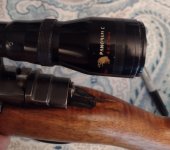
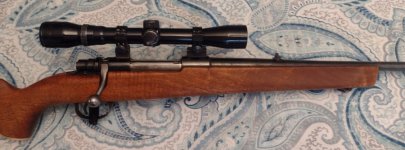
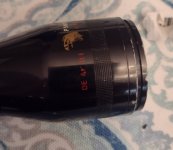
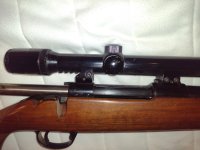
The first one is an interesting 4x37mm optic. Simple crosshair reticle, and the funky thing is an oblong field of view. Super clear and bright glass, great focus, but somewhat sensitive to sunlight light coming in from the front. Can anyone tell me... I mean my friend what kind it is? What were it's intended hunting scenarios and so forth? It came with my Husqvarna 1640, but currently it's mounted on my wife's 22.
IMG_20240731_195356047.jpgIMG_20240731_195844691.jpg

IMG_20240731_195852244.jpg

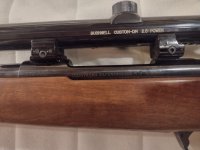
The next one is a fixed focal length Bushnell Custom-DM 2.5X. This one came with my Husqvarna 1900, but is now mounted on my youngest's Rascal. It's got a T-shaped reticle, and it's also pretty bright. Sure would appreciate some info, or even a link to a manuel.
1730250842514.jpeg
1730250891387.jpeg
 
What do you mean by fixed focal length- no parallax? I have one new with second focal plane but no parallax. 50 and 100 is clear, no problems, but could get fuzzy.
 
Maybe some words getting mixed up in use? You can measure "focal length" - the distance from rear lens to rear of your retina - shine flashlight into front end - find sharpest /smallest exit diameter - measure to rear lens - that is "focal length" - will be quite a bit different among various scope brands, and likely changes as a variable scope's power is changed. "Parallax" is about the alignment of the reticle with the target - nothing really to do about "focus" - although related - you can check for "parallax" by aiming at target from a good rest - move your eye side to side or up/down, without moving the scope - if you have "parallax", the cross hair will appear to move on the target dot - a scope can only be adjusted to be parallax free at one exact range - you will have that error at closer or longer ranges - although that will not be enough error to matter to most people. I think some scopes have a third turret on left side that alters parallax - it also alters the scope's "focus" - but "focus" and parallax are not the same thing. If you can mount your rifle exactly the same, for every shot, you will not have parallax sighting error - if there is an error, it will be the same for every shot that you take - if you address the rifle the exact same way every time.

I have Leupold rimfire scopes - the booklet that came with them says they are set parallax free at 60 yards - "fixed" parallax - I think centre-fire rifle scopes often fixed at longer range - 100 yards or 150 yards. With a fixed power 4X scope, I can move the cross hairs about 1 1/2" left or right at about 10 yards - by seeing some black on the opposite side of the view. If you are attempting to shoot a 0.005" 10 shot group at 100 yards, parallax likely matters to you.
 
Maybe some words getting mixed up in use? You can measure "focal length" - the distance from rear lens to rear of your retina - shine flashlight into front end - find sharpest /smallest exit diameter - measure to rear lens - that is "focal length" - will be quite a bit different among various scope brands, and likely changes as a variable scope's power is changed. "Parallax" is about the alignment of the reticle with the target - nothing really to do about "focus" - although related - you can check for "parallax" by aiming at target from a good rest - move your eye side to side or up/down, without moving the scope - if you have "parallax", the cross hair will appear to move on the target dot - a scope can only be adjusted to be parallax free at one exact range - you will have that error at closer or longer ranges - although that will not be enough error to matter to most people. I think some scopes have a third turret on left side that alters parallax - it also alters the scope's "focus" - but "focus" and parallax are not the same thing. If you can mount your rifle exactly the same, for every shot, you will not have parallax sighting error - if there is an error, it will be the same for every shot that you take - if you address the rifle the exact same way every time.

I have Leupold rimfire scopes - the booklet that came with them says they are set parallax free at 60 yards - "fixed" parallax - I think centre-fire rifle scopes often fixed at longer range - 100 yards or 150 yards. With a fixed power 4X scope, I can move the cross hairs about 1 1/2" left or right at about 10 yards - by seeing some black on the opposite side of the view. If you are attempting to shoot a 0.005" 10 shot group at 100 yards, parallax likely matters to you.
Thank you, that's really comprehensive and great info. I used the term "focal length" like you would use it for camera lenses (noob here :D).

What I mean is that these are two single power scopes (2.5X for the Bushnell and 4x for the other one). What I wanted to find out is more about these scopes as tools, as in specs, intended uses, etc.
 
Manual for a scope like those would be like a manual for a hammer. Not that complicated to use.

Fair enough. Really, I'm just curious about the 4X Tasco 667V clone.

What's the reason for the "panoramic" i.e. oval FOV. Is it to give you a bigger sight picture for acquiring your target?

I put that scope on the Savage Mk II plinker. We'll see how it does.
 
"oval" field of view - I think that started as a wider than circle view - advertisements back then referred to that as "wide angle" or to allow you to have more view for leading on a moving target - as I recall, it was also referred to as a "TV" view. Over the years, I have had cheap scopes that started with big round lens - then blocked off top and bottom - so it "looked" like the oval - likely sold - so someone bought them - if anyone buys, likely more made - does not have to make sense or be smart - from scope makers point of view, "sales" likely most important - is the buyer, at the time, who decides if that was smart idea or not.

For many years I had a Weaver brand K3W scope - round 20 mm front lens, then "TV" view for eyepiece. Many deer got shot with that outfit. I managed to crack / break that eye-piece lens - over looked a little set screw and got "rammy" trying to unscrew that "TV" eyepiece to replace with a round one. The pieces were around for a while - now in landfill, after a house move ...
 
Last edited:
Back
Top Bottom