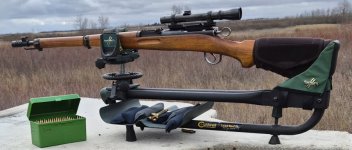
Shooting a K31

9.3 Hunter

CGN Ultra frequent flyer
Super GunNutz
Rating - 100%
497   0   1
Location
Yorkton
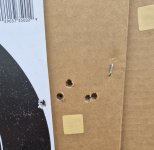
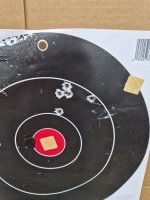
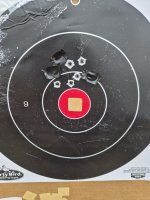
at the range yesterday 1st time shooting my K31. 175gr S&B. Sighted in ... have a old Weaver 4x with a post-recticle on it. So, shooting really tight has some limitations. The rifle does not disappoint - some pics attached. I can work on my shooting but the top of the post at 4x does take up about 3" at 100 yds, pretty consistent, so, these groups are really good ✔️ (tan patch is 3/4" square). I'll try it with a target scope next year, but, the idea is to shoot it with open sights or with the 4x ...
 

Attachments

  • 20251028_125748.jpg
    20251028_125748.jpg
    76.8 KB · Views: 26
  • 20251028_124359.jpg
    20251028_124359.jpg
    150.8 KB · Views: 25
  • 20251028_125355.jpg
    20251028_125355.jpg
    108.4 KB · Views: 20
  • 20251028_130146.jpg
    20251028_130146.jpg
    118.5 KB · Views: 26
GP11 is good ammunition, depending on the lot.

Given that most K31 types have seen anywhere from a bit of use to extensive use, depending on previous owners, accuracy would be dependent on the condition of the bore, bore measurements, GP11 lot.

I think you and your set up did a pretty good job shooting the groups in the pics.

I hand load for my K31 and Swiss K1911 rifles, and still have a decent shooting quantity of GP11, from an accurate, for my rifles, lot.

GP11 is no longer cheap, running at $120 for a 60 round pack, so hand loading is a very good option.

I do see the odd carton of GP11 being offered, but it's the last of the surplus. Switzerland is no longer selling their surplus on the markets, due to UN regs they've chosen to sign onto.

Norma and Lapua make very good brass, Graff is OK, and I had some Rottweil, scavenged from the scrap brass bucket at our range.

Any good .308 diameter bullets work well.

I had one K1896 type, that needed .310/.311 bullets to shoot well. The bore was sharp, as was the leade, but it wouldn't shoot .308 bullets well.

I sold it to a friend who was "almost" an exclusive Lee Enfield fan, and when he saw this rifle shoot, he had to have it. He shoots .314 powder coated cast bullets from it, and it's amazing.
 
Last edited:
I hand load for my K31 and Swiss K1911 rifles, and still have a decent shooting quantity of GP11, from an accurate, for my rifles, lot.

Norma and Lapua make very good brass, Graff is OK, and I had some Rottweil, scavenged from the scrap brass bucket at our range.

Any good .308 diameter bullets work well.
Since we're talking K-31's and reloading, what do you like for yours? I'm using 4064 and PRVI 150gr FMJ or 168gr Amax's. Accuracy is OK with iron sights and my crappy eyes, but I'm only seeing mid 2400's fps for velocity with the 168gr and near max loads from the Hornady 7th Ed. manual.


Mark
 
The load you're seeing is near max in manuals because they are being extremely careful, due to US liability rulings.

That load would still be safe in the 1896 rifle as a steady diet.

I no longer have any 1896 rifles, but when I did, I had cases set aside in well marked boxes, to indicate they were for those rifles and the little single shot trainer.

I have a stout load, which duplicates the Norma 180 grain, soft point, flat base bullet load, but I no longer have any Norm N204 powder.

I replaced it with IMR4350, which gives me appx 2650fps from both of my rifles.

IMR4320, H380, and H4831 are very close, but the accuracy is consistent with IMR4350.

52.0grains of IMR4350, over CCI 250 primers, in Norma cases, under 180 grain bullets. I have a large stash of surplus original, 174grain .309 diameter bullets, I bought through Century International back in the day. These bullets were made in Switzerland for the GP11 round and my load comes very close to duplicating it, with similar pressures.

I do not advise anyone to use this load. It's a proprietary recipe, for "my rifles use only." Don't even think about it for a Cadet rifle or an 1896.

I also have 150 grain and 120 grain loads I use, but they would be HOT and over max according to most manuals I've seen.

This is a great cartridge, very well designed, for the original powders used at the advent of the 20th century. It's still a very good design for use with components produced today.

I was tempted to build a turn bolt rifle based on this case, but didn't do it because it really doesn't have any advantage over other proven cartridges I have rifles chambered for already.

This cartridge and the rifles chambered for it get a lot of praise for their accuracy, and it's well deserved. That doesn't mean it's better.

In reality, it's a testament to the quality of the ammunition and rifles, built by the Swiss. Their quality control was excellent at every level.

I've spoken with Swiss civilian/military competitive shooters about this cartridge and the rifles it was made for.

They admitted, not all rifles were created equal, and neither were all batches/lots of ammunition.

One thing they did bring up, "when several shooters of equal capability were competing, it was the very slight difference between rifles, that determined who won the match."

It was also mentioned that some rifles preferred different lots of ammo over others.

So, just like Lee Enfields, Mausers, or any other military or commercial rifles, accuracy was a factor of a rifle in excellent condition, in the hands of a capable shooter, shooting ammunition tuned to the rifle.

No magic.

The Swiss straight pull rifles were built under peace time standards, to very stringent guidelines. Quality was always excellent, before a rifle would be released to the military or civilian militias.

I have some Kropatschek rifles, chambered for the 8mm Kropatschek cartridge. The rifles were built for Portugal, but other nations used them as well.

I'm going a bit off topic here, but only to make a comparison.

The Portuguese 1888 Kropatschek rifles were manufactured by Steyr of Austria. It was rumored that most of the production took place in Switzerland at the BERN factory. I've never seen anything to confirm this, but such things did happen then, just like now.

The fit, finish, chamber, and bore dimensions are so close on my rifles, I likely wouldn't be able to tell which rifle the fired cases came from, even with micrometer measurements.

Those rifles were built 130 years ago, with tech a bit older.

This certainly can't be said about other firearms built in that time period, other than finish and fit.

 
52.0grains of IMR4350, over CCI 250 primers, in Norma cases, under 180 grain bullets.
I have some IMR4350 for my 6.5Cr. Maybe I will do some testing with it in the K-31 as well. Good to know the book loads are way soft. I didn't go right to maximum, but I never saw any primer flattening, case marking or extraction issues with it and I was expecting they were just being well conservative.


Do you find you need the magnum primers?

As you say, they are lovely rifles. Superbly made as only the Swiss tend to do, with beautiful machining and top notch quality.


Mark
 
Primer flattening is a "poor indicator" to judge pressures by.

I have several different types of primers on hand, from three different North American manufacturers and three different European manufacturers.

From one lot to the next, primer hardness varies.

I've even had Remington #9 primers that were almost dead soft, and even with minimum loads, they flattened and cratered, same with Winchester, CCI, Norma, and Rotweil.

The best indicator is a "sticking bolt," one that's hard to pull back or lift. Usually, there will be impressions of bolt face features imprinted on the cartridge face.

Even that can change with different metallurgical mixes from manufacturers.

Some brands are very consistent, such as Norma and Lapua. Winchester, Remington, Federal, and Hornady, can be all over the spectrum.

One of the worst I've come across for hardness variances is PPU, but over the past ten years, the same can be said for all of them other than Lapua and Norma.
 
I enjoy shooting both my K11 and K31. I'll have to check my reloading journal for exacts, but I shoot cheap CamPro's 147gr FMJBT over 40.0gr IMR4064. I can get a ~3" group at 100 yards off a sandbag and irons which I am stoked about. I had to buy one of the new front sight posts from the US to get my K11 to shoot POA/POI at 100 yards

EDIT: checked reloading journal and confirmed load
 
Last edited:
I have some IMR4350 for my 6.5Cr. Maybe I will do some testing with it in the K-31 as well. Good to know the book loads are way soft. I didn't go right to maximum, but I never saw any primer flattening, case marking or extraction issues with it and I was expecting they were just being well conservative.

Do you find you need the magnum primers?

As you say, they are lovely rifles. Superbly made as only the Swiss tend to do, with beautiful machining and top notch quality.


Mark
Sorry for the delay in answering, just got back to this thread.

No, you don't need magnum primers.

Most milspec primers are hotter than "standard" primers. This is done to ensure consistent ignition with the powders they use, under all conditions, hot or cold, high or low elevation, to maintain the best accuracy/safety from their firearms.
 
That's a very mild load, should be great for plinking and paper. What are you seeing for velocity with that?


Mark

Following my Hornady manual it lists IMR4064 for 150gr bullets 35-46gr, so I'm about halfway or so on the load. I find it prints well enough on paper at 100 yards and no issue hitting steel at 200. Haven't had a chance to push it much further than that.

As far as velocity, I'm one of those reloaders that almost never shoots over a chrono. It's for no other reason than I don't enjoy packing it, assembling the sunshield, and setting it up. If I ever splurge on a Garmin or similar chrono I bet I would use it a lot more
 
Back
Top Bottom