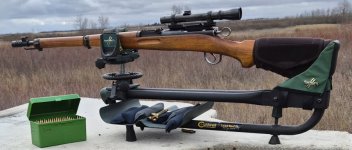
The load you're seeing is near max in manuals because they are being extremely careful, due to US liability rulings.
That load would still be safe in the 1896 rifle as a steady diet.
I no longer have any 1896 rifles, but when I did, I had cases set aside in well marked boxes, to indicate they were for those rifles and the little single shot trainer.
I have a stout load, which duplicates the Norma 180 grain, soft point, flat base bullet load, but I no longer have any Norm N204 powder.
I replaced it with IMR4350, which gives me appx 2650fps from both of my rifles.
IMR4320, H380, and H4831 are very close, but the accuracy is consistent with IMR4350.
52.0grains of IMR4350, over CCI 250 primers, in Norma cases, under 180 grain bullets. I have a large stash of surplus original, 174grain .309 diameter bullets, I bought through Century International back in the day. These bullets were made in Switzerland for the GP11 round and my load comes very close to duplicating it, with similar pressures.
I do not advise anyone to use this load. It's a proprietary recipe, for "my rifles use only." Don't even think about it for a Cadet rifle or an 1896.
I also have 150 grain and 120 grain loads I use, but they would be HOT and over max according to most manuals I've seen.
This is a great cartridge, very well designed, for the original powders used at the advent of the 20th century. It's still a very good design for use with components produced today.
I was tempted to build a turn bolt rifle based on this case, but didn't do it because it really doesn't have any advantage over other proven cartridges I have rifles chambered for already.
This cartridge and the rifles chambered for it get a lot of praise for their accuracy, and it's well deserved. That doesn't mean it's better.
In reality, it's a testament to the quality of the ammunition and rifles, built by the Swiss. Their quality control was excellent at every level.
I've spoken with Swiss civilian/military competitive shooters about this cartridge and the rifles it was made for.
They admitted, not all rifles were created equal, and neither were all batches/lots of ammunition.
One thing they did bring up, "when several shooters of equal capability were competing, it was the very slight difference between rifles, that determined who won the match."
It was also mentioned that some rifles preferred different lots of ammo over others.
So, just like Lee Enfields, Mausers, or any other military or commercial rifles, accuracy was a factor of a rifle in excellent condition, in the hands of a capable shooter, shooting ammunition tuned to the rifle.
No magic.
The Swiss straight pull rifles were built under peace time standards, to very stringent guidelines. Quality was always excellent, before a rifle would be released to the military or civilian militias.
I have some Kropatschek rifles, chambered for the 8mm Kropatschek cartridge. The rifles were built for Portugal, but other nations used them as well.
I'm going a bit off topic here, but only to make a comparison.
The Portuguese 1888 Kropatschek rifles were manufactured by Steyr of Austria. It was rumored that most of the production took place in Switzerland at the BERN factory. I've never seen anything to confirm this, but such things did happen then, just like now.
The fit, finish, chamber, and bore dimensions are so close on my rifles, I likely wouldn't be able to tell which rifle the fired cases came from, even with micrometer measurements.
Those rifles were built 130 years ago, with tech a bit older.
This certainly can't be said about other firearms built in that time period, other than finish and fit.














































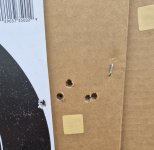
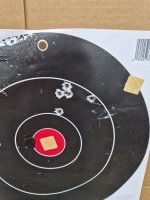
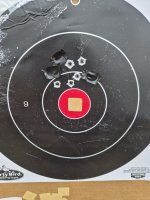
 (tan patch is 3/4" square). I'll try it with a target scope next year, but, the idea is to shoot it with open sights or with the 4x ...