.303 British Brass

peterdobson

CGN Ultra frequent flyer
Business Member
Rating - 100%
109   0   0
Location
Halifax
Between PRVI and Sellier and Bellot, which is higher quality?

Due to efforts of Al Mutch, Terry Miller and Sean Crosby, .303 matches are being resuscitated at AV, as well as at Bull Meadow.

Shooters are looking for brass.

Regards,

Peter
 
I've had problems with S&B brass in 6.5 Swede and 7.62X39, but never with the PPU stuff. I haven't loaded the .303 stuff since I have a lot of WWII and IVI Canadian brass.
 
Both brands work well. About the same life span. Most of my shooting is done with cast so cases last a long time, over 35 reloads. I fully resize as I use them in multiple rifles.
Local 303 shoots I could be interested in. I am assuming full wood and original sights. I have a few to choose from. More information on the matches would be appreciated.
 
Snider shooter, thanks for info and please email us at info@hirschprecision.com and we will get you on the contact list

A good deal of the match was discussion with enthusiasts/collectors as well as shooters. Great fun and interesting.

NSRA matches are at 200-600m and there are classes.

There will be 303 shooters at the NSRA Open section on scheduled Sundays @100M, perhaps longer ranges.

We will get you on the contact list.

Regards,

Peter
 
Prvi .303 brass is basically the same as old mk7 ball brass. It does not have the groove above the rim like American made brass. If you use the oring trick and neck size prvi brass will last a long time Anneal every few firings.
 
Prvi over s&b any day. My use case is likely an outlier, but prvi works better in full auto from a Lewis and lasts longer... S&b gets split necks sooner.

Also, s&b is owned by the cz group. I'm not buying their stuff because of their support for the buyback through colt canada.

I prefer ivi if I can get it, but I know it's only available occasionally as once fired.
 
Be careful with random source once fired brass fired in Lee Enfield rifles. I acquired a good quantity of brass fired in issue No. 4 rifles. Not miscellaneous surplus rifles, but issue ones. Before reloading, I check for incipient separations. Cull rate approaches 20%.

There has been lots written about reloading .303 and Lee Enfields. Headspace is a factor. So are chamber dimensions. Rim thickness variation from manufacturer to manufacturer. Thin rims plus headspace toward the maximum limit is not a good combination.

Loading for a II** Ross target rifle is entirely different than loading for a Lee Enfield. I have found that cases fired in a No. 4 and full length resized will not chamber in the Ross. Had to make a die to reduce the case diameter back toward the base.

The Sierra 174grMKs are excellent bullets. It is too bad they are boattailed, and not flat based.
 
Be careful with random source once fired brass fired in Lee Enfield rifles. I acquired a good quantity of brass fired in issue No. 4 rifles. Not miscellaneous surplus rifles, but issue ones. Before reloading, I check for incipient separations. Cull rate approaches 20%.

There has been lots written about reloading .303 and Lee Enfields. Headspace is a factor. So are chamber dimensions. Rim thickness variation from manufacturer to manufacturer. Thin rims plus headspace toward the maximum limit is not a good combination.

Loading for a II** Ross target rifle is entirely different than loading for a Lee Enfield. I have found that cases fired in a No. 4 and full length resized will not chamber in the Ross. Had to make a die to reduce the case diameter back toward the base.

The Sierra 174grMKs are excellent bullets. It is too bad they are boattailed, and not flat based.
I want to double like this ^

I'm having the same issues reloading for a Lewis MG. Brass fired in an issue enfield will often not size down enough to chamber in a Lewis same as in a Ross.
 
S&B is alright for a second firing, but I ditch it after that. Ppu, FC, Rem, and HXP have all worked out well for quite a few reloadings. HXP can actually go a long time. Very thick.
 
Thanks mkmel,

Peter
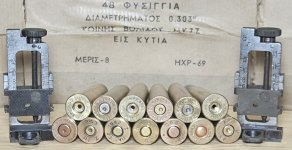
I invested a good many hours going through samples of domestic brass versus a fair number of samples of Mk VII ball from Commonwealth arsenals from 1940s through 1960s. And some Greek HXP circa 1968 that I had left over from when it was available in dirt cheap crates back in the early 1990s.
20250503_214417.jpg

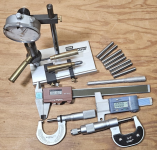
I've posted the results here and there in a few places with the tables of measurements, weights, volumes, etc. I only had a dozen cases through that range from various arsenal, but I assumed that was close enough to compare weight, volume and rim thickness in particular.
1768985670886.png

The short version is that Privi Partizan cases are the closest in all respects to military ball cases from the 1940s through to the 60's. None of the other commercial stuff I measured from Remchester et al was close.

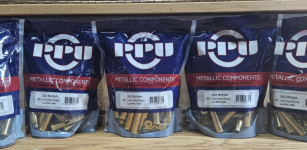
You will probably find PP available in plastic sealed bags; each bag has a lot number stamped on it. If you're going to do something like buy in bulk as I did with 500 to last a long time, I good retailer will agree to ensure the bags you get are all the same lot number.
1768985824272.png

Doing that may not make any difference, but if you take care of all the little things, that helps. I'm aware that the arsenal specs for the rifles and ammunition leave us with around 4 MOA as being at the better end of the military arsenal expectations. James Sweet in his books on fullbore competition with the LE rifles wrote that a competitor with a 2.5 MOA capable rifle had a very good piece of kit.

To address case life, there's O-rings and those approaches. I go beyond that and create a false shoulder on each shoulder so that I not only have support at the rim/bolt face, but the front of the case is centered in the chamber by contact with the false shoulder.
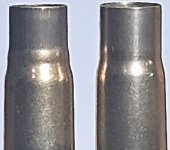
5-74.1.JPG

There are a few additional steps required to do this, but it's a one time operation in preparing a new batch of brass. The only piece of special tools is a Lyman .33 neck expanding M die.
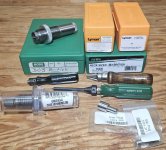
20250503_224417.jpg

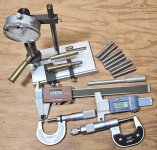
I start with prepping the new brass by uniforming flash holes, primer pockets and turning all the new brass to the same length for consistency.

I run all the brass through the M die to expand the case necks. Then start running the case into a full length sizing die, start with having ran the case about 1/3 of sizing down the neck. Try chambering the case; it won't completely chamber, hanging up before the bolt handle will turn down. Take the case out, screw the sizer down a bit and try again.

Keep repeating this until you can chamber the case with a light crush fit. You now have a case that is as centered in the middle as good as possible and supported both at the back and the front. On first firing, the only way the case can expand/stretch is radially outwards while centered in the chamber. The stretching at the base that can quickly kill cases isn't going to happen.

Do a few more of your batch of cases to ensure they have the same fit on chambering. After confirming that, do the remaining of your batch of cases and you're done.

For your resizing for that point on, I use a Lee Collet die as I prefer not dragging the neck expander ball through the case necks. I don't know if it makes a difference, but more taking care of the little things hoping they add up to a pay off. But by minimally working only the neck and not the case body each time, you will increase case life. Eventually you will have to get your lot of cases a light shoulder pump when chambering starts getting too tight.

The additional step I take is annealing the case necks with an alcohol lab lamp each time I reload. It does take a little extra time but I give each case a quick inspection any way. I do the simple method of rolling the shoulder/neck in the lab flame with the case rolling between my fingers and thumb until getting uncomfortable to hold. It's not the most precise way of doing it, but it is good enough for my purposes.

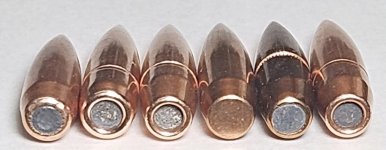
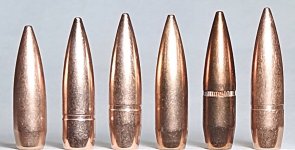
As for bullets, in addition to Hornady and Sierra offering their 174 grain loads, Privy Partisan also offers a bit of a range of bullets similar to the Mk VII in both weight and design. In the photos below, the closed base in the center is the Sierra, the one to it's right is the Hornady, and the remainder are PPs with different weight differences.

Within that range should be something that groups for you, all things being equal

20251008_225218.jpg

20251008_225945.jpg
 

Attachments

  • 20250503_222110.jpg
    20250503_222110.jpg
    183.7 KB · Views: 3
Rick:

Your work is educational and beneficial. I will file and disseminate to those interested.


Thanks and Regards,
Peter
 
Last edited:
Back
Top Bottom