How many times can anneal before use?

bigHUN

CGN frequent flyer
Rating - 100%
3   0   0
Location
Aurora/ON
Lapua W308 brass, reloading for target scoring only shooting.

Just happened that 2x100 empty brass shells came with a gun, I don't know the previous history on these.

In two occasions I sent away these two batches for annealing, I load each of these and shoot each sets.

I have learned big inconsistencies when sizing neck OD and ID also siting the bullets.

Couple months ago I finished preparing one batch to reload, but in mean time I built an induction annealer for diy and finally ready to use.

I am ready to start prepping the new-second batch,
and tinkering now about re-annealing all the brass with my new machine to a same.

Theoretically I want to take a control and instead having multiple groups of batches I would like to make all the same. Less clutter and lesser keeping a track about things.
New temperature and new timing. I am targeting 500+ C, the 1000F=535C Tempilaq was ordered I would expect it is in a mail.

Can I alter the crystal structure homogenized with multiple annealing all the brass shells?

Anybody can chime in?
 
Last edited:
Pretty sure brass that has been annealed but not loaded and fired can be re annealed with no ill effects
I’ve done it with pistol brass and some old rifle brass and didn’t notice any difference
 
So Big Hun - how did you decide on the 500 C brass annealing Temp ? and for how Long to anneal them for ? :unsure:

WHAT science lead you to this ? :unsure:
Many sources claiming 500-550 C is a best mid point for annealing brass shells, the internet is full with data.
I've read about on several shooters forums dated to way back, also some here @ CGN.

I don't know personally, but I got the equipment ready to test this out.

Pretty much I don't care for exactly what Temp, I built this induction annealer and it is a real beast. Just by testing it during built I melted couple samples. The timing is again irrelevant to me, 3 or 4 or 6 seconds doesn't really concern's me, I am retired :) .

From tools I am exclusively using Wilson dies, also have two digital force meters. If this winter lasts long enough I may make a new bullet siting press with a stepper motor/leadscrew for consistent sitting speed. But for now it is just an idea ...
 
Last edited:

big Hun " Pretty much I don't care for exactly what Temp, I built this induction annealer and it is a real beast. Just by testing it during built I melted couple samples. The timing is again irrelevant to me, 3 or 4 or 6 seconds doesn't really concern's me "

So ALL brass is the same and temp doesn't matter ? and the lenght of time annealing doesn't matter either ? Carry ON ! :p
 
big Hun " Pretty much I don't care for exactly what Temp, I built this induction annealer and it is a real beast. Just by testing it during built I melted couple samples. The timing is again irrelevant to me, 3 or 4 or 6 seconds doesn't really concern's me "

So ALL brass is the same and temp doesn't matter ? and the lenght of time annealing doesn't matter either ? Carry ON ! :p
I think you’re colourfully changing what bighun is meaning. His “time doesn’t matter “ isn’t referring to the actual annealing time but rather he’s retired and time is no consequence to him. He is also only reloading Lapua 308 and I didn’t see him say that temperature didn’t matter. He also mentions ordering tempilaq so obviously temperature is on his mind!. I think the annealing craze of late has gotten blown way out of proportion. I remember when I was young watching old friends of my father annealing brass in a dimly lit room. I use to like watching them turn that orange tint and the sound of the torches. Cortina has some interesting videos on annealing. Not everyone can have an AMP. They’re the best I’ve seen and super easy to use. A lot of propane bottles can be bought for $2800
 
So ALL brass is the same and temp doesn't matter ? and the lenght of time annealing doesn't matter either ? Carry ON ! :p

:) just don't flip it. I will do the ladder test.

Many people have the AMP annealer, but no one talks about what Temp they annealing. The AMP is doing something inside automatically and the screen has a Play Pause and the Stop.
Yes this very convenient.

As I said earlier, two guys were doing AMP annealing for me, and I feel the differences within the batches by my muscle memory..
So I collected my instruments to measure, for now measuring the force manually, but maybe a motorized arbour press will be the next project.
I am not rich and mad enough to shovel out $2.5K USD for AMP.

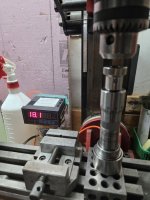
20250330_110348.jpg
 
No disrespect, but I'm curious.....
How tight are your groups that you expect improvement with this (seeming) obsession with measuring seating force?
 
No disrespect, but I'm curious.....
How tight are your groups that you expect improvement with this (seeming) obsession with measuring seating force?
I have learned that the seating force variations effects the ES/SD.
I've been doing reloading for 300 meter rings so far, ten shot groups averaging between 0.453 and 0.354 collected through multiple days over the last year season. No cherry picking.
Now I am focusing on next steps in f-class.
 
Theoretically I want to take a control and instead having multiple groups of batches I would like to make all the same. Less clutter and lesser keeping a track about things.
New temperature and new timing. I am targeting 500+ C, the 1000F=535C Tempilaq was ordered I would expect it is in a mail.

Can I alter the crystal structure homogenized with multiple annealing all the brass shells?

You can anneal all your cases and it will not harm them in any way, but it likely also will not make them all the same.

You said you sent the brass out for annealing, that service was probably performed using an AMP machine. As you pointed out yourself, the user is not intended to have any role in, or even knowledge of, the process parameters in using an AMP annealer. AMP programs the machines to anneal to a hardness of 95 HV, for reasons they have never explained. My own testing has indicated that it takes a full recrystallization anneal and substantial grain growth to get brass this soft, which requires temps up around 700°C to achieve in a short time.

It is a basic rule that once a material has been heat treated at a certain temperature, further or repeated heat treatments at lower temperatures will have no effect until the material has been worked to some degree. So if you take your brass that was previously AMP'd to 700C, and anneal it in your homemade induction unit at 550C, you will do nothing to it. If you take brass that was not previously AMP'd and anneal it in your homemade induction unit at 550C, that brass will be fully stress relieved, and might have some first nucleates of recrystallization, but will not have the same structure as the fully recrystallized brass that was done by AMP.

Whether or not that microstructural difference will have any impact on your velocity or accuracy, I can't say.
 
...AMP programs the machines to anneal to a hardness of 95 HV, for reasons they have never explained. My own testing has indicated that it takes a full recrystallization anneal and substantial grain growth to get brass this soft, which requires temps up around 700°C to achieve in a short time.

... So if you take your brass that was previously AMP'd to 700C, and anneal it in your homemade induction unit at 550C, you will do nothing to it. ...
Thanks for this,
I didn't know that AMP programming works on 700 C. Most people always talking about 700 F (or much lower), and this was a confusing.

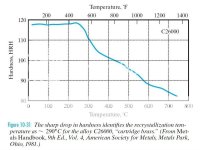
Based on that Celsius vs Fahrenheit confusion I decided working around the Temp (1000F=535C) based on this graph :

c26000annealing.jpg
 
You can anneal all your cases and it will not harm them in any way, but it likely also will not make them all the same.

You said you sent the brass out for annealing, that service was probably performed using an AMP machine. As you pointed out yourself, the user is not intended to have any role in, or even knowledge of, the process parameters in using an AMP annealer. AMP programs the machines to anneal to a hardness of 95 HV, for reasons they have never explained. My own testing has indicated that it takes a full recrystallization anneal and substantial grain growth to get brass this soft, which requires temps up around 700°C to achieve in a short time.

It is a basic rule that once a material has been heat treated at a certain temperature, further or repeated heat treatments at lower temperatures will have no effect until the material has been worked to some degree. So if you take your brass that was previously AMP'd to 700C, and anneal it in your homemade induction unit at 550C, you will do nothing to it. If you take brass that was not previously AMP'd and anneal it in your homemade induction unit at 550C, that brass will be fully stress relieved, and might have some first nucleates of recrystallization, but will not have the same structure as the fully recrystallized brass that was done by AMP.

Whether or not that microstructural difference will have any impact on your velocity or accuracy, I can't say.


From AMP ;

700C is way too hot for repeat reloading applications. 550C is ballpark correct. 700C will take the hardness down to dead soft (60 HV or so) which is nor desirable. He is also correct about re-working the brass.

FYI, Petersons and Alpha have our annealers, and they are very happy with them. They also have their own metallurgy labs.
 
Still waiting for the 535C=1000F Tempilaq.
In meantime I did the ultrasonic wash with SimpleGreen, drying the brass right now. The inside looks shiny now :)
Good ! I’m gonna try simple green to day to wash brass with my Frankford rotary machine .
I always use Dawn and LeminShine now but what the heck 🤷‍♂️
 
This discussion has been repeated, as has the information, several times on this site.

In the case of this particular subject, that's a good thing, IMHO.

I've mentioned before, I have several hundred very old Dominion Cartridge Co. 30-06 cases with at least 100 reloads on each case, and they are still going strong.

Over 50 years ago, I managed to purchase a 2000 lot of DCCo. headstamped 30-06, factory over-run brass.

It was rumored that many of the DCCo cases were manufactured by Norma at that time, but who knows?

Over the years, I gave many of those cases away, still untouched, to new handloaders, or just lost them on hunts, etc.

I re-anneal these cases after four or five reloads, or when the cases do not have the desired ductility, while resizing.

I will admit, they've been fired through rifles cut with the same chamber reamer most of the time, or specific rifles. I separate the brass for each rifle so that I can neck resize or partially resize only.

I put the cases into my oven at its highest temperature setting 520F/270C, for 15 minutes, then allow to air cool. I was dumping them in water, but it may have been hardening them. Only takes an extra half hour to air cool.

I wouldn't advise this method if you are annealing MAGNUM cases or loading to extreme pressures.

It works, and it's safe, under the conditions I load/shoot.
 
Good ! I’m gonna try simple green to day to wash.............
I am using SimpleGreem for a while, to wash my 3d printed parts, finishing with IPA with water baths after each step.
Earlier years I tried many other juice with less friendly results.
I just got a new fresh jug of SG from HD, I was shocked by latest prices. Worth to look around for better price, but the SG is definitely a good ordinary cleaner just for anything.
 
Back
Top Bottom