Thank you for your comments and advice. I appreciate it.
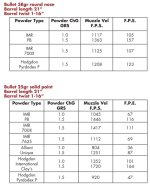
The Hodgdon chart is indeed informative. I've seen it recently, but with the added missing information that the length of the barrel Hodgdon used is 24". I would imagine that Hodgdon provided this information for people like me who'd like to "go subsonic" for one good reason or another.
But try to find other data for Titegroup being used in 223-calibre firearms with barrels under 24". Check out Hodgdon's pistol section and you'll see that there is nothing for Titegroup, but maybe I'm wrong on that and you can find some. If you do, please let me know.
I refer back to what I wrote about Titegroup being a fast-burning powder with Hodgdon's unstated intention that it be used primarily in pistols. One of the few 223 Rem.-caliber hand guns that I can think of was the venerable Remington XP 100 bolt-action hand gun that had barrel lengths of
up to 14". In my youth I wanted to own the then-recently released XP 100 very badly, but never did and, nowadays in Canada, certainly never will.
My understanding is that the generally accepted principle in reloading is that slower-burning powders should be selected for rifles having barrels consideraly longer than 9.5" and, when that is done, the length of time that it takes all the powder to burn should be at least somewhat close to the time that the projectile takes to travel the rifled distance of the barrel. Am I wrong on this? This is why I asked, when using a fast-burning powder, does the-longer-the-length of the barrel mean the faster the muzzle fps or the slower the muzzle fps?
If all the Titegroup has burned when the bullet has travelled only half way down a long barrel, even though there still may be pressure being exerted on the bullet as the hot gas still conitnues to expand in volume, at some point that pressure will be reduced to a point where the bullet will be "on its own" and, after that, I would imagine that the remaining rifling will reduce its speed. Taken to the extreme for illustration, if the barrel is extremely long, every shot will be a squib no matter how slowly the powder that completely fills the 223 case behind the bullet burns --in other words, the 223 case cannot hold enough powder to push the 223 bullet out of a barrel that long.
I believe that this is the reason that the only 223 data that Hodgdon publishes for Titegroup is for a rifle that has a 24" barrel -- they don't want to publish data the might possibly cause a squib in a firearm that has a 24" barrel. For an even lower fps in a 24" barrel, the even-fewer grains of Titegroup required would take up such little space available in the case that other combustion factors may come into play that just might cause a squib. I'm far less concerned about that happening in my gun's 9.5" barrel. Using less than 3.5 grains of Titegroup is going to mean even
less than 14,400 psi chamber pressure, which is already relatively low. Therefore, nothing unsafe can happen as I do my little experiments, unless one considers a 55 grain squib in a 9.5" barrel to somehow be unsafe, which I don't. (I already have a brass rod for squib removal should that happen.)
In the case of my "rifle" that has a 9.5" barrel (more like an XP 100 hand gun than a long gun, which is
precisely why I bought another firearm at my advanced age), if commercial 223 ammo is used, there is a bright ball of fire immediately after the bullet leaves the barrel. I understand that this flash is unburned powder that burns in the air beyond the muzzle. I think that this is wasteful and, additionally, might very well disturb nearby shooters at the range which I do not want to do at my age. I'm reloading to try to eliminate this waste and flash as much as possible, and at the same time reduce the gun's report considerably. (However, whenever I go to the range I'll take along some cartridges that are either commerical or I've reloaded to be about the same as commercial, so that I can occasionally get that big blast experience that will instantly remind me and others that I'm not shooting a 22 rimfire.)
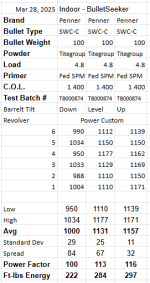
Anyway, I did/do realize that a 38 grain 22LR bullet was/is 17 grains lighter than a 55 grain .224" bullet, but that 22LR chart did make me wonder if the 3.5 grains of powder that I'm using might be overkill for my purposes. The Hodgdon chart did make me believe that I was probably "in the neighborhood" to where I wanted to be, but, one way or another, I'll find out with a fair degree of certainty exactly where I am.
In closing, I do not "believe the same engine that makes a civic go 0-60 in 8 seconds should do the same in a crown vic" (unless it's highly modified

).
Again, thanks for the advice. I appreciate it.

















































 You’re treating them as interchangeable because of one shared property.





















