Subsonic .223 with Titegroup

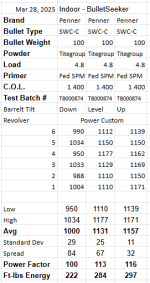
They were shot through a Power Custom modified PPC revolver that's based on a S&W K frame. It's a 6" bull barrel with Whichita 4 position rear sights. There's a noticeable difference in sound between the 1.8gr inset loads and the 3.2gr 1.4" COL loads. Factory loads are much louder, but don't group well at 50y.

Our shop reloading guy mentioned Titegroup so I ran a test on that as well. Didn't have any background on 38sp light loads with Titegroup, so I just used the min charge weight. My retirement gig is managing an indoor shooting range, so I have fun testing stuff in the off hours :p

1770319515253.png
 
They were shot through a Power Custom modified PPC revolver that's based on a S&W K frame. It's a 6" bull barrel with Whichita 4 position rear sights. There's a noticeable difference in sound between the 1.8gr inset loads and the 3.2gr 1.4" COL loads. Factory loads are much louder, but don't group well at 50y.

Our shop reloading guy mentioned Titegroup so I ran a test on that as well. Didn't have any background on 38sp light loads with Titegroup, so I just used the min charge weight. My retirement gig is managing an indoor shooting range, so I have fun testing stuff in the off hours :p
So the Titegroup powder mostly located at the bullet end of the brass is still significantly less "efficient" at the time of firing than the powder located mostly at the primer end of the brass. The efficiency of the powder being evenly spread across the bottom of the brass (when brass is in horizontal position) is significantly closer to that of the powder being mostly at the primer end than the bullet end.

My takeaway from your data is to, before shooting a reduced-load rifle round (I don't own a handgun), give the cartidges a bit of a jiggle with the round pointing upward before inserting it into the magazine or chamber. That way much of the powder should be located at the primer end at the time of firing. At the range or in the field, with rounds already in either the chamber or magazine, a quick tilting upward of the gun and a bit of shake before shooting should do the same (I would think). At the range, it would be best to keep the cartridges sitting upright on the primer-end of the case rather than rolling around on a table, or, worse still, pointed downward in a box.:)

Thanks again for the great data.
 
Last edited:
When I first started playing around with subsonic loads for my .308 I used pistol powders and used cotton balls as a filler and ensure the powder stayed at the bottom of the casing and in contact with the primer. From my research using small amounts of powder in a relatively large case could result in a secondary explosion.

I bought some Trailboss which allowed me to fill the cases more. Unfortunately there is no more Trailboss to be found anywhere.

I have a 12.5 inch barrel 300 Blackout and I've had great success with H110 for subsonic and supersonic loads.
Do you mind PMing me some of your 300 BLK successes?
I have had way better results with subs in my 20" 308 than in my 16" 300BLK which I bought specifically to run subs.
I have really only tried CFE 223 so far but was planning on some Titegroup testing.
 
So the Titegroup powder mostly located at the bullet end of the brass is still significantly less "efficient" at the time of firing than the powder located mostly at the primer end of the brass. The efficiency of the powder being evenly spread across the bottom of the brass is significantly closer to that of the powder being mostly at the primer end than the bullet end.

My takeaway from your data is to, before shooting a reduced-load rifle round (I don't own a handgun), give the cartidges a bit of a jiggle with the round pointing upward before inserting it into the magazine or chamber. That way much of the powder should be located at the primer end at the time of firing. At the range or in the field, with rounds already in either the chamber or magazine, a quick tilting upward of the gun and a bit of shake before shooting should do the same (I would think). At the range, it would be best to keep the cartridges sitting upright on the primer-end of the case rather than rolling around on a table, or, worse still, pointed downward in a box.:)

Thanks again for the great data.
Testing results is fun! For the handgun calibers I've tested, it appears to be directly related to case fill. Big case volume like a 1.4" COL 38sp shows a lot of variance depending on powder position.. Smaller cases like 9mm show a smaller variance. Magnum primers vs standard primers makes a difference in variance. Crimp would make a difference too, but too much crimp affects bullet accuracy, so I leave that one alone once I find a good crimp. Just started shooting precision .223 and having fun starting load workups for it. Definitely different variables between handgun & rifle reloads :)
 
VanMan, just a suggestion of a test that may interest you. The next time you create some reduced energy loads, after you pour in the powder, insert an appropriately sized piece of cotton ball (as homer76 does) to fill in the empty space and keep the powder at the primer end? Then, after you install the projectile, do the up, down, level test and see if there's still any difference in efficiency between the three? Maybe there won't be. And maybe reducing the COL will no longer make any difference, either.

Thanks.(y)
 
VanMan, just a suggestion of a test that may interest you. The next time you create some reduced energy loads, after you pour in the powder, insert an appropriately sized piece of cotton ball (as homer76 does) to fill in the empty space and keep the powder at the primer end? Then, after you install the projectile, do the up, down, level test and see if there's still any difference in efficiency between the three? Maybe there won't be. And maybe reducing the COL will no longer make any difference, either.

Thanks.(y)
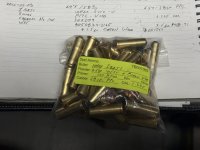
was doing up some practice target loads, so did 48 rounds with 1.5gr of cotton ball wadd on top of the powder. Will do the powder position sensitivity test later on this week, and do some accuracy testing to see if the any fouling from the cotton ball has any negative effect.
IMG_0910.jpeg

IMG_0911.jpeg

IMG_0912.jpeg
 
I'm not doing 223 but using Tightgroup in 45-70 with good results.
I dont use any filler, and I believe Hodgson didn't recommend using filler with Tightgroup either. I haven't had issues with it. 11gr in a big case. Nice cheap load that is fun to shoot.
 
I'm not doing 223 but using Tightgroup in 45-70 with good results.
I dont use any filler, and I believe Hodgson didn't recommend using filler with Tightgroup either. I haven't had issues with it. 11gr in a big case. Nice cheap load that is fun to shoot.
The 45-70 has a huge case. What percentage of the case do you estimate that the 11gr fills?

Thanks
 
Last edited:
The 45-70 has a huge case. What percentage of the case do estimate that the 11gr fills?

Thanks
Maybe 15%, I'm extremely careful doing these loads. I do use my 550 press but only one round at a time. Weigh each charge. I've shot around 200 or so with no problems.

Really cheap shooting with the Campro 405gr bullets.
 
Maybe 15%, I'm extremely careful doing these loads. I do use my 550 press but only one round at a time. Weigh each charge. I've shot around 200 or so with no problems.

Really cheap shooting with the Campro 405gr bullets.
I've never fired a 45-70, but I would imagine that accelerating a 405gr (wow!) projectile must produce quite a recoil. How do the fps and recoil of your custom rounds compare to the fps and recoil of commercial rounds?

Thanks.
 
I've never fired a 45-70, but I would imagine that accelerating a 405gr (wow!) projectile must produce quite a recoil. How do the fps and recoil of your custom rounds compare to the fps and recoil of commercial rounds?

Thanks.
There are 3 levels of 45-70 loads aside from subsonic. Trapdoor, modern lever , and ruger #1.

These subsonic rounds are light recoil. My lever with IMR 4198 is much more recoil. Subsonic is around 955fps. Lever probably 1600fps. Not punishing, my lever absorbs recoil well.

I shot a bison with my 1885 winchester, 1400fps with 405gr. I dont see the need to push 45-70 fast. Its very effective with lower velocity. This would be close to an original 45-70 load.
 
I'm back here again because I now have the firearm I previously mentioned in a post when I resurrected this thread on January 19 of 2026:

https://www.canadiangunnutz.com/forum/threads/subsonic-223-with-titegroup.1867224/post-21102109

I have also recently purchased the Lee Loader Classic 223 Remington that I also mentioned in that post, as well as one lb of Titegroup, some Campro 55 gr FMJ and some Campro small rifle primers. Yesterday I reloaded 87 once-fired Winchester brass with 3.5gn of Titegroup. (Reloading those cartridges turned out to be a lot of fun because it was my first experience in reloading. :) I believe that by round number 87 I was creating finished rounds at a rate of around one per minute, including measuring the OAL of each round, which I think is pretty decent.)

Unfortunately I have not yet been to the range to fire any of my rounds, but I'll go there soon. (Life sometimes interferes with the best laid plans.)

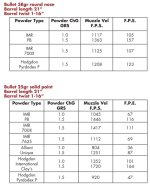
Anyway, today I noticed a very interesting video published by a company that makes 22LR reloading kits. (It's mentioned in a recent thread in the "Reloading" forum.) Below is a screen capture of the part of the video that I found most interesting and I think that it is relevant to this thread's topic.

Notice that, according to the chart, it takes only 1.5 grains of Hodgdon Pyrodex P (a powder that is similar in density to Titegroup) to push a 38-grain bullet out of a 21" barrel to get 1,208 fps and 123 fpe. After reading that, I can't help but wonder how little Titegroup it would take to push a 55gn bullet out of a 9.5", 1:8 barrel at 900 or 1,000 fps. (Again, I'll be shooting at paper targets at a distance of, at most, 40 yards, at an indoor range, so above 1,000 fps is really unnecessary, IMO.)

Titegroup is apparently a fast-burning powder designed primarily for pistols. Does this particular property mean that the longer the barrel, the faster the muzzle velocity or, because Titegroup burns "too fast", the longer the barrel, the slower the muzzle velocity?

Unfortunately I do not have a chronograph. I suppose I could use penetration in layers of plywood to estimate fps, but setting this up at the indoor range may be difficult or impossible.

The original poster, dirtybarry, mentioned the following in his first post:

"Slight bit of drop (3/8"ish) compared to 24.0 grains of Benchmark and the same bullet at that distance" (25 yards).

For the moment let's assume that a 55 grain bullet will be traveling at approximately 3,000 fps at 25 yards when propelled by 24 grains of Benchmark powder. According to Google AI, if that shot had been fired from a perfectly level barrel, the bullet would have dropped only about 0.12 inches at that short distance at such a high speed (the bullet travels that distance in only 0.025 seconds, which is the length of time that the bullet has to drop under the force of gravity).

If the Titegroup round dropped only an additional 3/8 inch (also assuming the perfectly level barrel), this would equal a total drop of 0.12" + 0.375" = 0.495" at 25 yards.

According to Google AI, a bullet that dropped 0.495 inches in a distance of 25 yards must have been travelling at an average speed of approximately 1,481 fps.

So we can fairly safely conclude that using 3.1 grains of Titegroup gives a 55 grain bullet an average speed of approximately 1,481 fps over a distance of 25 yards.

Again, I charged my brass with 3.5 grains of Titegroup. Dirtybarry also did not mention the length of his rifle's barrel. Again, my "rifle" has a 9.5" barrel. I have a hunch that my rifle's muzzle velocity might be considerably higher than 1,481 fps.

According to Google AI, "at 1500 fps, a sharp-pointed 223 FMJ bullet has enough energy to pass through roughly two to three 3/4-inch sheets of plywood". At least this provides me a rough starting point for estimating fps. Then maybe I can start lowering the grains of Titegroup to reach 900 to 1,000 fps.

22LR charges.jpg
 
https://hodgdonreloading.com/rldc/

Go here (hodgdon reloading) and look for your load, or similar, and it will show this. As for addressing your other lines of thought, regarding 22 rimfire needing X amount of powder, therefore 223 should need X amount of powder to do the same, stop your line of thinking and read up on reloading. There is no logic to your thought, unless you believe the same engine that makes a civic go 0-60 in 8 seconds should do the same in a crown vic.

Bullet: 55 GR. WIN FMJ-BT

Diameter: 0.224"

Case: Winchester

Primer: Winchester SR, Small Rifle
black_open.png

Starting LoadMaximum LoadAvailability
ManufacturerPowderC.O.L.Grs.Vel. (ft/s)PressureLoad Density %Grs.Vel. (ft/s)PressureLoad Density %
HodgdonTitegroup


2.195"N/A3.61,06514,400 PSIN/A
 
https://hodgdonreloading.com/rldc/

Go here (hodgdon reloading) and look for your load, or similar, and it will show this. As for addressing your other lines of thought, regarding 22 rimfire needing X amount of powder, therefore 223 should need X amount of powder to do the same, stop your line of thinking and read up on reloading. There is no logic to your thought, unless you believe the same engine that makes a civic go 0-60 in 8 seconds should do the same in a crown vic.

Bullet: 55 GR. WIN FMJ-BT

Diameter: 0.224"

Case: Winchester

Primer: Winchester SR, Small Rifle
black_open.png

Starting LoadMaximum LoadAvailability
ManufacturerPowderC.O.L.Grs.Vel. (ft/s)PressureLoad Density %Grs.Vel. (ft/s)PressureLoad Density %
HodgdonTitegroup


2.195"N/A3.61,06514,400 PSIN/A
Thank you for your comments and advice. I appreciate it.

The Hodgdon chart is indeed informative. I've seen it recently, but with the added missing information that the length of the barrel Hodgdon used is 24". I would imagine that Hodgdon provided this information for people like me who'd like to "go subsonic" for one good reason or another.

But try to find other data for Titegroup being used in 223-calibre firearms with barrels under 24". Check out Hodgdon's pistol section and you'll see that there is nothing for Titegroup, but maybe I'm wrong on that and you can find some. If you do, please let me know.

I refer back to what I wrote about Titegroup being a fast-burning powder with Hodgdon's unstated intention that it be used primarily in pistols. One of the few 223 Rem.-caliber hand guns that I can think of was the venerable Remington XP 100 bolt-action hand gun that had barrel lengths of up to 14". In my youth I wanted to own the then-recently released XP 100 very badly, but never did and, nowadays in Canada, certainly never will.

My understanding is that the generally accepted principle in reloading is that slower-burning powders should be selected for rifles having barrels consideraly longer than 9.5" and, when that is done, the length of time that it takes all the powder to burn should be at least somewhat close to the time that the projectile takes to travel the rifled distance of the barrel. Am I wrong on this? This is why I asked, when using a fast-burning powder, does the-longer-the-length of the barrel mean the faster the muzzle fps or the slower the muzzle fps?

If all the Titegroup has burned when the bullet has travelled only half way down a long barrel, even though there still may be pressure being exerted on the bullet as the hot gas still conitnues to expand in volume, at some point that pressure will be reduced to a point where the bullet will be "on its own" and, after that, I would imagine that the remaining rifling will reduce its speed. Taken to the extreme for illustration, if the barrel is extremely long, every shot will be a squib no matter how slowly the powder that completely fills the 223 case behind the bullet burns --in other words, the 223 case cannot hold enough powder to push the 223 bullet out of a barrel that long.

I believe that this is the reason that the only 223 data that Hodgdon publishes for Titegroup is for a rifle that has a 24" barrel -- they don't want to publish data the might possibly cause a squib in a firearm that has a 24" barrel. For an even lower fps in a 24" barrel, the even-fewer grains of Titegroup required would take up such little space available in the case that other combustion factors may come into play that just might cause a squib. I'm far less concerned about that happening in my gun's 9.5" barrel. Using less than 3.5 grains of Titegroup is going to mean even less than 14,400 psi chamber pressure, which is already relatively low. Therefore, nothing unsafe can happen as I do my little experiments, unless one considers a 55 grain squib in a 9.5" barrel to somehow be unsafe, which I don't. (I already have a brass rod for squib removal should that happen.)

In the case of my "rifle" that has a 9.5" barrel (more like an XP 100 hand gun than a long gun, which is precisely why I bought another firearm at my advanced age), if commercial 223 ammo is used, there is a bright ball of fire immediately after the bullet leaves the barrel. I understand that this flash is unburned powder that burns in the air beyond the muzzle. I think that this is wasteful and, additionally, might very well disturb nearby shooters at the range which I do not want to do at my age. I'm reloading to try to eliminate this waste and flash as much as possible, and at the same time reduce the gun's report considerably. (However, whenever I go to the range I'll take along some cartridges that are either commerical or I've reloaded to be about the same as commercial, so that I can occasionally get that big blast experience that will instantly remind me and others that I'm not shooting a 22 rimfire.)

Anyway, I did/do realize that a 38 grain 22LR bullet was/is 17 grains lighter than a 55 grain .224" bullet, but that 22LR chart did make me wonder if the 3.5 grains of powder that I'm using might be overkill for my purposes. The Hodgdon chart did make me believe that I was probably "in the neighborhood" to where I wanted to be, but, one way or another, I'll find out with a fair degree of certainty exactly where I am.

In closing, I do not "believe the same engine that makes a civic go 0-60 in 8 seconds should do the same in a crown vic" (unless it's highly modified;)).

Again, thanks for the advice. I appreciate it.

 
Thank you for your comments and advice. I appreciate it.

The Hodgdon chart is indeed informative. I've seen it recently, but with the added missing information that the length of the barrel Hodgdon used is 24". I would imagine that Hodgdon provided this information for people like me who'd like to "go subsonic" for one good reason or another.

But try to find other data for Titegroup being used in 223-calibre firearms with barrels under 24". Check out Hodgdon's pistol section and you'll see that there is nothing for Titegroup, but maybe I'm wrong on that and you can find some. If you do, please let me know.

I refer back to what I wrote about Titegroup being a fast-burning powder with Hodgdon's unstated intention that it be used primarily in pistols. One of the few 223 Rem.-caliber hand guns that I can think of was the venerable Remington XP 100 bolt-action hand gun that had barrel lengths of up to 14". In my youth I wanted to own the then-recently released XP 100 very badly, but never did and, nowadays in Canada, certainly never will.

My understanding is that the generally accepted principle in reloading is that slower-burning powders should be selected for rifles having barrels consideraly longer than 9.5" and, when that is done, the length of time that it takes all the powder to burn should be at least somewhat close to the time that the projectile takes to travel the rifled distance of the barrel. Am I wrong on this? This is why I asked, when using a fast-burning powder, does the-longer-the-length of the barrel mean the faster the muzzle fps or the slower the muzzle fps?

If all the Titegroup has burned when the bullet has travelled only half way down a long barrel, even though there still may be pressure being exerted on the bullet as the hot gas still conitnues to expand in volume, at some point that pressure will be reduced to a point where the bullet will be "on its own" and, after that, I would imagine that the remaining rifling will reduce its speed. Taken to the extreme for illustration, if the barrel is extremely long, every shot will be a squib no matter how slowly the powder that completely fills the 223 case behind the bullet burns --in other words, the 223 case cannot hold enough powder to push the 223 bullet out of a barrel that long.

I believe that this is the reason that the only 223 data that Hodgdon publishes for Titegroup is for a rifle that has a 24" barrel -- they don't want to publish data the might possibly cause a squib in a firearm that has a 24" barrel. For an even lower fps in a 24" barrel, the even-fewer grains of Titegroup required would take up such little space available in the case that other combustion factors may come into play that just might cause a squib. I'm far less concerned about that happening in my gun's 9.5" barrel. Using less than 3.5 grains of Titegroup is going to mean even less than 14,400 psi chamber pressure, which is already relatively low. Therefore, nothing unsafe can happen as I do my little experiments, unless one considers a 55 grain squib in a 9.5" barrel to somehow be unsafe, which I don't. (I already have a brass rod for squib removal should that happen.)

In the case of my "rifle" that has a 9.5" barrel (more like an XP 100 hand gun than a long gun, which is precisely why I bought another firearm at my advanced age), if commercial 223 ammo is used, there is a bright ball of fire immediately after the bullet leaves the barrel. I understand that this flash is unburned powder that burns in the air beyond the muzzle. I think that this is wasteful and, additionally, might very well disturb nearby shooters at the range which I do not want to do at my age. I'm reloading to try to eliminate this waste and flash as much as possible, and at the same time reduce the gun's report considerably. (However, whenever I go to the range I'll take along some cartridges that are either commerical or I've reloaded to be about the same as commercial, so that I can occasionally get that big blast experience that will instantly remind me and others that I'm not shooting a 22 rimfire.)

Anyway, I did/do realize that a 38 grain 22LR bullet was/is 17 grains lighter than a 55 grain .224" bullet, but that 22LR chart did make me wonder if the 3.5 grains of powder that I'm using might be overkill for my purposes. The Hodgdon chart did make me believe that I was probably "in the neighborhood" to where I wanted to be, but, one way or another, I'll find out with a fair degree of certainty exactly where I am.

In closing, I do not "believe the same engine that makes a civic go 0-60 in 8 seconds should do the same in a crown vic" (unless it's highly modified;)).

Again, thanks for the advice. I appreciate it.

I've used TG 5.2grains with 55gr bulk Campro Bullets They shoot well but definitely not a hunting load
 
This is what chatgpt has to say, because as a human, I simply cannot unpack my thoughts or type near fast enough


This one has a similar pattern: careful thinking in parts, but then stacked assumptions and invalid inferences that compound into unreliable conclusions. I’ll walk through the key logical errors.

1. False equivalence: Pyrodex vs Titegroup

“Pyrodex P… similar in density to Titegroup” → comparison of charge weights
  • Hodgdon Pyrodex P and Hodgdon Titegroup are not comparable systems.
  • Similar density≠ similar:
    • Energy content
    • Burn rate behavior
    • Pressure curve
👉 You’re treating them as interchangeable because of one shared property.


Logical issue: false equivalence / irrelevant similarity

2. Scaling error (nonlinear system treated as linear)

“1.5 grains pushes 38gr → so how little for 55gr at X fps?”
  • Internal ballistics is nonlinear:
    • Doubling bullet weight doesn’t scale powder proportionally
    • Shorter barrel radically changes pressure curve
  • You’re assuming you can “scale down” like a simple ratio.
👉 That’s not how combustion + pressure systems behave.
Logical issue: invalid proportional reasoning

3. Misuse of a single data point

Using one chart value to infer a whole behavior range
  • One data point (1.5 gr → 1208 fps in a 21" barrel) cannot define:
    • Behavior in a different cartridge
    • With a different powder type
    • In a different barrel length
👉 This is extrapolation far beyond the data.
Logical issue: hasty generalization

4. Faulty velocity calculation from bullet drop

This is the biggest technical/logical flaw.
“Drop difference → calculate fps → conclude 1481 fps”
Problems stacked here:

a) Ignoring sight alignment / zero​

  • Real rifles are not fired perfectly level
  • Sights are angled relative to bore

b) Ignoring ballistic trajectory​

  • Bullet path is not a simple gravity drop from a flat line
  • It includes:
    • Initial upward angle
    • Drag
    • Ballistic coefficient

c) Using “Google AI” as a physics engine​

  • The calculation assumes idealized conditions that don’t match reality
👉 The 1,481 fps figure is built on invalid premises, so the conclusion is unreliable.
Logical issue:
  • faulty model
  • garbage-in → garbage-out reasoning

5. Stacking assumptions (compounding uncertainty)

You explicitly assume:
  • 3,000 fps at 25 yards
  • Perfectly level barrel
  • Exact drop values
  • Comparable bullets and drag
Then you derive a precise velocity.
👉 When multiple assumptions are uncertain, the result becomes less reliable—not more precise.
Logical issue: compounding speculative assumptions

6. False precision

“0.495 inches → 1,481 fps”
  • You present a very specific number from very rough assumptions.
  • The precision (1,481 fps) suggests accuracy that isn’t واقعی.
👉 The math gives an illusion of certainty.
Logical issue: false precision

7. Unjustified causal link

“3.1 grains → 1,481 fps”
  • Even if the velocity estimate were valid (it isn’t), you:
    • Ignore barrel length differences
    • Ignore firearm differences
  • Then directly attribute velocity to powder charge alone.
👉 Multiple variables are being collapsed into one cause.
Logical issue: oversimplified causation

8. Speculative conclusion about your own setup

“My muzzle velocity might be considerably higher…”
  • Based on:
    • Invalid prior calculation
    • Unknown barrel length from the other shooter
👉 The conclusion depends on already flawed reasoning.
Logical issue: conclusion built on unsound premises

9. Plywood penetration as a velocity gauge

“Use plywood layers to estimate fps”
  • Penetration depends on:
    • Wood type
    • Grain direction
    • Bullet construction
    • Yaw/tumbling
  • It is not a reliable or consistent proxy for velocity
👉 This introduces massive uncontrolled variables.
Logical issue: unreliable measurement method / proxy fallacy

10. Selective acceptance of uncertainty

You:
  • Question powder charge levels (good)
  • But accept:
    • Internet-derived numbers
    • Simplified physics
    • Cross-system comparisons
👉 There’s inconsistent skepticism.
Logical issue: inconsistent epistemic standards

11. Barrel length reasoning still oversimplified

“Fast powder → longer barrel might reduce velocity?”
  • Same issue as before:
    • You’re framing it as a binary outcome
  • Reality:
    • Velocity gain tapers, not reverses abruptly
👉 Again, oversimplifying a continuous process.
Logical issue: false dichotomy

Bottom line​

The main pattern in this statement is:

1. Mixing incompatible systems​

  • Hodgdon Pyrodex P vs Hodgdon Titegroup
  • 22 Long Rifle vs .223 Remington

2. Building conclusions from weak proxies​

  • Bullet drop → velocity
  • Plywood → velocity

3. Treating a nonlinear system as linear​

  • Scaling powder charge
  • Inferring velocity from single variables

The most critical flaw​

This chain:
Drop → velocity → powder charge → prediction of your load
is not logically valid, because the very first step (drop → velocity) is unreliable.

and this regarding your other post
 
Regarding the other post

There’s a lot of thoughtful reasoning in what you wrote—but also several logical gaps, unsupported assumptions, and a few incorrect cause-and-effect conclusions. I’ll go through the main ones clearly so you can see where the reasoning breaks down.

1. Assuming intent without evidence (mind reading fallacy)

“Hodgdon…unstated intention that it be used primarily in pistols.”
  • You’re inferring intent from absence of data.
  • Hodgdon Powder Company publishes data based on tested safety and performance, not implied “intended use.”
  • Lack of .223 data for certain barrel lengths ≠ intention about how the powder should be used.
👉 Logical issue: argument from silence / speculation about intent

2. False cause: “They only publish 24" data to prevent squibs”

“…they don't want to publish data that might possibly cause a squib…”
  • There’s no evidence that squib risk is why only 24" data exists.
  • More likely reasons:
    • Standardization (test barrels)
    • Reliable pressure measurement
    • Consistency across datasets
👉 Logical issue: unsupported causal claim

3. Oversimplified model of internal ballistics

“Once pressure drops… the bullet will be ‘on its own’ and rifling will slow it down.”
This is partially true but framed incorrectly:
  • Gas pressure does not suddenly stop acting—it gradually decreases.
  • Velocity gain continues as long as pressure behind the bullet exceeds resistance.
  • The “bullet on its own” idea is a false binary (pressure vs no pressure).
👉 Logical issue: false dichotomy / oversimplification

4. Extreme example used as proof (faulty analogy)

“If the barrel is extremely long… every shot will be a squib…”
  • This is an exaggerated scenario that doesn’t meaningfully apply to real barrel lengths.
  • Yes, very long barrels can reduce velocity—but:
    • That doesn’t imply normal barrels behave similarly.
    • It doesn’t justify conclusions about 9.5" vs 24".
👉 Logical issue: reductio ad absurdum used incorrectly / weak analogy

5. Incorrect safety conclusion

“Therefore, nothing unsafe can happen…”
This is the most serious logical error.
  • You equate:
    • Low powder charge
    • Low pressure
      Safety
But that’s not valid.
  • Fast powders like Hodgdon Titegroup can behave unpredictably in underfilled rifle cases.
  • Risks you’re overlooking:
    • Inconsistent ignition
    • Pressure spikes (not always proportional to charge)
    • Squib + subsequent shot (major hazard)
👉 Logical issue: false sense of safety / invalid inference

6. Minimizing squib risk

“…unless one considers a squib…unsafe, which I don't.”
  • A squib itself isn’t catastrophic—but:
    • The real danger is firing another round after a squib
  • Having a brass rod doesn’t eliminate the risk of:
    • Not noticing the squib in time
    • Partial bore obstructions
👉 Logical issue: underestimating risk / incomplete hazard model

7. Misinterpretation of muzzle flash

“Flash is unburned powder burning in the air.”
This is partly wrong:
  • Muzzle flash is mostly:
    • Hot gases igniting outside the barrel
    • Not simply “unburned powder”
  • In short barrels (like 9.5"):
    • Powder may still be burning
    • But flash ≠ pure inefficiency
👉 Logical issue: incorrect premise leading to flawed conclusions

8. Comparing .22 LR to .223 (false equivalence)

“…22LR chart made me wonder if 3.5 grains is overkill…”
  • 22 Long Rifle vs .223 Remington:
    • Completely different:
      • Case design
      • Pressure curves
      • Powder types
  • You can’t scale powder charge by bullet weight alone.
👉 Logical issue: false equivalence

9. Generalization about burn rate rules

“Slower powders for barrels longer than 9.5"…”
  • That’s a rule of thumb, not a strict principle.
  • Powder selection depends on:
    • Case capacity
    • Pressure curve
    • Bullet weight
    • Desired velocity
👉 Logical issue: overgeneralization

10. Assuming linear relationship between barrel length and velocity

“Does longer barrel mean faster or slower fps?”
Your reasoning implies a simple rule, but:
  • Reality:
    • Velocity increases → peaks → can slightly decrease
    • Depends heavily on powder type
👉 Logical issue: expecting a simple linear relationship in a nonlinear system

Bottom line​

Your reasoning breaks down mainly because:
  • You fill in missing data with assumptions
  • You simplify complex physics into binary models
  • You treat low pressure as inherently safe
  • You compare systems that aren’t comparable

The most important correction​

The statement:
“Therefore, nothing unsafe can happen…”
is not logically or physically justified—and in this context, it’s the most critical flaw.

If you want, I can walk through the correct internal ballistics model in plain language (without getting overly technical) so the whole barrel-length / powder-burn relationship becomes much clearer.
 
Back
Top Bottom