I've seen 12 gauge open choked slug guns suggested for grizzly-stopping (which by the way, as with cape buffalo, is a whole different game than grizzly-hunting, and it's surprising to me how few Canadians get this, even in grizzly range. As compared to say the African countries where this sort of knowledge is general.) Apparently some slugs are tougher than others and that's what you want, you don't want a projectile that is going to mushroom, you want maximum penetration in the stopping gun. More commonly i have seen the .375 H&H or Ruger recommended. I have never seen any pro worth their salt recommend a 30 cal for grizzly safety. Not the ubiquitous .300 winmag, not the .30-06, certainly not a .30-30(!). Nor the 33's nor 35's. Recommended is .375 and up. 45-70 is often cited and i once carried one, but after seeing enough real-world examples of lousy performance on really big animals i moved 'up' to a .375H&H, which has never failed for me on the same class critters. If you go .45-70, in a modern Marlin for instance, you gotta handload to .450 Marlin specs - or get a .450 Marlin which should be fine. You want tough, heavy-for-calibre bullets for high sectional density with good frontal area (not spitzer rounds. Not fast expansion rounds.) Medium-low (highest teens) to medium velocities (22-2500) are your friend, high velocities are not. Other candidates - 9.3x62 (.366) perhaps, .404 Jeffery, i've even seen .416 Rigby suggested as not being too much when your ass is on the line with a griz incoming. Carry the right gun and carry spray, that's the word of the pros. The science is that spray is effective on griz in the high 90's percentiles. There's plenty of ol' boys out there who will tell you spray is useless, "just seasoning." Don't listen to those guys, they're only trumpeting their ignorance.















































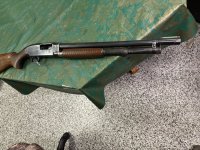


 . Bear was stone dead and I wasn’t. lol. And ya, I soiled myself. Didn’t have a bear tag but season was open, called the MNR and he told me to go buy a tag. Lol, and I did.