The allure of the British gun

On narrow guns like 410s I prefer it on the left. On 12s even trim ones like my Dougall I prefer the right hand so i can push it to the full extent to open the action. Guess I have short thumbs. Never really noticed before....thanks lol
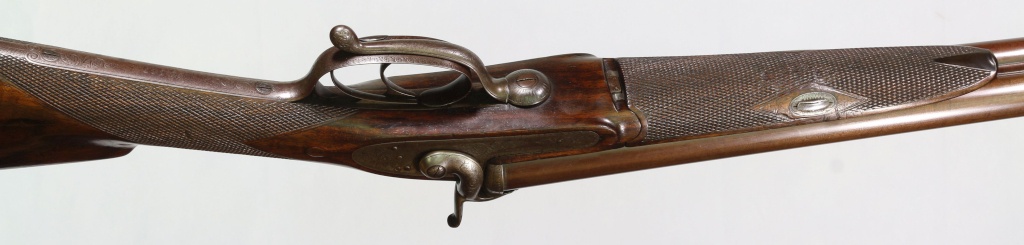
There is something special about a side lever opener though
 
Never really got to play with one... but I think on the left side would be more natural. At least as far as opening the action :unsure:

Speaking of opening the action, kind of surprise that no-one else other than Dickson made a side opening O/U? Seems like it make for a svelte shotgun... Yet another late 1800s creation!

Pictures from Bonhams website

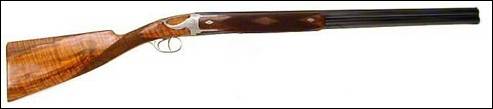
12-bore side-opening over-and-under round-action ejector gun by J. Dickson & Son, no. 4178, The first of only four ever made

Incorporating John Dickson & Son's patent number 215, sidelever-opening, the treble-grip action-body with the makers name in a scrolling banner surrounded by best foliate-scroll engraving, the highly-figured stock with pistol grip and horn pistol grip-cap, the barrels engraved John Dickson & Son, 63 Princes Street, Edinburgh with matt top-rib and horn-tipped wooden side-fillets, the right with lever-latch release
Weight 7lb. 4oz., 14¾in. stock, 30in. barrels, approx. cyl. & ⅜ choke, 2¾in. chambers, recent London nitro reproof

Footnotes

The makers have kindly confirmed that the gun was completed in 1888 for Schomberg Kerr, 9th Marquess of Lothian

image


image
 
Never really got to play with one... but I think on the left side would be more natural. At least as far as opening the action :unsure:

Speaking of opening the action, kind of surprise that no-one else other than Dickson made a side opening O/U? Seems like it make for a svelte shotgun... Yet another late 1800s creation!

Pictures from Bonhams website

12-bore side-opening over-and-under round-action ejector gun by J. Dickson & Son, no. 4178, The first of only four ever made

Incorporating John Dickson & Son's patent number 215, sidelever-opening, the treble-grip action-body with the makers name in a scrolling banner surrounded by best foliate-scroll engraving, the highly-figured stock with pistol grip and horn pistol grip-cap, the barrels engraved John Dickson & Son, 63 Princes Street, Edinburgh with matt top-rib and horn-tipped wooden side-fillets, the right with lever-latch release
Weight 7lb. 4oz., 14¾in. stock, 30in. barrels, approx. cyl. & ⅜ choke, 2¾in. chambers, recent London nitro reproof

Footnotes

The makers have kindly confirmed that the gun was completed in 1888 for Schomberg Kerr, 9th Marquess of Lothian

image


image

There was an article in Shooting Sportsman some years ago about the SuperBritte side opener O/U. I can't find it online but there are other sources of info inline. Here is an excerpt from an article in Shotgun Life written by The CEO of Griffin & Howe in 2008:
"Théophile Britte himself had a keen appreciation for unconventional engineering. Britte earned a patent in 1931 for a side-opening over and under design, and announced it to the world the following year as the “SuperBritte.”

The “Super” part of the name derives from the French word superpose(over-and-under), but the word fits Britte’s gun in more ways than one. It is an over/under, but instead of a conventional drop-down, the SuperBritte opens to the side.

He wasn’t the first to think of this ingenious design. W.W. Greener patented a side-opening over/under in 1873 – but his Wedge-Fast was a side-by-side action turned ninety degrees. John Dickson later did essentially the same thing with his famous round action – rotated it a quarter-turn to make a side-hinge over/under. Dickson’s built fewer than 10 examples altogether.

The key difference between these guns and the SuperBritte is that while Greener and Dickson adapted existing side-by-side actions, Théophile Britte designed his from scratch – and in doing so, perfected the side-opening action. The completed guns engraved with stocks mounted were entirely built in the Britte workshops and delivered, ready to shoot, after proofing in Liège and testing at the shooting grounds.


SuperBrite


The SuperBritte​

Because it does not require a frame in the conventional sense, this side-opener is inherently the shallowest over/under action possible. Because the action bar is on the side, there’s no need for the deep, U-shaped frame that a drop-down action requires. Therefore, the height of the action is exactly the same as the height of the barrels – and you just can’t make an over/under any slimmer in profile than that

Britte’s action is also about as narrow as an over/under can be. The cocking system works directly from the side-lever; push it down with your thumb to open the action, and you #### the locks at the same time. The degree of mechanical leverage is such that you don’t notice any unusual resistance or stiffness. The fastener is a double-bite bolt on the left and a rib extension on the right. The lump, moreover, extends completely through the action bar, lending additional support resulting in incredible action strength."

https://www.shotgunlife.com/shotguns/art-of-the-gun/the-fine-firearms-find-of-the-century.html
 
I've always been a sucker for nice case colors. The brits had the brightest blues and purples. Akus of turkey is said to use the same process of bone charcoal case coloring and they get some stellar colors.

Chemical case colors really lack the visual appeal up close
 
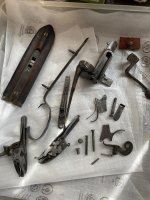
Getting back to British alluring guns and my admiring the sidelever opener, this one is an export quality gun (as in not bespoke or highest quality) by Wm. Moore and Co. Still, it is a nice handling little gun and now with the internals cleaned locks up very nicely on closing.
As my friend Steve Nash tells it, finer guns were more likely to be made by the separate business of Moore and Grey. I'm looking forward to shooting this one with black powder cartridges but there's more work to be done with repairing and refinishing the stock. Another project gun that
Moore_cleaning.JPG I'll put aside for now until winter returns.moore.jpg
 
A fellow i know in his 80's here in NB is a diehard grouse hunter runs an old A5 Browning along with his bird dogs. Couple years ago had a man from Ireland invited on a bird hunt. The Irishman refused to hunt with the older gent with the A5. Said semi automatic shotguns were unsafe to hunt with. Go figure.
 
It will be interesting to see what Victorian shooters will have to say about pump and semi :unsure:
- Tks for the article!
A Victorian gentleman would consider a double-barreled game gun bang up to the elephant, and anyone using a pump or semi would be a damfool saphead and a wooden spoon, and to think otherwise is barking at a knot and making a stuffed bird laugh. But if swung by a bricky revolveress, one might let it pass.
 
It will be interesting to see what Victorian shooters will have to say about pump and semi :unsure:
- Tks for the article!
At the risk of going somewhat off-topic, I can understand a certain European reluctance against semi-automatic actions, and even pump guns: you can’t easily open them up and drape them over your forearm to show they’re safe, like you can with a hinge-action gun, a 160-year-old habit. Even the switch from hammer guns to hammerless caused much consternation, as you couldn’t readily see if the action was in a safe configuration. This also prompted many makers, especially on the Continent, to include c_ocking indicators with their hammerless actions. When I did some museum collecting in Britain in 1980, I used an Ithaca Model 37 in 16; that caused more of a fuss and prompted more curiosity than my collecting efforts in village commons. Pumps and semis might be more commonplace in Europe today, but they sure weren’t 50 years ago. There must be a reason why British gunmakers/inventors never ventured into multi-shot repeaters. There was experimentation with three- and four-barrelled guns, but these never caught on and were ungainly – a cardinal sin in British gunmaking (ugly proportions spelled the end of Needham’s needle-gun and Bacon’s bolt gun). You would think that the masters of the industrial age would have welcomed mechanical guns, but it never happened. However, machine-driven, streamlined production gunmaking of the type the Americans were developing was very much admired in Britain, starting with Colt’s revolver. Following Samuel Colt’s display at the Great Exhibition of 1851, the British government sent a commission to the United States in 1854 to investigate American machine production of arms, specifically to study the use of precision machinery and the production of interchangeable parts. While this ultimately led to the factory-level production in Birmingham in the late 1800s, the Brits never developed repeating shotguns. Perhaps it was class-related, where it made more sense (??) to have a pair of finely-crafted doubles and the services of a loader/manservant, rather than wielding a single gun firing 5 shots.
 
A fellow i know in his 80's here in NB is a diehard grouse hunter runs an old A5 Browning along with his bird dogs. Couple years ago had a man from Ireland invited on a bird hunt. The Irishman refused to hunt with the older gent with the A5. Said semi automatic shotguns were unsafe to hunt with. Go figure.
An A5 is a wonderful grouse gun, especially in 16 gauge. I’ve given mine away to family, but I retain a fondness for John Browning’s ‘machine that goes ping.’

Mike’s comment had me reflecting on the beliefs we all have about firearms. We might not even notice them ourselves, except when they’re being challenged. Some opinions even change over time, upon reflection, or in response to new data. But not very often.

There is always much debate on CGN about choke types, barrel lengths, the best choices for clay sports, etc. I have a firm conviction that, on the subject of removable chokes, the discussion about whether they should be flush or extended, factory or aftermarket, is irrelevant. The right determination is whether they deliver the pattern you want at a given distance, with the ammunition you use, and not what the marketing department writes or claims on the wrapping. The Victorians had it right: you judge choke by the number and evenness of pellets within a circle, and ignore the claims the gunmaker is whispering in everyone’s ear. I enjoy vintage guns, and I’ll ignore choke in my selection of them, as it has no bearing on my enjoyment of the gun. It took me a while to realize that my enjoyment of the gun was the most important part, and it wasn’t at all related to my score. I don’t numericalize companionship. Sure, chokes have their value, but they don’t correct bad shooting, and there were times when everyone in Britain shot cylinder bores and everyone in North America had full chokes. Birds fell, clays broke, and the world didn’t end.

There was a time when 26-inch barrels were de rigueur. Then they fell out of fashion. Tell-tale word: fashion. Thirty inches used to be standard for game guns, then 28-inch barrels on semis and pumps with longer actions. Now there are those who swear that a 32-inch is needed for performance. And extended choke tubes! Other than the nudge choke might provide, the shot charge isn’t going to care much about its trip down the barrel, as it’s all about the propellants and how much length is necessary to maximize gas production and ensure velocity – about 20 inches to be certain. Manufacturers and marketing departments seem to forget that everyone is operating under the same laws of physics. But boy, we really want to believe this or that gun is better, and shoots harder. That stuff hasn’t changed at all in 200 years of sporting guns.

Barrel length is related to weight and balance. We want a gun that feels alive and points quickly, or swings evenly, qualities aimed for since the days of the Manton brothers. Weight and balance are much crowed about, but these change in semis and pumps when stuffing magnum shells in a magazine tube. I think Val Browning got it right with his Double Auto, which lacks a magazine tube and keeps the weight well between the hands, like a SxS. The overly thin barrels that are a British trademark are part of the weight-balance equation. The French often did the same with 27-inch barrels and doing away with top and under ribs. Felt recoil can be added to the equation, and the Europeans had the good sense to choose lighter loads to use in their lively guns. The pellets from a 7/8oz load are travelling through the air at the same speed as from a 1 ¾oz load, hence they have the same range and killing power. It doesn’t matter if the pellets have travelled through a 10, 12 or 28 bore. The only true variables are speed (the result of the propellant) and pellet size, to determine the amount of killing power at distance. Match the number of pellets per cartridge to your wingshooting ability/accuracy, and you’re good to go.

Sporting clays need an over/under, that’s another common belief. In truth, all you need is a gun you shoot well with, that shoots where your eyes are looking. It can be of any type, configuration or brand. It’s like championships weren’t won with the venerable Model 12. Or with the odd Ithaca or Parker. Nowadays, if you don’t have a Perazzi or a K-gun, you aren’t serious… Find a gun with a point of aim suited to your chosen sport, and practice. Lots of practice.

The notion that a SxS is not good for clays is rubbish. Or that only a O/U will stand up to serious use. Also rubbish. A well-built SxS should withstand seasons of tens of thousands of shells fired, if called upon. Of course, in past times, a gun would be checked over by a proper smith, or preferably its maker, after each season for maintenance and repairs; such guns would reliably last for several generations of use. A properly made gun will withstand use, and weather. Better yet, we have better steels and alloys nowadays, and we don’t have to worry about hygroscopic propellants and corrosive primers to pit our barrels – when was the last time you heard of someone having to lap a barrel of a recent gun to remove pits? I suspect new guns are built under the watchful eye of accountants and with shareholder interests in mind, made just good enough for the amount of use most people put them to. Throw in a limited warranty for the unlucky, and you have a marketable product to be hyped by the spin gurus. This is why, when it comes to mechanical guns, I prefer those made in the first six decades of the 20th century and avoid anything made afterwards. No one could make guns that well-machined today and make a profit.

OK, this rant has gone on a bit. It looks like this thread will soon reach 37,000 views. Maybe it’ll happen before AI ruins all semblance of discussion and thought. To stay on topic, here is a beautiful non-mechanical British gun, from Queen Victoria's favourite gunmaker. I would dread to think how much something like this would cost to make today.


nANOWUp.jpg

hRNBEAj.jpg
 
Perhaps the fascination by some with long barreled shotguns dates back to black powder days? The only way to get more power was to burn more powder. Didn't do any good if it burned outside the muzzle. Im 66 years old and when I was a boy all the old fellows claimed a goose or duck gun for pass shooting just had to have a long barrel. Now I believe differently. The only aid apparent to me is a smooth swing that is harder to stop or slow unintentionally.


 
Yesterday, in the airgun forum, Dosing posted a link to an old Daniel Fraser catalog from 1912... And like many rabbit holes, I ended spending way too much reading over other old catalogs from the turn of the century.

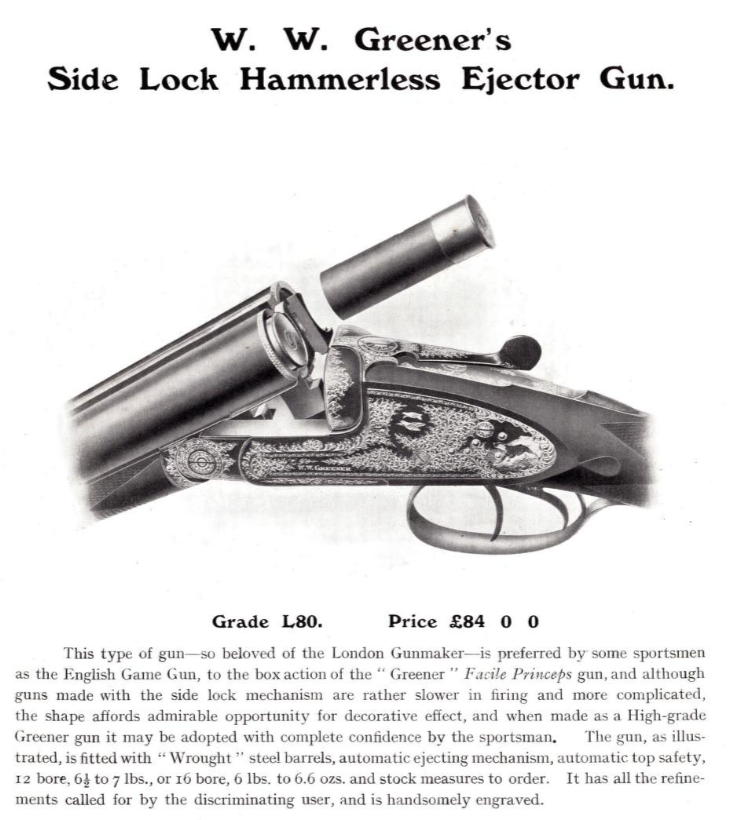
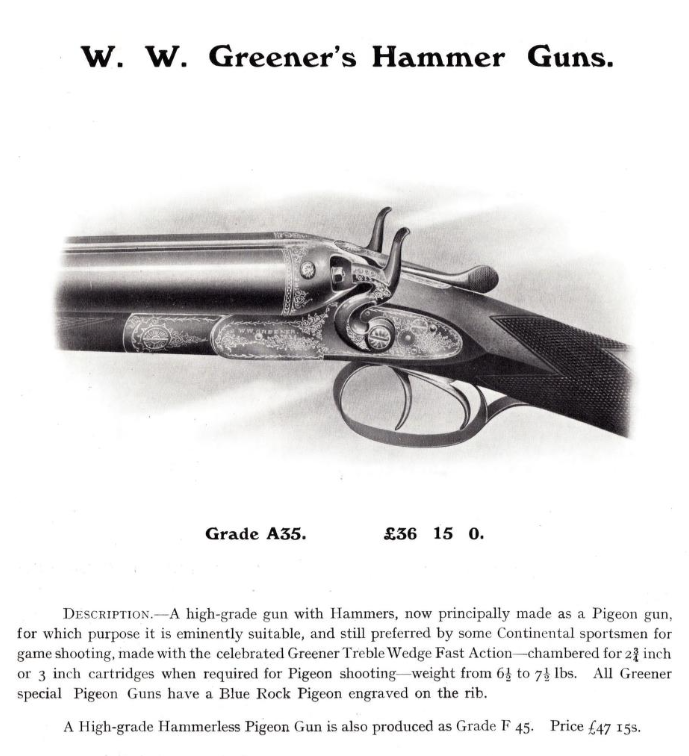
Anyway, while reading a 1920 Greener catalog... I was surprised to see
- 1) them saying their sidelock were "slower" to fire ?
- 2) They were still making hammer guns

fvBjijJ.png


ACpV2NK.png

https://archive.org/details/greeners-sporting-guns-1920/page/n39/mode/2up
 
Yesterday, in the airgun forum, Dosing posted a link to an old Daniel Fraser catalog from 1912... And like many rabbit holes, I ended spending way too much reading over other old catalogs from the turn of the century.

Anyway, while reading a 1920 Greener catalog... I was surprised to see
- 1) them saying their sidelock were "slower" to fire ?
- 2) They were still making hammer guns

fvBjijJ.png


ACpV2NK.png

https://archive.org/details/greeners-sporting-guns-1920/page/n39/mode/2up
I read that to say the sidelock is slower than the boxlock. I wonder how they measured lock time in those days and how the External hammer lock time compares to a hammerless side lock and boxlock.
 
The ‘speed’ of lockwork is something that has been debated for as long as locks have existed, and at least as long as flint and steel did the job. I think the impetus has always been something like ‘mine is better than yours.’ While the debate has been lengthy, there has never been any satisfactory conclusion, or certainly not one borne out of verifiable and quantifiable study. The mechanics are easy enough, whereby the priming cap has to be hit hard enough to detonate, with the least measure of time between the trigger pull and ignition. The variables, though, are many: size and strength of springs, and whether they are V-shaped or coiled; the length of throw between the hammer and firing pin, various friction points around pivots, the geometry of the sears, and probably even the anvil structure within the firing cap, to name but a few. In the early days of percussion and pin-fire, there was much discussion on the mechanical superiority of bar locks vs back-action locks, which came down to whether you believed a V-spring pushing up was better than one that pushed down. Bar locks often appeared on more expensive guns, because it took more labour to fit the locks to the steel action bar, as opposed to inletting into wood (back-action locks). Naturally, folks thought the more expensive option was better, human nature again. But mechanically? Take your pick. Going the hammerless route, most sidelocks were of the bar variety, though back-action sidelocks were also popular. Again, up to the gunmaker and the client.

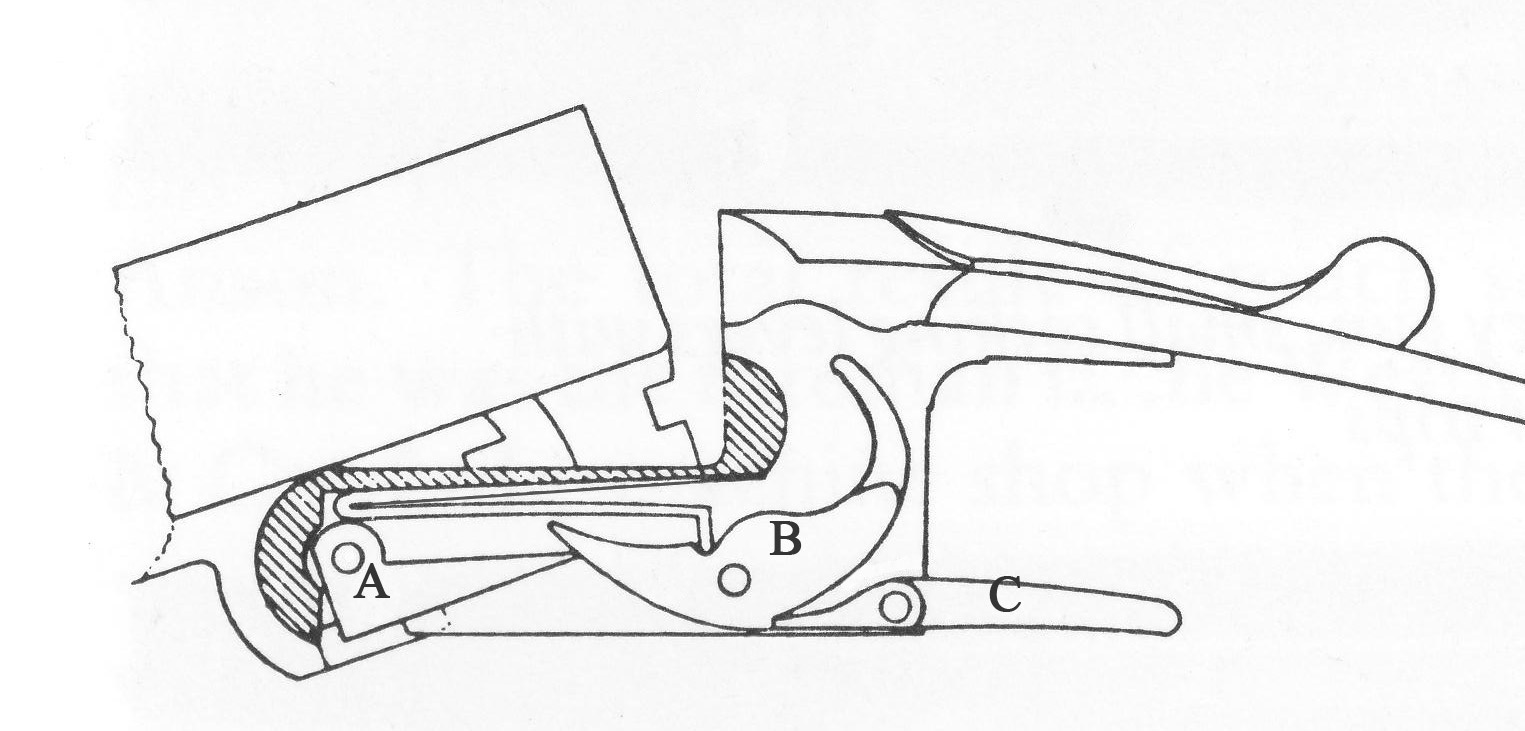
I suppose a more significant time-to-ignition difference might involve the arrival of the Anson & Deeley boxlock action. Extremely simple compared to sidelocks of either type, with few pivot points and friction surfaces, and having the hammer and firing pin combined.

Anson & Deeley action, from the Hallowell & Co. Illustrated Firearms Dictionary:
iKgJmPs.jpg


However, until a trio composed of a mechanical engineer, a physicist, and a mathematician sit down together for a year to work out all the equations and experimental data, the matter will remain unresolved. Until then, mine is better than yours.
 
Last edited:
Here we are on Victoria Day, so a good moment to reflect on Queen Victoria, whose reign of more than 63 years (1837 to 1901) let her see the last gasp of the flintlock musket (1838), the rise and fall of the percussion and pin-fire systems, and the perfection of the centrefire, all the way to the hammerless ejector double with fluid steel barrels. Had she hung on for another two years, she could have had an opinion on John Browning's A-5!

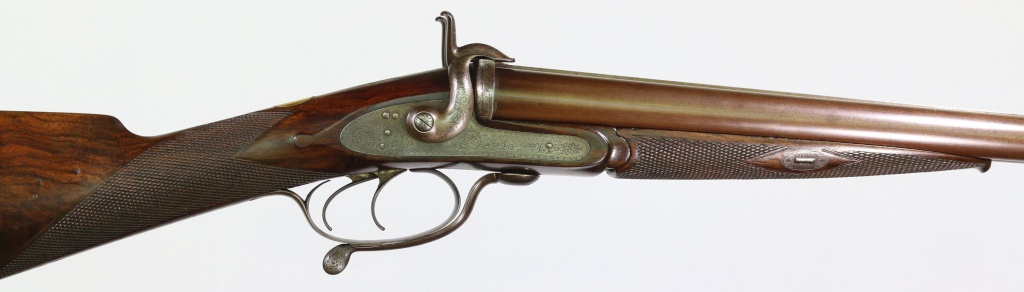
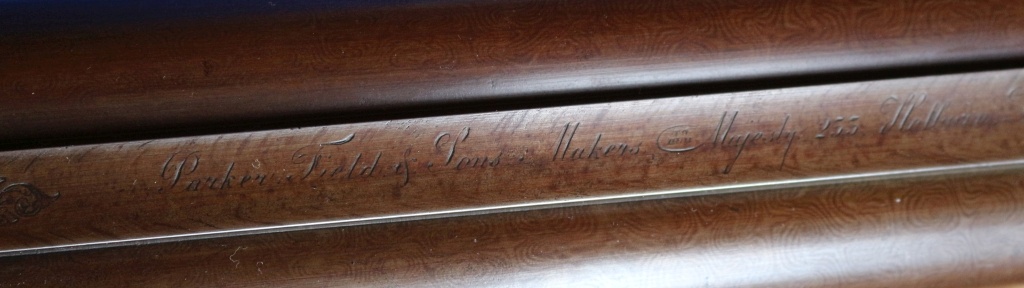
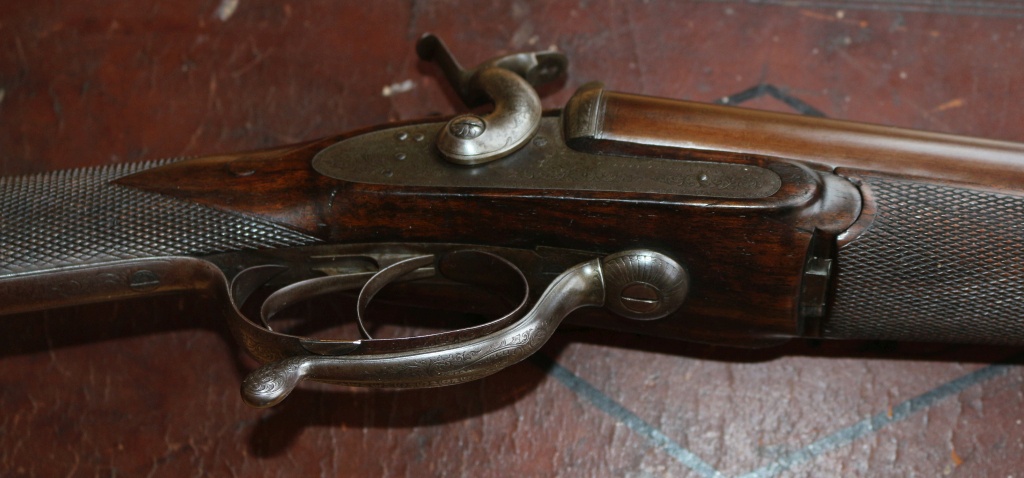
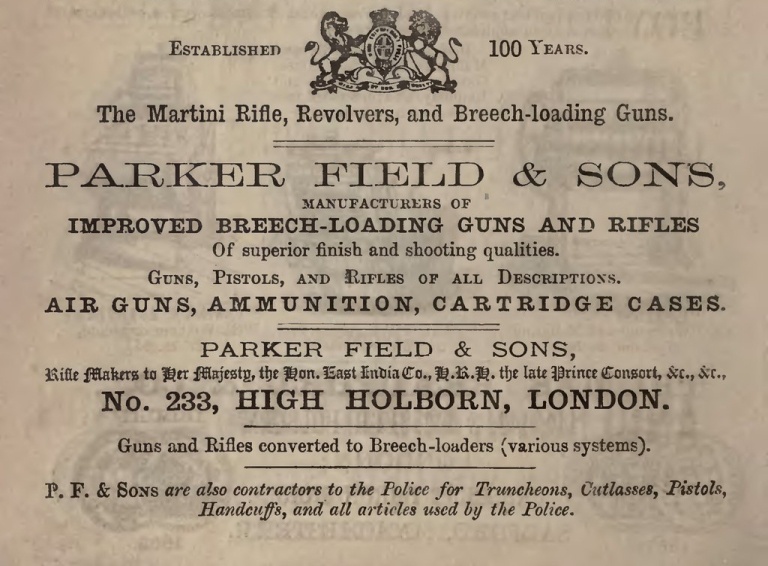
While other members of the Royal Family have favoured various gunmakers over the years, like Holland & Holland and Westley Richards, Victoria was not averse to field sports, and the London gunmaker Parker, Field & Sons had the claim of being gunmaker to her Majesty. Here once again is more of a 'best quality' bar-in-wood pin-fire of theirs from around 1865:

9xSL8qt.jpg

CltJMtC.jpg

KLAsJMC.jpg


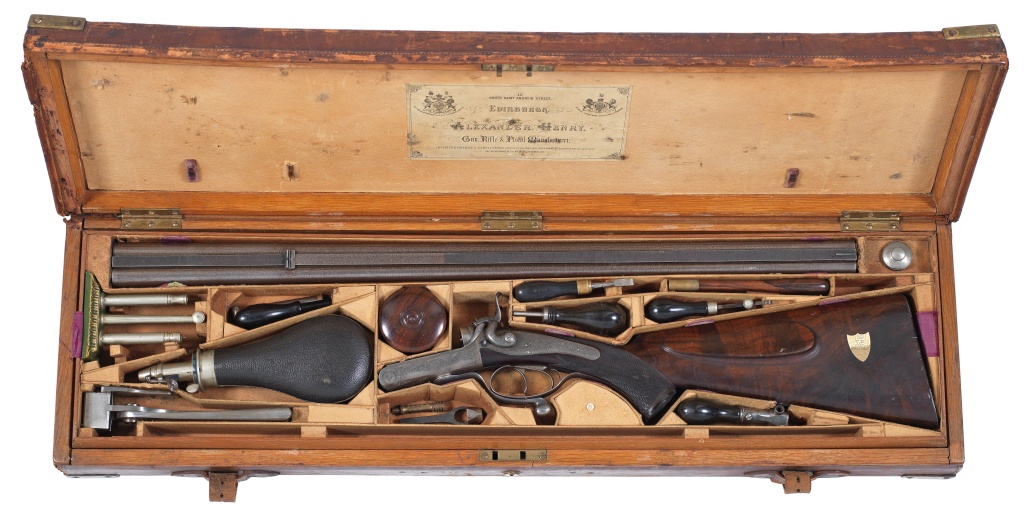
The .450 double rifle that Queen Victoria gifted to John Brown in 1873 was by Alexander Henry of Edinburgh. Good taste in guns!

4Ailwoj.jpg

(Bonhams Auction House photo)
 
Last edited:
With the recent passing of pre turkey patterning season I tested several unlikely guns for my annual turkey hunt. This year I tested a new beretta 688 sporting with extended turkey and xf chokes using grand slam buffered shot and flite control wads to various british 2.5" chambered guns. One being a Damascus barreled C. Smith and the other a webley and scott 700 or 702. I used a rolled crimp reload with an Oz of nickel plated 5s for the vintage guns. Surprisingly even woth ic/mod chokes the webley put more holes in the turkey picture than my new beretta with tight chokes and advanced ammo. The smith had just a few pellets shy of the beretta with the more open barrel and tied for its tighter barrel. I cant recall the choke of the smith or if it was even marked but the bire was .719
So as for the op stating chokes dont matter its all on the paper I truly believe thst to be correct.
Now at 40 yards every gun I tested this season would have killed a turkey effectively but the old fixed chokes and short chambers proved to be not a disadvantage even when throwing less shot.
Funny how we as shooters and hunters get caught up on the latest gear but in reality it is all just marketing
 
Back
Top Bottom