I believe that G's tests were over 'many days' with the same equipment, so what more variation could there be ? IMO the 'accuracy question' revolves on Both the 'consistency' of the shooter AND the consistency of the ammo. In that respect the ES/SD has a contribution to the accuracy. Many factors involved in the equation. NOT just "the product . . . ".













































You are using an out of date browser. It may not display this or other websites correctly.
You should upgrade or use an alternative browser.
You should upgrade or use an alternative browser.
Chronographs, ES/SD and Accuracy – What’s Myth and Reality
- Thread starter grauhanen
- Start date
One more thing about a chrono and rimfire is the concept of Mach trimming with ammo around the 1100fps range. So your expected muzzle velocity may not be as real as you think after what I call, the ‘speed bump’ that occurs a short distance from the rifle.
Check out Bryan Litz on the topic. It’s interesting.
Check out Bryan Litz on the topic. It’s interesting.
- Location
- Northeastern Ontario
I don't expect any Mach Trimming to be involved.One more thing about a chrono and rimfire is the concept of Mach trimming with ammo around the 1100fps range. So your expected muzzle velocity may not be as real as you think after what I call, the ‘speed bump’ that occurs a short distance from the rifle.
Check out Bryan Litz on the topic. It’s interesting.
A reading of Litz will explain.
Apologies, I was speaking more generally. Not for this ammo.I don't expect any Mach Trimming to be involved.
A reading of Litz will explain.


I agree!
I have yet to go down this rabbit hole.
I don't have any experience, but I suspect, as with all measuring instruments, calebration and repeatability can be an issue.
I wonder how much variation there would be with same rifle, same chronograph, similar temperature and pressure, two weeks apart?
I think it would be interesting to see just how repeatable results may be.
Likewise, if two units (different or similar) are used at the same time, how comparable are the results one to another?
Already been done.
This Primal Rights video compares 3 and was of interest to me as I was moving from a Magnetospeed to a Garmin.
The differences in FPS between those two were minimal and wouldn't mean much in the real world but the Garmin is waaaay easier to use.
Chrono only tells you what the bullet is doing when it leaves the barrel, unless you have one of the more high end setups that the folks like the bullet/ammo mfgrs use, that can track it downrange to the target. Even they can't totally predict what it'll do between the muzzle and target, they can only tell you the tale of what it did, And even that doesn't necessarily say a lot once it actually hits the target. Paper shows what the worst shots will be, the percentage of the shots that are a "flyer" within that worst group parameter is what a person needs to worry about. The group could be huge thanks to one shot, the trick is to minimalize the effects of that shot, Maybe it was a 9, even an 8, how many 10's or X's did that ammo hit vs the 9's, and how consistent is the picture overall. Chrono can't tell you that.
Chrono only tells you what the bullet is doing when it leaves the barrel, unless you have one of the more high end setups that the folks like the bullet/ammo mfgrs use, that can track it downrange to the target. Even they can't totally predict what it'll do between the muzzle and target, they can only tell you the tale of what it did, And even that doesn't necessarily say a lot once it actually hits the target. Paper shows what the worst shots will be, the percentage of the shots that are a "flyer" within that worst group parameter is what a person needs to worry about. The group could be huge thanks to one shot, the trick is to minimalize the effects of that shot, Maybe it was a 9, even an 8, how many 10's or X's did that ammo hit vs the 9's, and how consistent is the picture overall. Chrono can't tell you that.
Shotmarker kinda does both (deffo more on the high end and not its primary purpose).
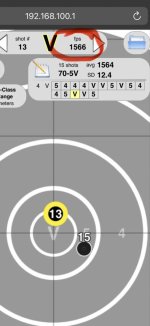
It pretty much instantly shows where you hit the target on your hand held device and it also shows the FPS at that point too so combined with the data of speed leaving the muzzle it builds a good picture if something is out of whack / inconsistent.
Fine if folks want to spend the loot on a shotmarker, most don't, most clubs don't either, or don't necessarily allow members to use it regularly. And it still doesn't tell you what the next shot or the ones after that will do for sure, only what that one did,
Fine if folks want to spend the loot on a shotmarker, most don't, most clubs don't either, or don't necessarily allow members to use it regularly. And it still doesn't tell you what the next shot or the ones after that will do for sure, only what that one did,
I dont know of any device that can do that.
This maybe?

Best you can do with the current gear is look at the numbers and reverse engineer from there.
Ever since I figured out how to reliably track every .22LR with my old Labradar, I have noticed a couple things.
1) the random very low velocity shots from SKRM, like 30fps below average, will drop below the group.
2) within a regular group with average velocities, the rounds go where they want. Some lower fps may place high, and some higher fps shots may go low.
Other shooting I’ve done with SKLRM, Lapua Long Range and Center-X, align with the OP.
1) the random very low velocity shots from SKRM, like 30fps below average, will drop below the group.
2) within a regular group with average velocities, the rounds go where they want. Some lower fps may place high, and some higher fps shots may go low.
Other shooting I’ve done with SKLRM, Lapua Long Range and Center-X, align with the OP.

Great research and data gathering! I agree with virtually everything you say. Your data speaks for itself. However, it will take some time to digest all your assumptions.What Chronographs are Actually Good For
Chronographs can be useful – just not for predicting accuracy.
The are excellent for:
• establishing a rifle’s MV
• tracking MV with temperature (warmer temps = faster MV; cooler temps = slower MV)
• detecting rounds with unusual MV behaviour
• monitoring MV consistency
A chronograph is like a thermometer. It tells you when something is normal or not – but it cannot tell you how well a lot will shoot. It tells you whether you’re hot or not. It doesn’t tell you why.
The way I look at ES’s and SD’s…
MV analysis including ES’s and SD’s are only one (of many) possible predictors of precision. As you found, they are probably not statistically significant enough to make predictions of ultimate precision within your test parameters.
ES’s are more statistically dependent on number of shots (data set size). Hypotheticallly, the more shots you fire, the higher probability that ES’s will increase.
After a point, SD’s will not vary a remarkable amount with data set size. Hypothetically, they will normalize and stay that way (with minor variation) after a point and shouldn’t change considerably with data set size.
I would eliminate ES’s as an analyzed factor unless all datasets were roughly the same size.
SD’s and ES’s are only one component of a predictor of rifle accuracy that cumulates to describe many of the effects of internal ballistics. External ballistics are a whole other ballgame. Both these two, In & Ex ballistics, should ultimately correlate to a predictor of precision.
Regarding a rimfire and 100yds accuracy tests, wouldn’t shooting at closer ranges (50 yds and less) eliminate some other factors or variability? In my opinion average MV and ES’s may be a decent predictor of vertical dispersion in long range centerfire precision. Clearly, shooting at .22LR at 100yd, and using velocity data is not a good predictor of vertical dispersion or precision. There are just too many other variables which start to play dominant roles.
Looking at bare data is always challenging. I would like to see the data run through a statistical calculator (I used Minitab in my profession life). It might give you some unseen correlations. A multi-variant analysis, and the null hypothesis to determine statistically significant factors, for example, might be useful to see the effects of the more controllable and measurable variables.
Specifically, I would like to run the data which shows lots ranked by ES/SD and the second graph of Target Performance by lot. If one was to use only Lot M715 (best ES/SD and best accuracy) and Lot M344 (worst ES/SD and worst accuracy) there would be a correlation between ES/SD and accuracy. But to run all the data might show you what fits and what are the outliers. Then by using other data collected (such as weather variables or your insight), you might actually discover additional drivers of accuracy. In my opinion, it would be a useful exercise for someone who is interested into a “deeper dive’” in the data.
The shooter’s consistency is a significant variable in determining precision. That is why we have competitions. Environmental factors are another.
Although it’s not possible, I would like to see similar data to that which you collected, but shot using a test set-up similar to the Lapua’s test center. It is shot indoors (with controlled, consistent environment conditions and no wind) at reasonably close range, using an action attached to a fixed sled type device. This eliminates some of the shooter variation and external ballistics effects. I would then like to run the data through statistical software.
If you eliminate the external ballistics effects and shooter variability, MV characteristics might start to be a better indicator of ultimate ammo precision. In my opinion, it is not everything, but it might be something.
Last edited:
A shot marker, recording velocity on target data, does provide some information on external ballistics. Unfortunately, it doesn’t record subsonic ammo. It requires supersonic velocities at target. So, virtually all target .22LR ammo won’t record.Shotmarker kinda does both (deffo more on the high end and not its primary purpose).
Last edited:
Thanks, so no calebration needed?Already been done.
This Primal Rights video compares 3 and was of interest to me as I was moving from a Magnetospeed to a Garmin.
The differences in FPS between those two were minimal and wouldn't mean much in the real world but the Garmin is waaaay easier to use.
On chronographs?Thanks, so no calebration needed?
I have never calibrated either of the units I have (Garmin & Magnetospeed). I'm not even sure it is possible?
Not possible on any chrono I've ever owned.On chronographs?
I have never calibrated either of the units I have (Garmin & Magnetospeed). I'm not even sure it is possible?

Leuchtkafer
Member
• Good ammo is good across good barrels
Sure, the ammo doesn't become "bad" by virtue of shooting it through a different barrel, LOL.
If you are suggesting the results on target are good simply because good ammo was fired through a good barrel, that is a categorically FALSE assertion for which there is NO EVIDENCE in existence to suggest this is even a possibility, so PLEASE STOP making misleading statements as though they are fact. They ARE NOT.
- Location
- Northeastern Ontario
Twenty thousand rounds from nine different lots across multiple barrels is strong evidence that good ammo shoots well across good barrels. About 2000 rounds from a lot of Center X with multilple rifles showed virtually the same results with each barrel. That's good evidence, too.
No barrel "fixes" bad ammo. Inconsistent ammo always remains inconsistent ammo. There's no magic synergy that makes some barrels cure inconsistent ammo by turning it into something else.
If you have any reliable evidence to support your claims, please direct readers to it. No one should hold his breath for this.
No barrel "fixes" bad ammo. Inconsistent ammo always remains inconsistent ammo. There's no magic synergy that makes some barrels cure inconsistent ammo by turning it into something else.
If you have any reliable evidence to support your claims, please direct readers to it. No one should hold his breath for this.





















