












































Brigade Makasi MK15 First impression Canada review

I really don't see a need to buy spare parts for the Makasi - I kinda say the same thing for AR. Like the hammer spring will go for 20K and back in the days of questionable quality extractor spring is like a 6000 rounds affair out of SBR if someone else pays for it but normal people did not have to do that.

Regarding match trigger and all that stuff, I will be very conscious - this thing runs two springs of different lengths and spring rates which my guess is to increase resistance as BGC progresses through its travel. In most guns with push rods, the spring guide is full length and extended through a hole in the BGC, and offset from the axis of the push rod. The makasi has the recoil spring and push rod aligned on the same axis. OK, I cheated and asked AI to explain this better:
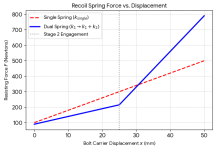
2. Velocity in Compression (Rearward Travel)
Compression velocity is driven by high-pressure gas expansion forcing the bolt backward, violently fought by the recoil spring. [1]
  • Single Spring Behavior: The bolt carrier flies backward at a massive initial velocity. Because the spring rate is constant and linear, the slowing force builds up slowly. If the gas pressure is high, the spring fails to sap all kinetic energy, resulting in a high terminal velocity when the carrier slams hard into the rear buffer wall. [1, 2, 3]
  • Dual Spring Behavior: The initial rearward velocity is allowed to stay high during Stage 1, ensuring the rifle unlocks and extracts dirty or weak brass reliably. However, once the bolt enters Stage 2 (\(k_1 + k_2\)), the massive spike in force rapidly bleeds off the bolt's kinetic energy. The velocity drops to near zero right before the end of travel, eliminating the harsh metal-on-metal frame slap.

1782143493391.png

So - Watch out for bolt velocity and disconnector strike. Obviously they are running this configuration because they figured out the BGC is going at higher velocity. Don't be surprised if disconnector strikes happen and wreck the expensive trigger. This is a risk.
 
I really don't see a need to buy spare parts for the Makasi - I kinda say the same thing for AR. Like the hammer spring will go for 20K and back in the days of questionable quality extractor spring is like a 6000 rounds affair out of SBR if someone else pays for it but normal people did not have to do that.

Regarding match trigger and all that stuff, I will be very conscious - this thing runs two springs of different lengths and spring rates which my guess is to increase resistance as BGC progresses through its travel. In most guns with push rods, the spring guide is full length and extended through a hole in the BGC, and offset from the axis of the push rod. The makasi has the recoil spring and push rod aligned on the same axis. OK, I cheated and asked AI to explain this better:


View attachment 1163790

So - Watch out for bolt velocity and disconnector strike. Obviously they are running this configuration because they figured out the BGC is going at higher velocity. Don't be surprised if disconnector strikes happen and wreck the expensive trigger. This is a risk.
Are you saying you SHOULDN'T install aftermarket triggers on the Makasi? Specifically, I was going for a TriggerTech AR15 Duty Single Stage Trigger, 3.5lbs. Was also pairing it with a TriggerTech AR Safety.
 
Are you saying you SHOULDN'T install aftermarket triggers on the Makasi? Specifically, I was going for a TriggerTech AR15 Duty Single Stage Trigger, 3.5lbs. Was also pairing it with a TriggerTech AR Safety.

A "safer" solution may be to install a trigger specifically configured for the SIG MCX rifle, which comes with a special sheet metal "guard" to protect the Disconnector from high-velocity Hammer strikes. Geiselle manufactures such a trigger, however it is quite pricey at $445 CAD:

https://canadiansafetysource.ca/sig-sauer/geissele-automatics-super-mcx-ssa-m4-curved-trigger
 
A "safer" solution may be to install a trigger specifically configured for the SIG MCX rifle, which comes with a special sheet metal "guard" to protect the Disconnector from high-velocity Hammer strikes. Geiselle manufactures such a trigger, however it is quite pricey at $445 CAD:

https://canadiansafetysource.ca/sig-sauer/geissele-automatics-super-mcx-ssa-m4-curved-trigger

Triggertech has a MCX rated trigger as well: https://triggertech.com/products/sig-mcx-two-stage-trigger-adaptable

You can likely order through a variety of CGN forum vendors.

Given the lack of options on where to put AR triggers, people may be still willing to try them in the Makasi. If anyone has trouble with a standard AR trigger, please let us know.
 
A "safer" solution may be to install a trigger specifically configured for the SIG MCX rifle, which comes with a special sheet metal "guard" to protect the Disconnector from high-velocity Hammer strikes. Geiselle manufactures such a trigger, however it is quite pricey at $445 CAD:

https://canadiansafetysource.ca/sig-sauer/geissele-automatics-super-mcx-ssa-m4-curved-trigger
I'm going to try and call Brigade to iron this out, or email at the very least. I could've sworn they advertised this as simply being compatible with ANY aftermarket AR15 trigger. Idk enough about ARs or MCXs to tell what the hecks the difference between their trigger compatibility.
 
There's interesting post on Reddit on how one guy re-barreled his Makasi, drilled it for a roll pin, and addressed the issue of HG misalignment.
Might comes handy in the future, so posting it here -

I'm down in the U.S.

Just picked up the 16 inch version.

Can confirm, multiple parts are interchangeable with AR15 parts.

I personally swapped the standard trigger with a Rise Armament LE145 drop in trigger.

I also wanted to upgrade the barrel to a chrome lined (just a personal thing with me). I went with a Criterion Hybrid 16 inch chromelined with a .223 Wylde chamber and headspaced BCM bolt.

While the Makasi uses AR15 barrels, they are drilled and pinned. I used the following Jig to drill the new barrel myself. BRD engineering MK4.

It comes with a 1/8 guide to drill the pin, but the makasi gas block uses a 3/16 pin. I found and used the following bushing without issue, it will fit on the MK4 jig in place of the 1/8 guide.

I did notice that the 2 bolts that interface through the handguard and the barrel nut were not in line, resulting in teeth marks on the barrel nut from the handguard mounting bolts. I easily fixed it by adding some shims to the barrel nut.

Finally, I wanted more of a fixed stock look for the Makasi. Unfortunately, I could not find any ready to order adapters that convert from 1913 picatinny to M16 female end plate. I combined the 2 items below to make my own. I had to Dremel the edges of the Yueoct mount so they would fit inside the anti rotation ledges of the adapter mount, but thankfully everything else lined up fine (the 2 parts even has the same 1/4 bolt matching threads!) Items below.


Now that I've got it set up, will try to take it out for a spin in the next week or so. If anyone has questions about specific aspects of the rifle, let me know, I'll answer as much as possible.
 
Not sure about adding shims between the barrel nut and the receiver is a good idea in general because it is pushing the extension away from the BGC envelop. While supposedly headspace is fixed if the BGC and barrel extension are fixed in position, changing relative position of the BGC and barrel extension generates "funky" outcomes based on my experience. I would rather leave this hanguard cross bolt issue alone and call warranty when it dies. Instead of toying with shims between the barrel nut and receiver, the fix should be with the handguard.
 
Back
Top Bottom






















