













































I really don't see a need to buy spare parts for the Makasi - I kinda say the same thing for AR. Like the hammer spring will go for 20K and back in the days of questionable quality extractor spring is like a 6000 rounds affair out of SBR if someone else pays for it but normal people did not have to do that.
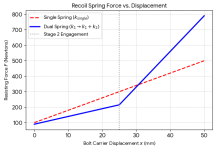
Regarding match trigger and all that stuff, I will be very conscious - this thing runs two springs of different lengths and spring rates which my guess is to increase resistance as BGC progresses through its travel. In most guns with push rods, the spring guide is full length and extended through a hole in the BGC, and offset from the axis of the push rod. The makasi has the recoil spring and push rod aligned on the same axis. OK, I cheated and asked AI to explain this better:
So - Watch out for bolt velocity and disconnector strike. Obviously they are running this configuration because they figured out the BGC is going at higher velocity. Don't be surprised if disconnector strikes happen and wreck the expensive trigger. This is a risk.
Regarding match trigger and all that stuff, I will be very conscious - this thing runs two springs of different lengths and spring rates which my guess is to increase resistance as BGC progresses through its travel. In most guns with push rods, the spring guide is full length and extended through a hole in the BGC, and offset from the axis of the push rod. The makasi has the recoil spring and push rod aligned on the same axis. OK, I cheated and asked AI to explain this better:
2. Velocity in Compression (Rearward Travel)
Compression velocity is driven by high-pressure gas expansion forcing the bolt backward, violently fought by the recoil spring. [1]
- Single Spring Behavior: The bolt carrier flies backward at a massive initial velocity. Because the spring rate is constant and linear, the slowing force builds up slowly. If the gas pressure is high, the spring fails to sap all kinetic energy, resulting in a high terminal velocity when the carrier slams hard into the rear buffer wall. [1, 2, 3]
- Dual Spring Behavior: The initial rearward velocity is allowed to stay high during Stage 1, ensuring the rifle unlocks and extracts dirty or weak brass reliably. However, once the bolt enters Stage 2 (\(k_1 + k_2\)), the massive spike in force rapidly bleeds off the bolt's kinetic energy. The velocity drops to near zero right before the end of travel, eliminating the harsh metal-on-metal frame slap.
So - Watch out for bolt velocity and disconnector strike. Obviously they are running this configuration because they figured out the BGC is going at higher velocity. Don't be surprised if disconnector strikes happen and wreck the expensive trigger. This is a risk.
























