Russian & Soviet Service rifles (19th century and 20th century) - Collections & Accessories

Jeepix

Member
Rating - 0%
0   0   0
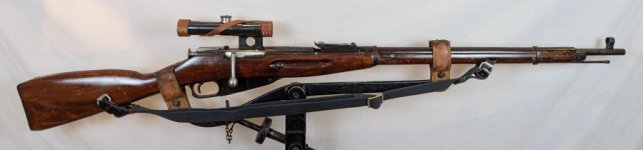
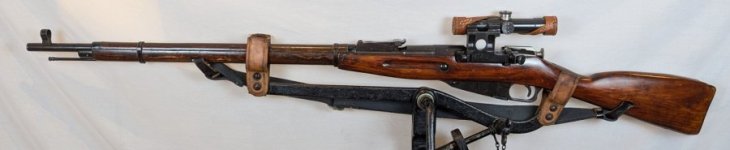
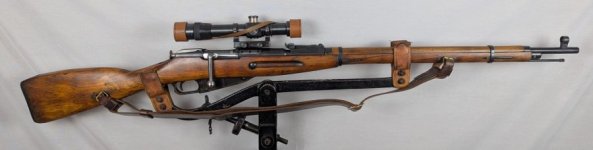
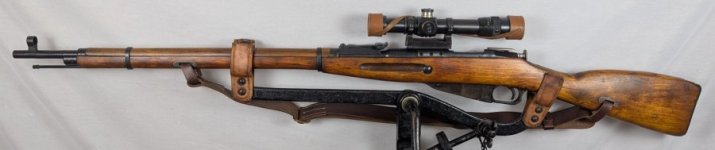
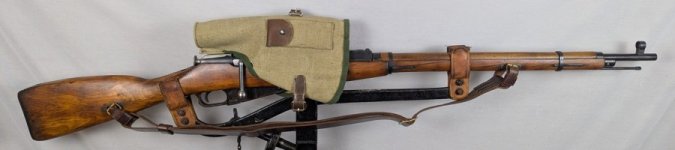
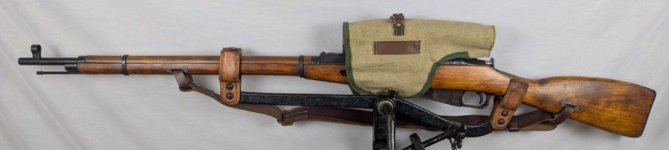
Mosin-Nagant M1891/30 PU (Снайперская винтовка) - винтовка Мосин-Наган
Made by Izhevsk Mechanical Plant
Ижевский Механический Завод, Izhevsky Mekhanicheskiy Zavod
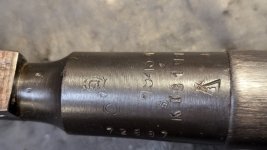
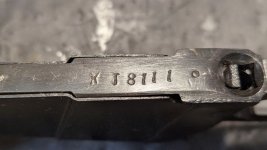
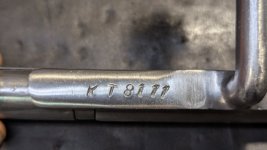
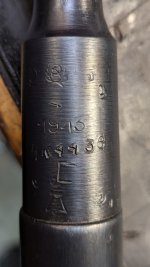
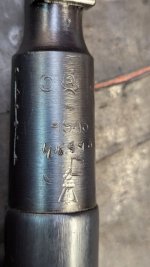
SN# KT8111 (CT8111 in Latin)
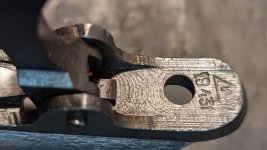
1943
159,579 PU sniper rifles were produced in 1943 by Izhevsk.
7,62×54mmR (m.1930 typ D)
5 rd. Single stack Integral Box Magazine (Non-removable)
Does not work with stripper clips due of the PU Scope mount.
Bolt action (Cocking on open & Round receiver)
Designed by Captain Sergei Ivanovich Mosin & Émile and Léon Nagant.

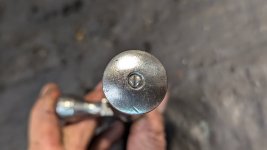
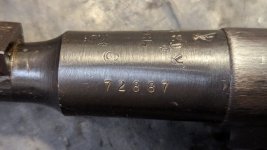
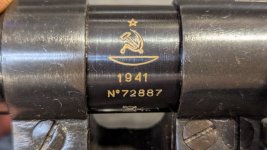
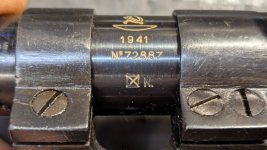
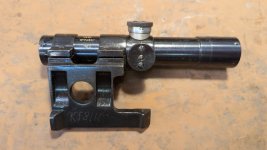
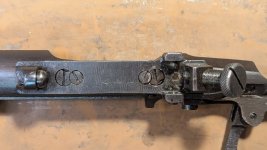
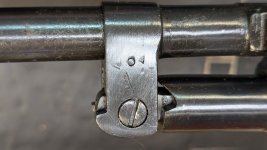
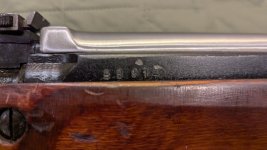
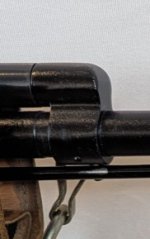
Optic PU-1 (ПУ, прицел укороченный, 'Scope short-cut') 3.5×21mm (SN# 72887) SVT Type (1941) ** Match with the rifle ** - Made at Factory #357 NKV Leningrad/Omsk, the only remaining PU scope manufacturer & Kochetov mount (standard bracket). 42,879 PU Scope are produced in 1941 at Factory #357 NKV Leningrad/Omsk. Production of the PU sniper rifles at the Izhevsk factory began in November 1942; "C in circle" sniper grade proof mark on the left side of the barrel shank.

Capture d’écran 2025-12-19 202814.jpg
Capture d’écran 2026-07-18 170344.jpg
PXL_20251220_211152873.jpgPXL_20251220_211138731.jpg
PXL_20251220_211453865.jpg
PXL_20251220_214313568.jpg
PXL_20251220_224011376.jpg
PXL_20251220_224509449.jpg
PXL_20251220_224516091.jpg
PXL_20260522_014924922.jpgPXL_20260522_010219954.jpg
 
Last edited:
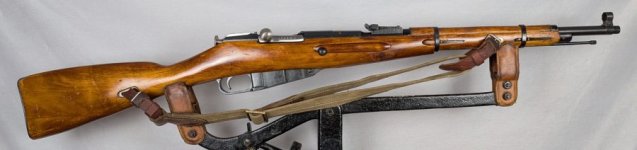
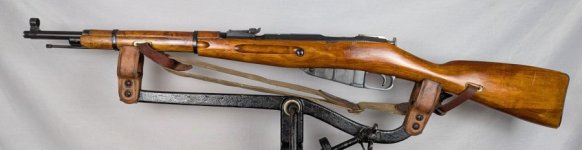
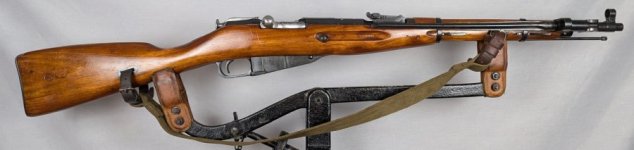
Mosin-Nagant M1938 (Модель 1938 года)
Винтовка Мосина-Наганта
Made by Izhevsk Mechanical Plant
Ижевский Механический Завод, Izhevsky Mekhanicheskiy Zavod
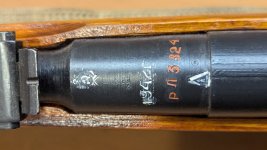
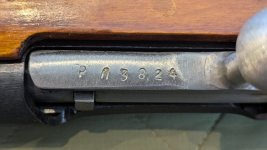
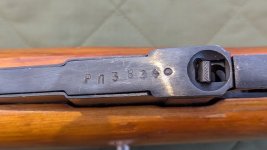
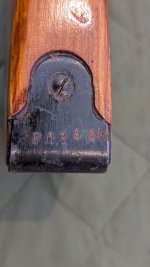
SN# PП3824 (RP3824 in Latin)
1942
Izhevsk production of M1938 in 1942 (687,426).
It was put into service in 1939 and remained in production until 1945.
7,62×54mmR (m.1930 typ D)
5 rd. Single stack Integral Box Magazine (Non-removable)
Bolt action (Cocking on open & Round receiver)
Designed by Captain Sergei Ivanovich Mosin & Émile and Léon Nagant.

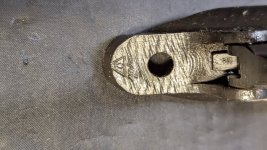
The M1938 does not accept a bayonet. Post-war stock uncommon in an M1938 pattern (no M1944 bayonet groove); This Mosin-Nagant carbine is 40 inches in length and has a stock that is 3.25 inches shorter. The front sight is of the hooded type with a wire pin post instead of a blade. The rear sight is graduated in meters from 100 to 1000. Many of the M38's on the market at this time were fitted with a laminated stock from an M1944, during an arsenal refurbishment, after WWII. Carbines that have been refurbished will sometimes bear a refurbishment mark which is a small square with a line through the center. This model saw extensive use, even the ones that have been refurbished show plenty of wear and mixed serial numbers.

Capture d’écran 2026-07-18 174235.jpg
Capture d’écran 2026-07-18 174259.jpg
PXL_20260718_212412054.jpg
PXL_20251103_215423455.jpg
PXL_20251103_215441506.jpg
PXL_20251103_215459794.jpg
PXL_20251113_233725535.jpg
 
Last edited:
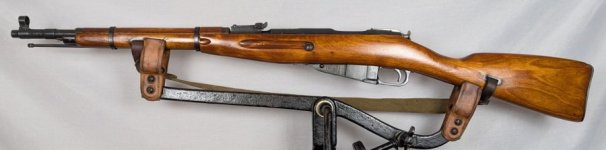
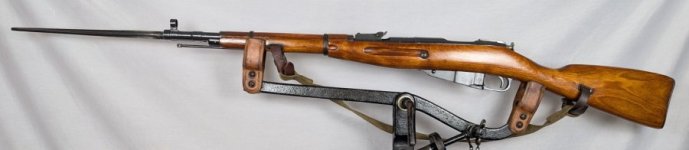
Mosin-Nagant M1944 (Модель 1944 года)
Винтовка Мосина-Наганта
Made by Izhevsk Mechanical Plant
Ижевский Механический Завод, Izhevsky Mekhanicheskiy Zavod
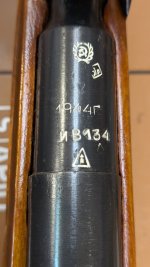
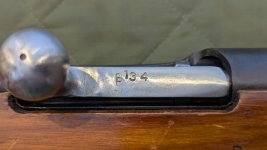
SN# ИВ134 (IV134 in Latin)
1944
Izhevsk production of M1944 in 1944 (1,638,264).
It was put into service at the end of 1943 and remained in production until 1948.
7,62×54mmR (m.1930 typ D)
5 rd. Single stack Integral Box Magazine (Non-removable)
Bolt action (Cocking on open & Round receiver)
Designed by Captain Sergei Ivanovich Mosin & Émile and Léon Nagant.

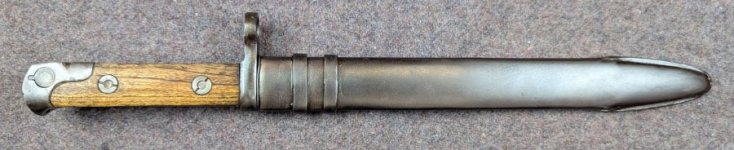
Cruciform bayonet (Fixed side mount); Early primary types of bayonet locking systems; Manufactured by Russia during and after WWII, Hungary, Poland, and Romania after the war. Overall length is 40.4 inches, barrel length is 20.47 inches, front sights are wire pin post, rear sights are graduated 100 to 1000 meters. There are two versions of the front sight and bayonet, the early version bayonet mfg. from 1943 to sometime in 1945 and the later version from 1945 to 1948.

Capture d’écran 2026-07-18 174800.jpg
Capture d’écran 2026-07-18 174934.jpg
Capture d’écran 2026-07-18 174839.jpg
Capture d’écran 2026-07-18 174906.jpg
PXL_20260718_213735434.jpg
PXL_20251103_215642171.jpg
PXL_20251114_002415117.jpg
PXL_20251114_002438557.jpg
 
Last edited:
Mosin-Nagant M1891/30 (Ex-Mosin-Nagant M1891 Dragoon)
Винтовка Мосин-Наган образца 1891/30 «бывший драгунский кавалер»
Vintovka Mosin-Nagan obraztsa 1891/30 «byvshiy dragunskiy kavaler»
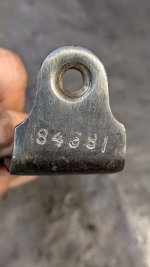
SN# 84381
1928
Production 1893 to 1932 (Izhevsk Mosin-Nagant M1891 Dragoon).
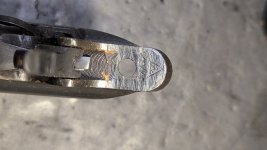
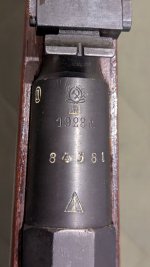
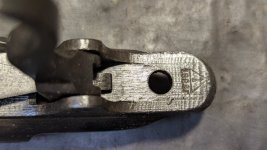
Receiver Tang marking – Year (1928) & Made by Izhevsk (Mosin-Nagant M1891 Dragoon).
7,62×54mmR (m.1930 typ D)
5 rd. Single stack Integral Box Magazine (Non-removable)
Bolt action (Cocking on open & Round receiver)
Designed by Captain Sergei Ivanovich Mosin & Émile and Léon Nagant.

Updated from Izhevsk Dragoon; Shortly after the adoption of the Model 1891 Infantry rifle two shorter versions were developed for mounted troops. The Model 1891 Dragoon was intended for mounted infantry. the Dragoon was sighted with the bayonet attached. Production of these models only took place at Izhevsk and Tula and overlapped Model 1891/30 production by a few years in the early 1930s. Most of these rifles were later updated to Model 1891/30 specifications with new sights, handguards, and barrel bands, but will retain the earlier barrel markings shown on this page. They are commonly referred to as "ex-Dragoons" or "updated Dragoons" by collectors. Among collectors the type of sights is the primary consideration when determining if a rifle is a Dragoon or ex-Dragoon regardless of the handguard and barrel band types.

Capture d’écran 2026-02-10 200248.jpg
Capture d’écran 2026-07-18 175422.jpg
PXL_20260108_205911703.jpg
PXL_20260113_052529671.jpg
PXL_20260113_053134695.jpg
 
Last edited:
Mosin-Nagant M1891/30 PE (Снайперская винтовка)
Винтовка Мосина-Нагана обр.1891/30 г.П. (Ex-Mosin-Nagant M1891/30 PU)
Made by zhevsk Mechanical Plant
Ижевский Механический Завод / Izhevsky Mekhanicheskiy Zavod
SN# ИК4436 (IR4436 in Latin)
1943
159,579 PU sniper rifles were produced in 1943 by Izhevsk.
Receiver Tang marking – Year (Non-visible) & Made by Izhevsk.
7,62×54mmR (m.1930 typ D)
5 rd. Single stack Integral Box Magazine (Non-removable)
Does not work with stripper clips due of the PE Scope mount.
Bolt action (Cocking on open & Round receiver)
Designed by Captain Sergei Ivanovich Mosin & Émile and Léon Nagant.

Production of the PU sniper rifles at the Izhevsk factory began in November 1942; "C in circle" sniper grade proof mark on the left side of the barrel shank.

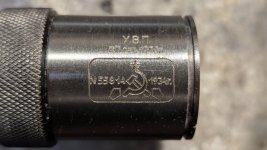
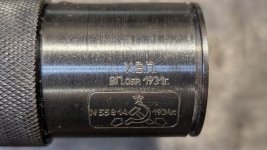
PE scope (Винтовочный оптический прицел образца 1931 г.)
Manufacturer: Factory No. 19/ No. 69 (Factory of precise mechanics), Krasnogorsk
Year of manufacture: 1934 (Production en 1934 = 7,400)
SN# : N55814
Magnification: 3.87x
Objective Lens Diameter: ~30mm (or 30x)
Field of View: 5.5°
Eye Relief: 85 mm
Exit Pupil: 7.6 mm
Lens Coating: Green (tinted)
Mounting: Used with the Smirnsky top mount system
Design: A Soviet copy of a Zeiss design, with early models (1932-1933) having distinct square turret housings and external locks
Evolution: Replaced by the simpler, more common PU scope (3.5x21mm) for later Mosin-Nagant sniper rifles
Functionality: Adjusted via windage (milliradians) and elevation turrets (meters), with a distinctive bent bolt required on the rifle for operation.

Capture d’écran 2026-02-07 172522.jpg
Capture d’écran 2026-07-18 180000.jpg
Capture d’écran 2026-07-18 180101.jpg
Capture d’écran 2026-07-18 180141.jpg
PXL_20260203_035100854.jpg
PXL_20260203_035044262.jpg
PXL_20260203_035153069.jpg
PXL_20251220_000220760.jpg
PXL_20251220_000231603.jpg
 
Last edited:
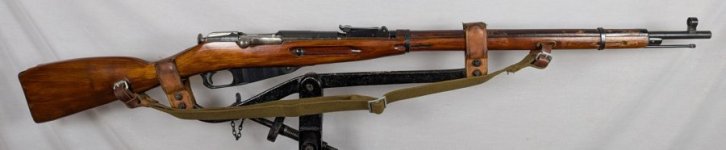
Mosin-Nagant M1891/30 Винтовка Мосина-Нагана обр.1891/30 г.
Made by Izhevsk Mechanical Plant
Ижевский Механический Завод / Izhevsky Mekhanicheskiy Zavod
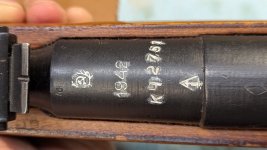
SN# КЦ2751 (KC2751 in Latin)
1942
Receiver Tang marking – Year (Not visible) & Made by (Not visible).
7,62×54mmR (m.1930 typ D)
5 rd. Single stack Integral Box Magazine (Non-removable)
Bolt action (Cocking on open & Round receiver)
Designed by Captain Sergei Ivanovich Mosin & Émile and Léon Nagant.

Capture d’écran 2026-02-10 194848.jpg
Capture d’écran 2026-07-18 180817.jpg
PXL_20260718_221150615.jpg
PXL_20260718_221600355.jpg
PXL_20260205_212110867.jpg
PXL_20260205_212532244.jpgCapture d’écran 2026-04-06 223843.jpg
Capture d’écran 2026-04-06 223924.jpg
 
Last edited:
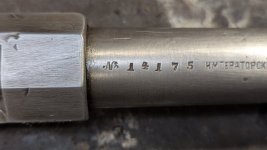
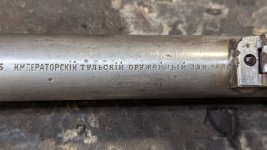
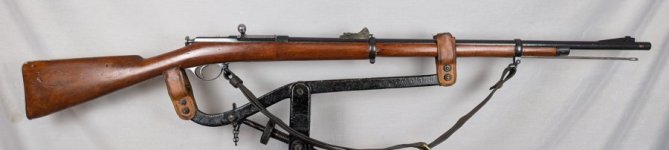
M1870 (AKA ‘’Russian Berdan II’’)
Pekhotniya vintovka Berdana obr. 1870g / Пехотная винтовка Бердана образца 1870 года
SN# 14175
1880
Production: 1870-1891, total production about 3,2 million.
10,75x58mmR (Berdan) - M1870 ball ammunition – Black Powder (Metal cartridge - Single shot)
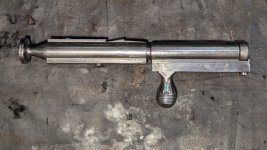
Bolt Action (Turning-bolt action & Cocking on close)
Design by Hiram Berdan.

100 prototypes Made in the USA (1869); 30,000 Made by Birmingham Small Arms Co, England, (1870-73) & 1,000,000+ Made by Ishevsk & Tula, Russia (1874-92); Caliber: 10.67x58mm rimmed & Muzzle velocity 437 m/sec M1870 ball ammunition; Turning-bolt action, locked by the bolt-handle rib abutting the receiver bridge; 1355mm [53.3"] overall, 4.4kg [9.6 lbs]; 833mm [32.8"] barrel, 6-groove rifling, RH, concentric. The machinery for the Russian factories was originally made in Leeds, England. Manufacturing was started in 1874 in Tula and in 1878 in Ishevsk. Russian experiments with quick loaders and magazines during 1877-85:
1. Sylvester Krnka Quick Loader: a 10-round canvas cartridge box strapped to a plate on the left side of the forend ahead of the chamber.
2. Lutkovskiy Magazine: a 6-round magazine, which hung on the left side of the breech.
3. Schulhof Butt-Magazine system: a 20-round tube and elevator cartridge feeding system located inside the buttstock.

Mostly in 1915 Austro-Hungarian forces on the Eastern front captured quantities of Russian Berdan M1870 (Berdan II) rifles along with the Mosin Nagant M1891 rifles and also received large numbers taken by the Germans. Captured and inspected rifles were marked with 'AZF' (Artillerie Zeugs Fabrik) and/or 'OEWG' (OEsterreichische Waffenfabrik Gesellschaft) on the receiver. The AZF marked guns in Austro-Hungarian service were issued with captured 10.67x58mm Russian ammunition. When supplies begun to run short, some guns were rebarreled in the Wiener-Neustadt Armory for the standard rimmed 8x50mm Austrian round. The OEWG marked guns went through arsenal repairs/reconditioning or caliber conversion.

Main designer of Berdan rifles was American Colonel Hiram Berdan (1824 - 1893), who had gained reputation with unit of his own during US Civil War. First version of his rifle was m/1868, which was accepted to Russian military use in 1870 but only about 46,600 were ever produced. From those 46,600 rifles Colt manufactured 30,000 and the remaining 16,600 were manufactured in Russia by Tula and Sestroryetsk before Berdan II (AKA M1870) replaced M1868 in production in year 1874. As the name suggests the main designer was Hiram Berdan, but also Russian Colonel Gorlov and Lieutenant Hunnius played important role in planning, improving and introducing the design of Berdan M1868 to use of Russian military. Locking mechanism of Berdan m/1868 was not yet bolt-action in modern sense and reloading it was much more complicated process.

Colonel Berdan continued developing the rifle also after the Russian military had adopted his m/1868 rifle design. This development work led to new improved rifle, which Berdan presented to Russian officials during his visit to St. Peterburg in year 1869. Unlike Soviet literature (for sense of national pride?) used to claim all the main improvements of the new rifle model were designed by Hiram Berdan. The main difference to older m/1868 was bolt-action locking mechanism sliding in receiver - a real bolt-action rifle action in modern sense instead of hammerless trapdoor-like design of Berdan M1868. The Russians organised tests in which the new rifle proved so superior, that they decided to replace just recently adopted Berdan m/1868 with it. The main advantage of the new rifle was due to its bolt mechanism, which allowed much faster reloading and therefore considerably increased rate-of-fire. The improved rifle, also known as Berdan II, was approved to Russian use in year 1870 and some 3.2 million rifles of this type were manufactured. Early on Birmingham Small Arms Company (BSA) manufactured 30,000 rifles for Russia, but the Russians did not buy more rifles from BSA after this first delivery. Soon main Russian arsenals (Tula, Izhevsk and Sestroryetsk) started all manufacturing Berdan M1870 rifles. All three Russian arsenals manufactured Berdan m/1870 rifles in 1874 - 1879 with their combined total production reaching about 1.68 million rifles. From these Tula manufactured about 553,000 rifles, Sestroryetsk about 525,000 rifles and Izhevsk about 602,000 rifles. What is known suggests that production of Cossack rifle, Dragoon rifle and carbine version is included to those numbers.

Russian Army used Berdan M1870 rifle in Turkish War of 1877 - 1878. It presumably fared fairly well against Turkish Peabody-Martini rifles, but less so against Winchester Model 1866 and Model 1873 repeater rifles, which the Turkish military also had in its inventory. Even if Berdan M1870 was much better than earlier Russian rifles, it was still just single shot rifle - lacking magazine of any sort. Basically, this meant that after each shot the used cartridge case had to be removed and new cartridge had to be inserted to action by hand before closing the bolt mechanism. Firepower-wise it could not really compete with lever-action rifles, which had 15-round tubular magazines. Losses that the Russian infantry suffered in battles were simply appalling. While Russian use of already outdated tactics seems to have been a major factor for reasons that caused this, Berdan M1870 rifle was made the scapegoat for poor Russian military performance. Hence increasing rate-of-fire for the rifles became a matter of highest priority for Russian military. They first tried adding magazine to Berdan M1870 rifle, but none of the tested designs proved particularly successful. Only real solution was to get a new repeater-rifle, that rifle was 7,62 mm Mosin-Nagant M1891, which replaced Berdan rifles in frontline use before World War 1. However, as all major nations taking part World War 1, Russia underestimated the number of rifles they actually needed in case of major war. Hence due to serious shortage of rifles during World War 1 Russian military was forced to reintroduce Berdan M1870 rifles and carbines back into military use. Year 1918 many Russian military units stationed in Finland still had Berdan M1870 rifles in their use.

Special Features: Modified rear sight of unknown origin. Modern 20th-century front sight (modified), provenance unknown. Bayonet lug removed. (In this condition at the time of acquisition, in addition to the wood being painted black and varnished with floor varnish).

Capture d’écran 2026-04-28 220306.jpg
Capture d’écran 2026-07-18 182952.jpg
PXL_20260421_170130402.jpg
PXL_20260421_170136177.jpg
PXL_20260429_025102381.jpg
PXL_20260429_025212185.jpg
PXL_20260429_025223590.jpg
PXL_20260422_001319069.jpg
 
Last edited:
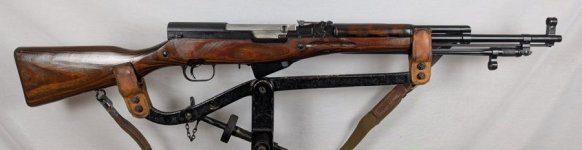
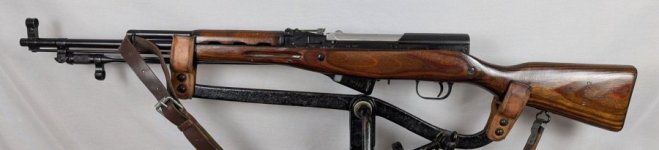
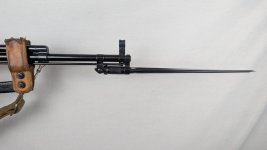
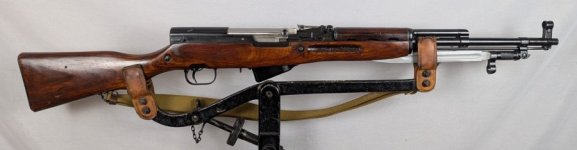
Simonov SKS-45
Full Russian name: Samozaryadnyj Karabin sistemy Simonova 1945 (or in Cyrillic: Самозарядный карабин системы Симонова, 1945; CKC-45)
Made by Tula (Tula Arms Plant) Toulski Oroujeïny Zavod / Завод по производству оружия в Туле
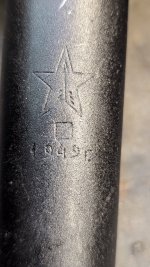
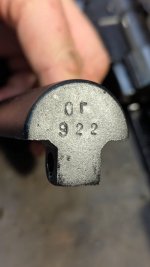
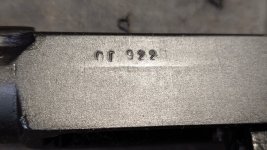
SN# ОГ922 (OG922 in Latin)
1949 (First year of production)
In 1949 the USSR began full production of the SKS-45 and continued to produce it through 1958. Production figure of 2,7 million for the SKS-45.
7,62x39mm (M43)
10 Rd. Double stack Integral Box magazine (Pinned to 5 rd. for Canada) - (Non-removable)
Semi-automatic (Gas-operated reloading)
Designed by Sergei Simonov.

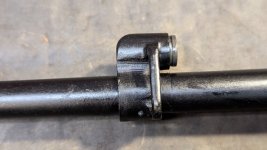
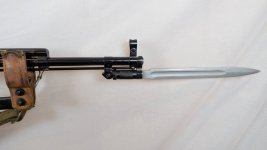
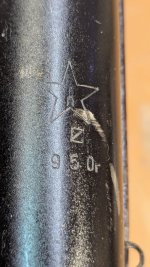
First year of production; Rarity fact: The 1949 Russian SKS represents approximately 0.14% of all SKS production and is considered extremely rare; Obvious 1949 unique parts: The Cruciform (Spike) Bayonet; Spring-Loaded Firing Pin; Square Gas Block & Looped Receiver Cover Latch; Some parts are force matched as a result of the arsenal refurbish process; Laminated stock; The 1949 Tula was the very first production SKS-45 and has a lot of unique features, The 49' has many features that are not seen on any other SKS-45, here is a list of the different features. Probably the most notable difference is an original 49' will have a blued 4 lobe spike bayonet, 90-degree gas block, looped takedown lever, hand etched top cover stampings; From 1949-55 Tula origin was clearly designated by an arrow inside a star on the top of the receiver cover and the left side of the buttstock. 1949 had an original black spike bayonet similar to the Mosin-Nagant M-44 Soviet bayonet.

Capture d’écran 2026-02-10 192557.jpg
Capture d’écran 2026-07-18 184215.jpg
Capture d’écran 2026-07-18 184256.jpg
Capture d’écran 2026-07-18 184325.jpg
PXL_20260624_155903009.jpg
PXL_20251229_185217202.jpg
PXL_20251229_185223739.jpg
PXL_20251229_185310008.jpg
PXL_20251229_185354234.jpg
 
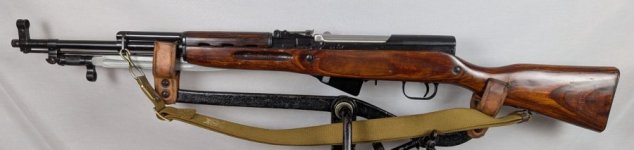
Simonov SKS-45
Full Russian name: Samozaryadnyj Karabin sistemy Simonova 1945 (or in Cyrillic: Самозарядный карабин системы Симонова, 1945; CKC-45)
Made by Tula (Tula Arms Plant) Toulski Oroujeïny Zavod / Завод по производству оружия в Туле
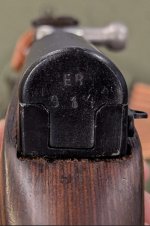
SN# EB914 (EV914 in Latin)
1950
Based on its characteristics, this SKS-45 was manufactured in the first half of 1950. In 1949 the USSR began full production of the SKS-45 and continued to produce it through 1958. Production figure of 2,7 million for the SKS-45.
7,62x39mm (M43)
10 Rd. Double stack Integral Box magazine (Pinned to 5 rd. for Canada) - (Non-removable)
Semi-automatic (Gas-operated reloading)
Designed by Sergei Simonov.

The 1950 SKS-45 is a very collectable year also for 2 reasons, it is a transitional year meaning the Russians were experimenting with different changes to the carbine as the year went on, very early 50's will have a 90-degree gas block looped take down lever, hand etched top cover marking, these are extremely collectable. Laminated stock; Blade bayonet; 90-degree gas block, looped takedown lever; From 1949-55 Tula origin was clearly designated by an arrow inside a star on the top of the receiver cover and the left side of the buttstock.

Capture d’écran 2026-02-10 191438.jpg
Capture d’écran 2026-07-18 185116.jpg
Capture d’écran 2026-07-18 184902.jpg
Capture d’écran 2026-07-18 184931.jpg
PXL_20251228_034725334.jpg
PXL_20260624_153939696.jpg

Capture d’écran 2026-07-18 185458.jpg
PXL_20250626_201755493.jpg
Capture d’écran 2026-07-18 185644.jpg
 
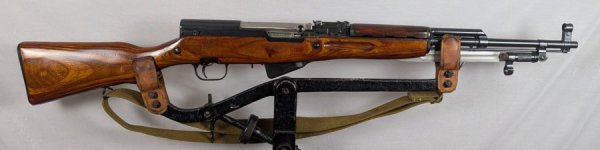
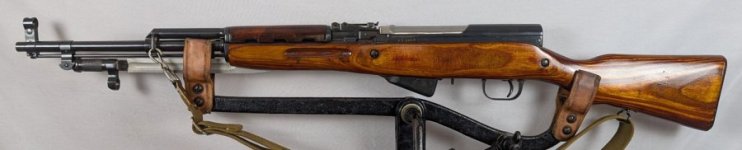
Simonov SKS-45
Full Russian name: Samozaryadnyj Karabin sistemy Simonova 1945 (or in Cyrillic: Самозарядный карабин системы Симонова, 1945; CKC-45)
Made by Tula (Tula Arms Plant) Toulski Oroujeïny Zavod / Завод по производству оружия в Туле
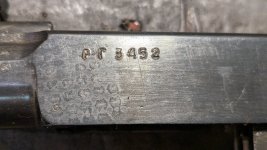
SN# РГ3452 (RG3452 in Latin)
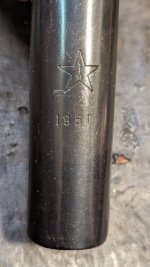
1951
7,62x39mm (M43)
10 Rd. Double stack Integral Box magazine (Pinned to 5 rd. for Canada) - (Non-removable)
Semi-automatic (Gas-operated reloading)
Designed by Sergei Simonov.

Capture d’écran 2026-01-28 174107.jpg
Capture d’écran 2026-07-18 185902.jpg
PXL_20260128_041810412.jpg
PXL_20260128_034719044.jpg
PXL_20260128_041628706.jpg
Capture d’écran 2026-07-18 190224.jpg
 
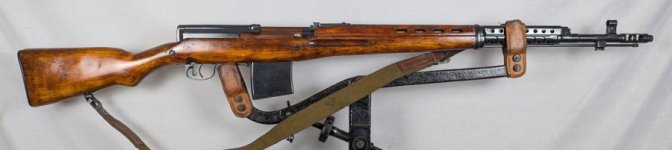
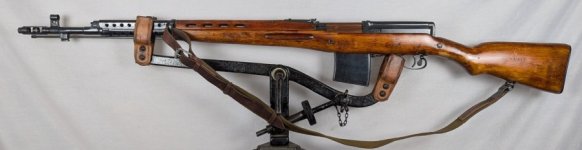
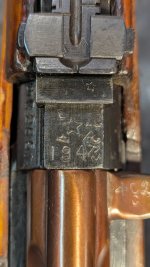
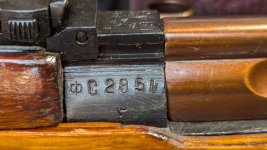
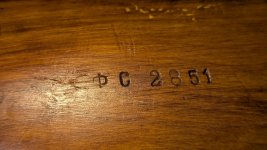
Tokarev SVT-40 (Токарев СВТ-40) – (AKA Svetka)
Made by Tula (Tula Arms Plant) Toulski Oroujeïny Zavod / Завод по производству оружия в Туле
SN# ФС2851 (FS2851 In Latin)
1943
7,62×54mmR (m.1930 typ D)
10 rd. Double stack Box Magazine (Removable) - (Pinned to 5 rd. for Canada)
Semi-automatic (Gas-operated reloading - Short-stroke)
Дизайн Федора Васильевича Токарева
Design by Fiodor Vassilievitch Tokarev.

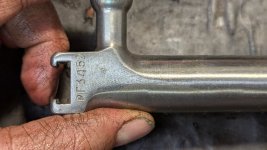
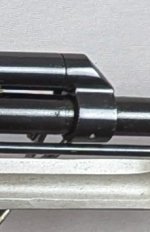
Later (Refurbishment) bluing on bolt & bolt carrier (It turns out more reddish because of the type of steel alloy used for those pieces. The alloy and the hardening are responsible for the color); Receiver with no rails for scope; late single piece front barrel band; Wide stock with two cutouts; Early stock with swivel; Early grooved flat rear sight leaves; Later barrel shroud (metal vented handguard); Early top barrel shroud (vented metal handguard) 8 holes version; No hole in safety/selector switch; Late trigger guard; Round back wall; Cleaning rod (645mm); Muzzle brake (Early Podolskt wo-port muzzle brake); Receiver type 3 (SVT-40); Magazine Type 3 with double lug and seam (Represents typical early Type 3 mag).

Capture d’écran 2026-03-23 153800.jpg
Capture d’écran 2026-07-18 190443.jpg
PXL_20260322_221058682.jpg
PXL_20260322_221104289.jpg
PXL_20260323_163953196.jpg
Capture d’écran 2026-04-07 160118.jpg
Capture d’écran 2026-04-07 160209.jpg
 
Last edited:
To my knowledge, the magazines of the SVT-38 as well as the SVT-40 are all double stack, but anything is possible in the world of Soviet weapons manufacturing.

I was referring more to the Mosin Nagant variants.
I've only messied with 1 SVT40...too loud for my liking.
 
Last edited:
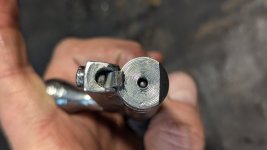
Many of the berdan 2 rifles in Canada were demilitarized with a hole drilled across the receiver and barrel chamber. It seems some of these were welded up and the chambers re-cut by who knows who. Jury seems out on whether they can be safely shot.

Your example appears to be one of these, based on your photos - in case you were not aware.
 
Many of the berdan 2 rifles in Canada were demilitarized with a hole drilled across the receiver and barrel chamber. It seems some of these were welded up and the chambers re-cut by who knows who. Jury seems out on whether they can be safely shot.

Your example appears to be one of these, based on your photos - in case you were not aware.
(M1870 Berdan II) This one is functional and has no holes as you told me.
 
Back
Top Bottom