Introduction
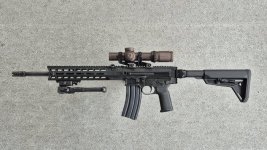
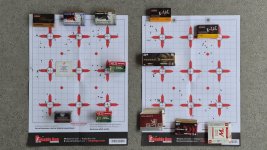
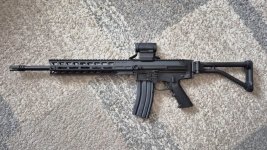
The purpose of this report is to provide Canadian firearms owners a realistic construction and accuracy review of this boutique firearm. This report will not investigate the long-term reliability of the rifle. There is a lack of unbiased reviews on the Makasi which has led to intense speculation regarding the purported reliability, accuracy, quality, and value of the firearm.It should be noted that that the version being evaluated in this report is a 16” Restricted rifle that was imported by IRunGuns. This model should be regarded as representative of the flagship model being sold on the American market for the past 3 years. This specific rifle should have been manufactured before the Canadian market placed large orders with Brigade Mfg. The Non-Restricted rifles expected to arrive in Canada late Summer 2026 may exhibit differences in construction and production quality.
First Impressions
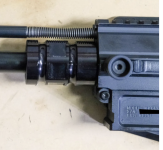
The rifle takes design cues originating from the FN FAL including the charging handle, magwell cutout, takedown lever, and folding stock. The handguard, and lower receiver ergonomics are likewise similar to the AR15. It is surprisingly light and well balanced, weighing 7 lbs 0.3 oz without a magazine. The internals are heavily oiled from the factory and there are minor machining marks on the exterior of the rifle which are clearly visible but functionally inconsequential. The buttstock length of pull is relatively short, measuring at 12.5” and requires intentional force to fold. The safety selector and trigger are basic milspec with a mushy ~4.5 to 5.5 lbs trigger pull. There is no wiggle between the upper and lower receivers and takedown is intuitive. It is interesting to note that my rifle has a serial number under 500 which will be discussed below.Construction Review
Gas System
The barrel is 16” length, 1:7” twist, government profile, carbine gas length, 4150 CMV nitride. It is AR15 compatible if the replacement barrel is carbine gas length with a 0.750” gas journal for the proprietary gas block.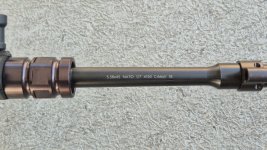
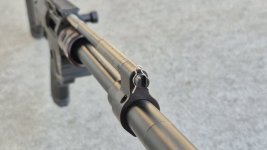
The gas system is a near direct copy of the Brownells BRN-180 and consequently the AR18 short stroke gas system design. The gas block is 2-position adjustable for both suppressed and unsuppressed settings and is pinned to the barrel with an additional 2 set screws underneath. The digital user manual incorrectly identifies the gas settings of the 2-position adjustable gas block. Based on the construction, the correct unsuppressed setting has the slot on the front of gas adjustment valve set vertically, and the suppressed setting is horizontally. Users should ensure that their gas system is set appropriately if the rifle does not function properly.
The gas adjustment valve is secured in place with a hairpin clip which was inappropriately oversized. The clip fell off easily when the handguard was removed, but the user can pinch the clip together to improve securement. However, the pin does not affect the function of the rifle and is useful for disassembly and reassembly of the gas system for cleaning.
Handguard
The handguard is a clamp-on, friction-fit design that tightens around the steel barrel nut using steel cross bolts. However, the clearance slots in the barrel nut and the location of the steel cross bolts interfere with each other such that the cross bolts are partially threaded into the barrel nut. The steel cross bolts are also threaded directly into the aluminum handguard which will degrade over time from disassembly and reassembly when cleaning the gas system. There was no thread locking compound used by the manufacturer to secure the cross bolts to the handguard. Metal dust was found when removing the handguard indicating the steel or aluminum materials have been degraded by the cross bolt assembly process.The Picatinny and M-LOK rails are dimensionally out of spec which causes issues with mounting certain attachments to the handguard. The Picatinny slots are cut too shallow, and the M-LOK slots are too narrow. There is also insufficient width on the backside of the M-LOK slots to allow the T-nuts to fully lock into place. Additionally, the Picatinny rail does not align with the rail of the upper receiver.
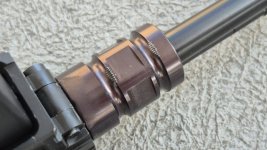
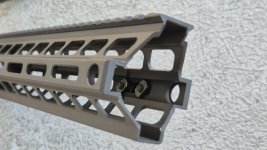
Since the handguard and barrel nut have been forced together by the misaligned cross bolts, it is very likely that loading the handguard on obstacles or a bipod will cause an excessive point-of-impact shift to the rifle. For bench shooters, this will cause repeatability and reproducibility issues if the rifle is not loaded with the same pressures and location between strings of fire.
Upper Receiver
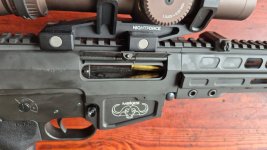
Like the handguard, the upper receiver Picatinny rail is out of spec which may cause issues with compatibility with certain attachments or optics. Again, the slots are cut too shallow and optic mount screws may scrape the finish of the rail off.The rifle lacks a brass deflector so extracted brass may be flung behind the ejection port causing wear to the upper receiver. This is similar to the original FN FAL and SIG SG 540/550 series designs and can be mitigated by sticking adhesive Velcro behind the ejection port. Left-handed users may find that brass is ejected directly into their face.
Charging Handle
The charging handle design is copied from a metric pattern FN FAL. It is non-reciprocating, uses a ball detent to secure itself to the upper receiver, and is generously large for easy manipulation. The charging handle slot in the upper receiver is covered by the charging handle slide to prevent the ingress of dust and dirt into the receiver. Overall, the charging handle is fairly stiff and rough to operate but may wear in through use. When pulled to the rear, the charging handle slide may interfere with wide or folding buttstock assemblies. The charging handle cannot be operated when the original folding “para” stock is folded to the left of the rifle.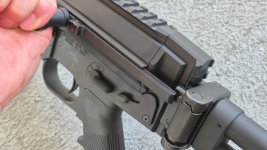
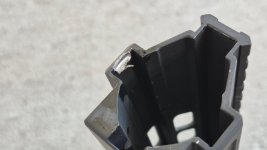
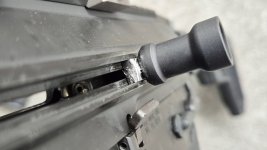
Pulling back the charging handle and releasing causes the charging handle slide to wedge itself under the handguard. In addition to the metal chipping and peening, the charging handle can be wedged so tightly that the rifle must be mortared or slammed into a barrier to operate again. This is a significant and repeatable failure of the rifle during normal operation that cannot be neglected, though it may wear in through use.
Bolt Carrier Group
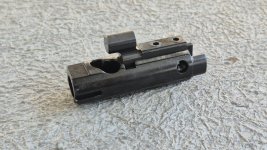
Like most of the crucial operating parts of the Makasi, the BCG is derived from the AR15 with many parts being compatible. The bolt carrier is proprietary but is similar to an AR15 apart from the rear tail being truncated and lacking gas vents. The bolt assembly is AR15 compatible, as is the firing pin, firing pin retaining pin, and cam pin. It is marked MPI but no indication of HPT. It also appeared unfired from the factory.The gas key is replaced with a piston strike face for the operating rod to strike against. It has a recoil boss with the bolt carrier to prevent the piston impulse from imparting energy directly into the gas key screws to cause them to shear. The gas key screws are not staked which may allow them to loosen over time, and they do not exhibit the knurling that makes staking effective. Since the recoil spring is in line with the gas piston, this should minimize the effects of carrier tilt causing excessive internal wear.
Lower Receiver
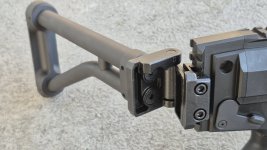
The lower receiver exhibits AR15 ergonomics and an FN FAL takedown lever. Takedown is intuitive and lifting the takedown lever is stiff to prevent unintentional operation. The Makasi comes with a basic milspec trigger group, safety selector, magazine release, and A2 pistol grip. All these parts are AR15 compatible and can be upgraded by the user, but the pistol grip cannot have a beavertail. Again, the Picatinny slots for attaching a stock are cut too shallow and the screws of the folding stock were scraping the finish of the rail off.Bolt Catch
The bolt catch is a proprietary design to provide clearance between the upper and lower receivers. The bolt release button is angled outwards from the rifle and requires excessive force to activate. This was determined to be due in part to sloppy tolerances which pinch the bolt catch into the lower receiver, though this may wear in and improve through use.Folding “Para” Stock
The folding FN FAL paratrooper-inspired stock rounds off the aesthetic of the Makasi despite not being exactly faithful in appearance. On its own, the stock assembly weighs in at 1 lb 7.0 oz due to its steel construction. It is very stiff to fold and has some retention while folded. Additionally, the stock can be adjusted to fold left or right with a couple of screws. The length of pull is short at 12.5”. The stock is attached via the Picatinny rail section on the rear of the lower receiver which opens up possibilities for the user to attach their own preferred stock.