Brigade Mfg. Makasi MK-15 Construction and Accuracy Review

Sma the Average

New member
Rating - 0%
0   0   0
Location
BC
Setup (1).jpg
Being an early adopter of the Makasi MK-15, I thought I would share my experiences so that potential buyers can make an informed decision to purchase this rifle. The following review is an excerpt from my report on the Brigade Mfg. Makasi MK-15. Please find the complete report with photos here: https://drive.google.com/drive/folders/11YDbqxH2p0BJLQTxt_2dmiVq34_S1OQD?usp=sharing

Introduction

The purpose of this report is to provide Canadian firearms owners a realistic construction and accuracy review of this boutique firearm. This report will not investigate the long-term reliability of the rifle. There is a lack of unbiased reviews on the Makasi which has led to intense speculation regarding the purported reliability, accuracy, quality, and value of the firearm.

It should be noted that that the version being evaluated in this report is a 16” Restricted rifle that was imported by IRunGuns. This model should be regarded as representative of the flagship model being sold on the American market for the past 3 years. This specific rifle should have been manufactured before the Canadian market placed large orders with Brigade Mfg. The Non-Restricted rifles expected to arrive in Canada late Summer 2026 may exhibit differences in construction and production quality.

First Impressions

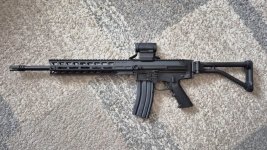
The rifle takes design cues originating from the FN FAL including the charging handle, magwell cutout, takedown lever, and folding stock. The handguard, and lower receiver ergonomics are likewise similar to the AR15. It is surprisingly light and well balanced, weighing 7 lbs 0.3 oz without a magazine. The internals are heavily oiled from the factory and there are minor machining marks on the exterior of the rifle which are clearly visible but functionally inconsequential. The buttstock length of pull is relatively short, measuring at 12.5” and requires intentional force to fold. The safety selector and trigger are basic milspec with a mushy ~4.5 to 5.5 lbs trigger pull. There is no wiggle between the upper and lower receivers and takedown is intuitive. It is interesting to note that my rifle has a serial number under 500 which will be discussed below.

Construction Review

Gas System

The barrel is 16” length, 1:7” twist, government profile, carbine gas length, 4150 CMV nitride. It is AR15 compatible if the replacement barrel is carbine gas length with a 0.750” gas journal for the proprietary gas block.
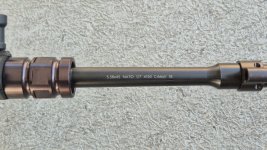
Gas system barrel information.jpg

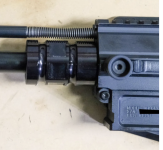
The gas system is a near direct copy of the Brownells BRN-180 and consequently the AR18 short stroke gas system design. The gas block is 2-position adjustable for both suppressed and unsuppressed settings and is pinned to the barrel with an additional 2 set screws underneath. The digital user manual incorrectly identifies the gas settings of the 2-position adjustable gas block. Based on the construction, the correct unsuppressed setting has the slot on the front of gas adjustment valve set vertically, and the suppressed setting is horizontally. Users should ensure that their gas system is set appropriately if the rifle does not function properly.

The gas adjustment valve is secured in place with a hairpin clip which was inappropriately oversized. The clip fell off easily when the handguard was removed, but the user can pinch the clip together to improve securement. However, the pin does not affect the function of the rifle and is useful for disassembly and reassembly of the gas system for cleaning.
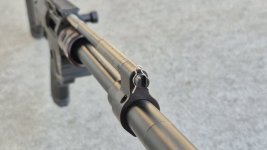
Gas system gas adjustment valve.jpg

Handguard

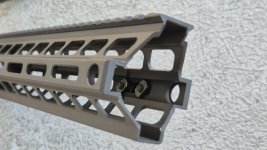
The handguard is a clamp-on, friction-fit design that tightens around the steel barrel nut using steel cross bolts. However, the clearance slots in the barrel nut and the location of the steel cross bolts interfere with each other such that the cross bolts are partially threaded into the barrel nut. The steel cross bolts are also threaded directly into the aluminum handguard which will degrade over time from disassembly and reassembly when cleaning the gas system. There was no thread locking compound used by the manufacturer to secure the cross bolts to the handguard. Metal dust was found when removing the handguard indicating the steel or aluminum materials have been degraded by the cross bolt assembly process.

The Picatinny and M-LOK rails are dimensionally out of spec which causes issues with mounting certain attachments to the handguard. The Picatinny slots are cut too shallow, and the M-LOK slots are too narrow. There is also insufficient width on the backside of the M-LOK slots to allow the T-nuts to fully lock into place. Additionally, the Picatinny rail does not align with the rail of the upper receiver.
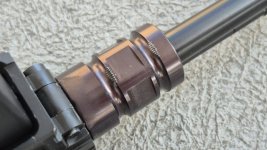
Handguard barrel nut damage.jpg Handguard MLOK Tnut failure.jpg

Since the handguard and barrel nut have been forced together by the misaligned cross bolts, it is very likely that loading the handguard on obstacles or a bipod will cause an excessive point-of-impact shift to the rifle. For bench shooters, this will cause repeatability and reproducibility issues if the rifle is not loaded with the same pressures and location between strings of fire.

Upper Receiver

Like the handguard, the upper receiver Picatinny rail is out of spec which may cause issues with compatibility with certain attachments or optics. Again, the slots are cut too shallow and optic mount screws may scrape the finish of the rail off.

The rifle lacks a brass deflector so extracted brass may be flung behind the ejection port causing wear to the upper receiver. This is similar to the original FN FAL and SIG SG 540/550 series designs and can be mitigated by sticking adhesive Velcro behind the ejection port. Left-handed users may find that brass is ejected directly into their face.

Charging Handle

The charging handle design is copied from a metric pattern FN FAL. It is non-reciprocating, uses a ball detent to secure itself to the upper receiver, and is generously large for easy manipulation. The charging handle slot in the upper receiver is covered by the charging handle slide to prevent the ingress of dust and dirt into the receiver. Overall, the charging handle is fairly stiff and rough to operate but may wear in through use. When pulled to the rear, the charging handle slide may interfere with wide or folding buttstock assemblies. The charging handle cannot be operated when the original folding “para” stock is folded to the left of the rifle.
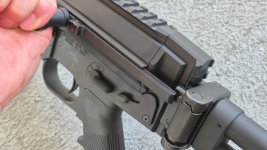
Charging handle stock interference.jpg

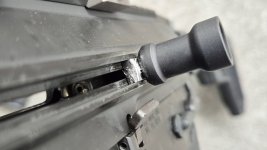
Pulling back the charging handle and releasing causes the charging handle slide to wedge itself under the handguard. In addition to the metal chipping and peening, the charging handle can be wedged so tightly that the rifle must be mortared or slammed into a barrier to operate again. This is a significant and repeatable failure of the rifle during normal operation that cannot be neglected, though it may wear in through use.
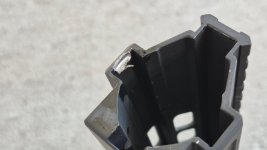
Handguard damage from charging handle slide.jpg Charging handle slide damage (2).jpg

Bolt Carrier Group

Like most of the crucial operating parts of the Makasi, the BCG is derived from the AR15 with many parts being compatible. The bolt carrier is proprietary but is similar to an AR15 apart from the rear tail being truncated and lacking gas vents. The bolt assembly is AR15 compatible, as is the firing pin, firing pin retaining pin, and cam pin. It is marked MPI but no indication of HPT. It also appeared unfired from the factory.

The gas key is replaced with a piston strike face for the operating rod to strike against. It has a recoil boss with the bolt carrier to prevent the piston impulse from imparting energy directly into the gas key screws to cause them to shear. The gas key screws are not staked which may allow them to loosen over time, and they do not exhibit the knurling that makes staking effective. Since the recoil spring is in line with the gas piston, this should minimize the effects of carrier tilt causing excessive internal wear.
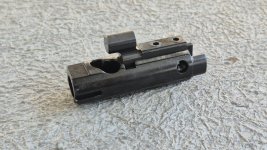
Bolt carrier.jpg

Lower Receiver

The lower receiver exhibits AR15 ergonomics and an FN FAL takedown lever. Takedown is intuitive and lifting the takedown lever is stiff to prevent unintentional operation. The Makasi comes with a basic milspec trigger group, safety selector, magazine release, and A2 pistol grip. All these parts are AR15 compatible and can be upgraded by the user, but the pistol grip cannot have a beavertail. Again, the Picatinny slots for attaching a stock are cut too shallow and the screws of the folding stock were scraping the finish of the rail off.

Bolt Catch

The bolt catch is a proprietary design to provide clearance between the upper and lower receivers. The bolt release button is angled outwards from the rifle and requires excessive force to activate. This was determined to be due in part to sloppy tolerances which pinch the bolt catch into the lower receiver, though this may wear in and improve through use.

Folding “Para” Stock

The folding FN FAL paratrooper-inspired stock rounds off the aesthetic of the Makasi despite not being exactly faithful in appearance. On its own, the stock assembly weighs in at 1 lb 7.0 oz due to its steel construction. It is very stiff to fold and has some retention while folded. Additionally, the stock can be adjusted to fold left or right with a couple of screws. The length of pull is short at 12.5”. The stock is attached via the Picatinny rail section on the rear of the lower receiver which opens up possibilities for the user to attach their own preferred stock.
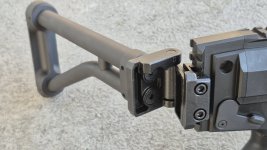
Stock folding.jpg
 

Shooting and Accuracy Review

Preparation and Setup

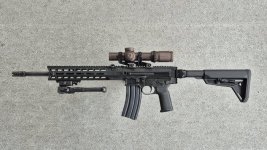
Prior to taking the rifle to the range, the barrel and bolt carrier group were cleaned of any factory oils or grease. The bolt carrier group and charging handle were then relubricated to mitigate wear. The optic used was a Vortex Optics Razor HD Gen III 1-10x24 LPVO in a Nightforce Ultramount with all mounts torqued to factory specification. A Knights Armament Company precision bipod was attached to the rifle. The para folding stock was replaced with a SBI Picatinny buffer tube adapter and Magpul SL carbine stock for additional, adjustable length of pull. The rear of the rifle was supported by a bag as a consistent rest. A Magpul K2 XL grip was modified to fit the rifle for ergonomic handling, and an ALG Defense milspec trigger was added for a crisper trigger pull.
Setup (2).jpg

Reliability

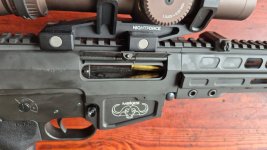
For this range trip, 281 rounds were fired through the Makasi. The firing schedule began with 90 rounds of PMC X-TAC M193 ammunition to break-in the rifle while zeroing the optic. This ammunition was selected because it is considered “hotter” than typical loads. The first shot did not cycle the rifle – the casing extracted but the bolt did not pick up the next round in the magazine. The gas system adjustment valve was then switched to the suppressed setting to ensure that there was no user error in selecting the gas setting. Firing the next round did not extract the casing so the gas system was switched back to the unsuppressed setting. For the rest of these break-in rounds, the rifle operated identically to a straight-pull action rifle as the bolt always failed to pick up the next round. The variety of magazines had no difference in reliability.

After the initial 90 rounds, it was decided to begin the accuracy evaluation. 13 cartridge loadings were tested. Groups were shot over a period of 2 hours with adequate time between strings of fire to allow the barrel to cool. In total, 131 rounds were shot during this period. Throughout the accuracy evaluation, the rifle continued to fail picking up the next round about 75% of the time with many failures to feed and jams regardless of the ammunition used. By the end of the accuracy evaluation, the rifle may fire up to 7 rounds at a time without jamming.

After the accuracy evaluation, an additional 60 rounds of spare ammunition were fired to continue breaking in the rifle. At the end of this string of fire, the rifle was able to barely cycle all 10 rounds of .223 Rem-spec ammunition in a magazine without issue.
Shooting failure to feed.jpg

Accuracy

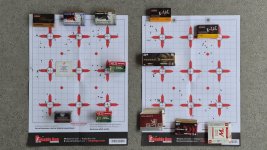
As the barrel is compatible with an AR15, accuracy was expected to be on par or slightly worse than an AR15 due to its short stroke gas piston system. 10 round groups were measured with various ammunition types at a range of 100 yards. Environmental conditions were cloudy with a high of 20°C and low to no wind. Groups were measured with all 10 rounds (100%), the tightest 9 rounds (90%), and the tightest 8 rounds (80%) to account for any fouling shots or shooter-induced error.
Targets.jpg

Cartridge Description​
80% Group (MOA)​
90% Group (MOA)​
100% Group (MOA)​
Federal Premium Gold Medal Sierra MatchKing
223 Rem, 77 Grain, Sierra Matchking BTHP
0.98​
1.88​
2.11​
Sellier & Bellot Tactical Rifle Ammunition
223 Rem, 69 Grain, HPBT
1.00​
1.34​
2.11​
Barnaul
223 Rem, 62 Grain, SPBT, lacquered steel case
2.04​
2.44​
3.00​
Barnaul
223 Rem, 55 Grain, HPBT, lacquered steel case
2.07​
2.44​
2.70​
PMC X-TAC M193
5.56 NATO, 55 Grain, FMJBT
2.28​
2.52​
3.78​
PMC Bronze
223 Rem, 55 Grain, FMJBT
2.52​
3.04​
3.25​
Chinese Surplus M193
5.56 NATO, 55 Grain, FMJBT
2.88​
3.01​
3.87​
Federal American Eagle
5.56 NATO, 55 Grain, FMJ
2.96​
3.75​
4.44​
MFS
223 Rem, 55 Grain, FMJ, zinc plated steel case
3.07​
3.74​
4.02​
Winchester “USA White Box” M193
5.56 NATO, 55 Grain, FMJ
3.14​
3.75​
5.11​
Federal American Eagle
223 Rem, 55 Grain, FMJ
3.44​
3.56​
5.19​
PMC X-TAC M855
5.56 NATO, 62 Grain, Green Tip
4.52​
–*​
–*​
Federal American Eagle
223 Rem, 62 Grain, FMJ BT
4.91​
5.02​
6.60​
Average​
2.76​
3.04​
3.85​
*Note: Measurements not taken due to the rounds impacting off the target paper.

When considering the 100% groups, the results are as expected; on par or slightly worse than comparable AR15 1:7” barrels which prefer higher grain weight bullets. Surprisingly, the Barnaul cartridges outperformed expectations, and other 62 grain bullets performed very poorly.

Observations

The most concerning issue found during the construction review seems to correct itself through wear. The charging handle slide impacting the handguard removed enough material that there is now clearance between the components and it no longer becomes stuck. There is a significant amount of metal shavings where the material was forcibly removed. The charging handle continues to work as intended but the longevity of the design remains to be determined. It also began to operate more smoothly when charged, and the bolt catch became easier to operate through use.

As expected, due to the lack of a brass deflector, ejected brass impacts the side of the upper receiver. There is metal peening on the edge of the ejection port and noticeable brass marks. Left-handed shooters will experience ejected brass to the face without any modification to the rifle.

While shooting, one of the gas block screws fell out. Notably, there is no thread locking compound to retain the screw. However, this may be inconsequential as the gas block is primarily retained by the coiled spring pin on the top of the barrel. Furthermore, after a full disassembly, it was discovered that the factory did not use any grease for the barrel extension or barrel nut, and there was no thread locking compound for the flash hider.

Overall, no other significant issues were noted. Upon disassembling the rifle for inspection, the gas system yielded nothing remarkable. The bolt carrier, piston strike face, and cam path exhibit no unusual wear. Speculating if the manufacturer actually test fired the rifle, one may wonder if the rifle cycled and operated without issue at the factory or if their claim of factory testing is false.
 

Remarks

Online Reviews

Due to the lack of reviews on the internet, several voices have been amplified which may skew the perception of the rifle to the new Canadian market. I would not blindly trust the popular Makasi reviews from Tim Harmsen (Military Arms Channel) or Chris Bartocci (Small Arms Solutions). MAC has a history of shilling firearms he receives for review, and especially the ones that he sells through his company. Refer to the FEG SVD controversy and remind yourself that he actively tries to create engagement-farming content for his channel. SAS is known to be overly excited for new and innovative designs derived from the AR15 and posts blatant shill videos. No reviewer in 2026 should be recommending rifles from Palmetto State Armory, Diamondback Firearms, and similar brands for serious civilian or home defense use. Additionally, listening to information from people online who have not seen or held the rifle is moot – they cannot evaluate the rifle’s quality through a screen and the rifle will have to prove its worth over time.

Other Canadians who received their Makasi rifles through IRunGuns have slightly different experiences which I highlight here.

Greentips on the CanadianGunNutz forum is a very early adopter of the rifle, and it was noted that his example does include staking to the piston strike face (gas key replacement). He experienced a break-in of 15 rounds before the rifle ran 160 rounds without reliability issues apart from the bolt failing to lock back on an empty magazine while using lower-powered ammunition. The next 240 rounds remedied the bolt lock issue and had no issues to report. PMC X-TAC M855 62gr “green-tip” yielded a 10-round grouping of about 2.6 MOA.

313operator on Instagram (u/twistedhumoraffy on Reddit) also has a rifle with a round count of about 300 rounds. While he claims he did not experience any jams or malfunctions, he experienced a break-in period before the last round bolt hold open began to work. It is important to note his rifle’s serial number is #269 (clearly displayed in his public videos) indicating that the rifle was likely built a while ago with higher attention to detail due to low rate production.


Warnings and Cautions

Given that the serial number is less than 500, I do not take seriously the argument that this rifle might be good because it has been on the American market for over 3 years. Low rate production may have allowed Brigade Mfg. to focus on their quality control. This substantially changes when you consider they must exponentially ramp up production in a short period of time to fulfill their orders for the Canadian market.

A huge red flag is that many of the issues highlighted in this report have been problems from the very beginning of production. It has been over 3 years and the manufacturer has put no effort into even touching the digital user manual, design, dimensions, or manufacturing processes of this rifle. With production suddenly ramped up, I highly doubt they will address any of these issues before the rifles arrive in Canada.

Shooting and Operation

Both the AR15 and AR18 designs are tolerant to a certain degree of poor manufacturing which may allow this rifle to become somewhat reliable in the future despite the issues highlighted in this report. However, there are many indications that this rifle may not be able to survive years of use and high round counts. I have not been able to find anecdotes of round counts higher than 2000 as I suspect the serviceable obtainable market in America consists of novelty collectors who do not seriously shoot their rifles.

If the end user cares more about accuracy as a bench shooter, then these findings may not be consequential. Due to the use of an AR15 barrel and short stroke gas piston system, the accuracy seems to be on par or slightly worse than an AR15 with heavier bullets performing better out of the 1:7” barrel.

What may redeem the design is that many parts are compatible with the AR15 so higher quality parts can be substituted to keep the rifle running reliably and more accurately. Considering its only real competition is the IWI Carmel which also has minimal civilian adoption in the American market, both platforms will have to be proven over time.

Value

With a retail MSRP of $2400 CAD for the Non-Restricted version, it is difficult to recommend this rifle based on the construction and reliability. Having to spend a few hundred dollars on ammo before the rifle breaks-in is a frustrating cost to be considered. With the numerous issues which have not been addressed, the quality seems to be on par with Canadian firearms manufacturers such as Kodiak Defense and Crusader Arms. Considering that a Daniel Defense MK18 or CZ Bren 2Ms were $2400 CAD when they were available, the value of the Makasi is very poor. But comparing the currently available semi-auto options, there isn’t much variety to choose from.

Potential users must consider the general issues of the rifle’s design and decide if they would be significant enough to avoid the platform entirely. Operation and shooting may be somewhat reliable and accurate after the break-in period, but no anecdotes exist for long-term testing. As adopters of an unproven platform, the Canadian market will likely face uncertain quality control issues or quirks over the next few months.

Conclusion

Based solely on the construction and operation of the Brigade Mfg. Makasi MK-15, there are numerous issues which do not inspire confidence in the long-term longevity of the platform. Many of the highlighted concerns have been reported since the initial release of the rifle onto the American market 3 years ago, yet the manufacturer has not made any effort to improve the design. Additionally, the rifles built for the Canadian market will likely have QC issues as the manufacturer has not produced this design at such large scale. Despite these concerns and poor performance, the rifle may operate acceptably after the break-in point due to the proven reliability of the AR15 and AR18 designs incorporated into the rifle.

Overall, the Makasi is a novel design that fills a niche within the Canadian firearms market with growing interest due to its Non-Restricted classification. Compatibility with many AR15 parts also contributes to the reliability and customizability of the platform. At $2400 CAD, the value proposition is difficult to justify, but potential users will have to judge for themselves their risk tolerance of using an unproven design. Further testing of additional rifles will be required to fully evaluate the Brigade Mfg. Makasi MK-15.
 
MANY thanks for the detailed review and your findings WRT accuracy, reliability, quality of manufacture, and long-term value proposition of the Makasi. I will be the first to admit that I was initially intrigued by this design when it first appeared on the US market, and even moreso when seemingly out of the blue it was announced with an NR FRT entry for the Canadian market several months ago. GT's findings don't mirror yours WRT reliability, however even if you happened to receive a one-of "lemon", that fact does not bode well for Brigade Manufacturing's ongoing QC and factory proof-firing. That this could occur with such a low serial number rifle is definitely worthy of note, as your observations about the unlikely correction of existing shortcomings before Brigade ramps up production for the Canadian pre-order launch are likely 100% accurate. If they didn't get those first several hundred rifles right, what happens when production goes into overdrive? Nothing good, in all likelihood.

I am going to keep my pre-order for the Makasi going, as I am a sucker for new/hybrid designs and I have considerable holdings of .223 and 5.56 ammo which needs to get fired. Notwithstanding your disappointing reliability experience, the balance of probabilities based on reviews thus far suggests that the rifle will function with acceptable reliability once a several hundred round break-in period is observed, if not before. I certainly appreciate your brutally honest input however, as forewarned is fore-armed in terms of potential hiccups and resultant disappointments with this rifle. Best to nip any hype in the bud and accept the Makasi for what it is - an over-priced, boutique firearm with an array of minor tolerance and design issues, most of which will resolve themselves with time and/or owner corrective action. That said, it is one of only 2 current options for a semi-automatic rifle in that chambering, and I simply cannot abide the aesthetics and weight of the IWI Caramel, so..... the Makasi it shall be for me, warts and all.

Watch and shoot.......
 
MANY thanks for the detailed review and your findings WRT accuracy, reliability, quality of manufacture, and long-term value proposition of the Makasi. I will be the first to admit that I was initially intrigued by this design when it first appeared on the US market, and even moreso when seemingly out of the blue it was announced with an NR FRT entry for the Canadian market several months ago. GT's findings don't mirror yours WRT reliability, however even if you happened to receive a one-of "lemon", that fact does not bode well for Brigade Manufacturing's ongoing QC and factory proof-firing. That this could occur with such a low serial number rifle is definitely worthy of note, as your observations about the unlikely correction of existing shortcomings before Brigade ramps up production for the Canadian pre-order launch are likely 100% accurate. If they didn't get those first several hundred rifles right, what happens when production goes into overdrive? Nothing good, in all likelihood.

I am going to keep my pre-order for the Makasi going, as I am a sucker for new/hybrid designs and I have considerable holdings of .223 and 5.56 ammo which needs to get fired. Notwithstanding your disappointing reliability experience, the balance of probabilities based on reviews thus far suggests that the rifle will function with acceptable reliability once a several hundred round break-in period is observed, if not before. I certainly appreciate your brutally honest input however, as forewarned is fore-armed in terms of potential hiccups and resultant disappointments with this rifle. Best to nip any hype in the bud and accept the Makasi for what it is - an over-priced, boutique firearm with an array of minor tolerance and design issues, most of which will resolve themselves with time and/or owner corrective action. That said, it is one of only 2 current options for a semi-automatic rifle in that chambering, and I simply cannot abide the aesthetics and weight of the IWI Caramel, so..... the Makasi it shall be for me, warts and all.

Watch and shoot.......

Thank you both for the detailed reviews!

Bartok5 and Sma the Average , have either of you shot the AKDAS Alcor 223? I have 2 of them. One has the Kodiak Defence tactical setup and the other has the Crusader Arms Kit on it.

I haven’t had any issues with either of them so far. I mainly use PMC bronze 223 55gr. They are definitely not very accurate with this ammo. Heavier weight bullets seem to be more accurate.

I am also not a firearms expert. I have never shot an AR15 😢

I’m just curious for my own experience if you could compare this gun to the Alcor. I like it.

Thanks
 
Thanks for the detailed review. I wonder what mags were you using, and did changing magazines have any bearing on the feed/failure rate?

Very disappointing to hear the various QC issues; No excuse for not having in spec MLok and Picatinny rails on the Handguard, and due to its dimensions not something that can be easily replaced.
No grease on barrel tenon, and that charging handle/handguard interface is concerning.

All of this screams lazy manufacturing, which also suggests lazy customer support. Buyer beware!
 
Things are made and bought in batches, so until the part bins run out and they fix the issue with new programming, or they just junk the bins ( like the loose gas regulator pin) , they are probably common to hundreds of units

The initial batches are usually the learning batch - the process is not down, people are learning the new products and processes- supervisors haven't figured out all the "what can go wrong", managers are watching scrap rate and time to make sure they aren't losing money.... if this is a massive operation, there would be production engineers doing a production prototype run, but I suspect most gun companies other than bigger defence contract, that are pumping out tens of thousands of more complex units in the next 5 to 10 years on government contract, would have skipped that anyways. If the process is not there, it will be down to how good and switched on the teams are.

If the Canadian units are newly made and the part bins have run out, it is possible they will or have already fixed the programming. It is really the importer's job to get assurance from the manufacturer. Return and repair cost money, and eat into the margin.
 
FFS this isn’t the review I was hoping for
I have the Makasi preordered and besides the function/fit/cycling issues the fact that a lefty shooter (which I am) is gonna eat brass is prob gonna be the nail in the coffin for me
I will keep my preorder but may have to sell if it’s gonna give me a brass diet
Maybe the new backland comp would be the better choice as it fixes most of the issues with the original which I do have and have no issues shooting
I guess I could also just get the IWI as well
Thanks for the review it is very appreciated
 
I think what pisses me off the most is the fact we are all paying 2k plus for garbage quality that should realistically be a less then $1000 rifle
My orig $900 wk180 is better quality then all this junk we have nowadays and that’s pretty sad lol
WTF can’t companies just make something decent any more?
 
Things are made and bought in batches, so until the part bins run out and they fix the issue with new programming, or they just junk the bins ( like the loose gas regulator pin) , they are probably common to hundreds of units

The initial batches are usually the learning batch - the process is not down, people are learning the new products and processes- supervisors haven't figured out all the "what can go wrong", managers are watching scrap rate and time to make sure they aren't losing money.... if this is a massive operation, there would be production engineers doing a production prototype run, but I suspect most gun companies other than bigger defence contract, that are pumping out tens of thousands of more complex units in the next 5 to 10 years on government contract, would have skipped that anyways. If the process is not there, it will be down to how good and switched on the teams are.

If the Canadian units are newly made and the part bins have run out, it is possible they will or have already fixed the programming. It is really the importer's job to get assurance from the manufacturer. Return and repair cost money, and eat into the margin.

Those are nice hopeful thoughts but it appears nothing is done logically at Brigade.

Initial batches is one thing but when Brigade Manufacturing has been in business since 2013 and cannot even produce AR15 variants properly than it shows they are complete retards for lack of better words.

The owner has been in the firearms industry since 1993 and still hasn't gotten a clue.
https://www.classicfirearms.com/new...rigade-manufacturing-bm-9-rifles-and-pistols/

You can view their entire factory in these two videos.


They have all of the technology in the world at their disposal yet they are forcing parts together like cavemen instead of actually solving the root issues, MASSIVE OPERATIONAL RED FLAG!

Listening to Gus is absolutely painful but it lets you step inside his head which is just full of water, uhhh's and umm's.

People like Gus willingly produce garbage and will lie you to your face about how excellent it is, the same behavior has been demonstrated by Canadian industry members as well. ANOTHER MASSIVE RED FLAG.

Big thanks to you Sma the Average for the extensive review, thanks for taking one for the team. ;)
 
Those are nice hopeful thoughts but it appears nothing is done logically at Brigade.

Initial batches is one thing but when Brigade Manufacturing has been in business since 2013 and cannot even produce AR15 variants properly than it shows they are complete retards for lack of better words.

The owner has been in the firearms industry since 1993 and still hasn't gotten a clue.
https://www.classicfirearms.com/new...rigade-manufacturing-bm-9-rifles-and-pistols/

You can view their entire factory in these two videos.


They have all of the technology in the world at their disposal yet they are forcing parts together like cavemen instead of actually solving the root issues, MASSIVE OPERATIONAL RED FLAG!

Listening to Gus is absolutely painful but it lets you step inside his head which is just full of water, uhhh's and umm's.

People like Gus willingly produce garbage and will lie you to your face about how excellent it is, the same behavior has been demonstrated by Canadian industry members as well. ANOTHER MASSIVE RED FLAG.

Big thanks to you Sma the Average for the extensive review, thanks for taking one for the team. ;)
Right? Ar15s are as common as bread and butter down there and if the dingus can't even make those properly that's a big red flag.
No thanks, I'll stick with what I have.

Even my gen 2.5 m10x runs perfectly out of the box and I know how lemony their earlier generations were. And I only paid 1600 for it, not $2400.
 
Back
Top Bottom