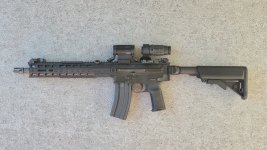
Brigade Mfg. Makasi MK-15 Construction and Accuracy Review

Im okay with a heavier barrel...but that's just me.
Judging by the OP pics from google drive, the 16" Makasi barrel is a government profile M4 barrel with a M203 cut, but instead of being 14.5" it's extended to 16" due to NFA.

The government profile was designed with the intent of having extra stiffness near the muzzle for bayonet use, and the incorrect perception that soldiers were bending M16A1 barrels by using them to pry open crates. Both are highly dubious justifications on a modern rifle.

The problem is multi fold:

1. The government profile is thinnest between the chamber and gas block, it has the least material in the segment with the highest thermal load, while simultaneously putting useless mass towards the muzzle. This makes the barrel more suspectable to thermal drift while at the same time hurts ergonomics by introducing a front heavy bias.​
2. The M203 cut is purely extraneous. It sits under the handguard and serves zero practical purpose. But it does create a spot of local thermal unevenness, introduces harmonic discontinuity, and the cutout creates a stress concentration point. All of that affects accuracy and consistency of the barrel.​
3. Weight distribution is completely backwards. Barrel profile plays a big role not only in the total weight of the rifle, but also in how it feels and handle. It appears they extended the thick section all the way out to the muzzle for the 18.6" barrel version. This results in an even more front heavy feel, common to many NR modern sporting rifles in Canada.​
 
Making assumptions? We can see several examples of the Makasi all having issues and there are lots of negative reviews about Brigades products in general. With said issues remaining unaddressed for MANY YEARS that speaks even more of the character of Gus.

We are drawing logical conclusions based on Gus's own statements and behavior.

It is more than fair to go after the owner for his on camera performance because he is blatantly lying to people while doing it.

It is much easier to tell the truth than to lie. When you tell the truth, you do not need to remember what you said before. Lies grow bigger and harder to manage over time.

After 10 years of Trudeau going uhh and umm through the constant lies it's not hard to recognize this pattern at all.

The guy doing the interview is a coward and blatant shill, made obvious in the YT video descriptions saying these are the best made and he can't wait to buy them, love at first sight/ect.

Classic Firearms are also shilling for Brigade as noted in their conclusion.


L:ying through your teeth with a big smile speaks volumes about a persons character and sense of morals which we are rightfully judging.

I compared Gus directly to NEA/BCL from the get go because this exact behavior has been demonstrated at extensive lengths by Jeff Hussey and his crew of shills.

He reminds me of this guy.
1785728582958.png
 
I concur. I tend to be prepared for the worst while hoping for the best, which I think applies quite well to Brigade Manufacturing and their Makasi rifle as it enters the Canadian market.

The fact that one of the few Restricted Makasi's currently in Canada is apparently a malfunctioning "lemon" is troubling news, and there's nothing to be gained from diminishing the truth or ignoring the facts. This strongly implies that the rifle in question left the factory in highly unreliable condition, despite whatever live-fire testing and/or post-assembly QC the Makasi's receive from their parent company. This does not inspire confidence in Brigade Manufacturing's internal QC systems, notwithstanding all of the positive U.S. Youtube reviews of the Makasi rifle.

Despite the above, others have received Restricted Makasis which functioned fine following the recommended break-in period. The rifle received by GT did not experience the nose-diving Charging Handle/Handguard interface, nor did it appear to suffer from out-of-spec top rails. It ran reliably and produced acceptable accuracy. Are there minor "issues" with GT's rifle? There are, but they are nothing that cannot be readily remedied by a mechanically-astute owner.

So what to believe? On the balance of probabilities, we can expect to receive a rifle which (following break-in) is reliable and reasonably accurate, notwithstanding the singular example of a lemon received by one customer thus far. We can expect there to be minor issues such as a loose Gas Plug Retention Clips, which are easily sorted by just about anyone. We can expect the Handguard Retention Screws to have been installed in such a way that they partially thread the grooves of the Barrel Nut. This is unsightly and speaks again to sloppy QC by Brigade Manufacturing, but at the same time it is hardly the end of the world provided the Handguard mounting is solid and repeatable without further wear to the Barrel Nut. What else? Nothing much comes to mind based on what I have read and watched about the Makasi thus far. So, not what I would "normally" consider to be a $2400 rifle, but these are not "normal" times with only two 5.56mm/.223 cal semi-automatic platforms currently available to Canadian consumers. Based on what I know about both platforms I am going to stay with the Makasi, quirks and all. So long as mine is reliable and reasonably accurate following the break-in, I will be well satisfied.
Fair analysis, it seems it'll come down to Brigade Mfg.'s QC at the end of the day. But it's exactly what makes evaluation so difficult - some will receive great rifles without issues, and others like mine. It also depends on how experienced the buyer is who can notice things as small as unstaked gas key screws or the lack of grease on the barrel nut.

My experience with the rifle is just an unlucky consolidation of all the negative aspects which have been reported to some extent by American reviewers. I certainly hope the rifles that other Canadians receive run fine (especially with the extra operating pressure and dwell time of the 18.6" barrels,) but I have my doubts since the factory couldn't even bother to update their digital user manual.

Anyways, I've already voided the warranty by swapping to a 12.5" barrel. Ran 300 rounds today without issue after removing one of the recoil springs for a total lifetime round count of 581. Gotta love AR15 parts compatibility, there's usually something that can be purchased to fix these issues.
 
Judging by the OP pics from google drive, the 16" Makasi barrel is a government profile M4 barrel with a M203 cut, but instead of being 14.5" it's extended to 16" due to NFA.

The government profile was designed with the intent of having extra stiffness near the muzzle for bayonet use, and the incorrect perception that soldiers were bending M16A1 barrels by using them to pry open crates. Both are highly dubious justifications on a modern rifle.

The problem is multi fold:

1. The government profile is thinnest between the chamber and gas block, it has the least material in the segment with the highest thermal load, while simultaneously putting useless mass towards the muzzle. This makes the barrel more suspectable to thermal drift while at the same time hurts ergonomics by introducing a front heavy bias.​
2. The M203 cut is purely extraneous. It sits under the handguard and serves zero practical purpose. But it does create a spot of local thermal unevenness, introduces harmonic discontinuity, and the cutout creates a stress concentration point. All of that affects accuracy and consistency of the barrel.​
3. Weight distribution is completely backwards. Barrel profile plays a big role not only in the total weight of the rifle, but also in how it feels and handle. It appears they extended the thick section all the way out to the muzzle for the 18.6" barrel version. This results in an even more front heavy feel, common to many NR modern sporting rifles in Canada.​
Yup! Apparently some companies think M203's are common in the modern sporting rifle crowd...
 
Fair analysis, it seems it'll come down to Brigade Mfg.'s QC at the end of the day. But it's exactly what makes evaluation so difficult - some will receive great rifles without issues, and others like mine. It also depends on how experienced the buyer is who can notice things as small as unstaked gas key screws or the lack of grease on the barrel nut.

My experience with the rifle is just an unlucky consolidation of all the negative aspects which have been reported to some extent by American reviewers. I certainly hope the rifles that other Canadians receive run fine (especially with the extra operating pressure and dwell time of the 18.6" barrels,) but I have my doubts since the factory couldn't even bother to update their digital user manual.

Anyways, I've already voided the warranty by swapping to a 12.5" barrel. Ran 300 rounds today without issue after removing one of the recoil springs for a total lifetime round count of 581. Gotta love AR15 parts compatibility, there's usually something that can be purchased to fix these issues.
How's the ejection pattern with the 16" and 12.5" barrels? No brass deflector might be a deal breaker for left handed users.
 
Last edited:
Despite the above, others have received Restricted Makasis which functioned fine following the recommended break-in period. The rifle received by GT did not experience the nose-diving Charging Handle/Handguard interface, nor did it appear to suffer from out-of-spec top rails. It ran reliably and produced acceptable accuracy. Are there minor "issues" with GT's rifle? There are, but they are nothing that cannot be readily remedied by a mechanically-astute owner.
actually I did not check the rail and the M-lok slot dimensions - these things got pumped out in batches run by the same program, so I will expect if one is off very likely all others are off provided the serial numbers are within range of each other. The cross bolt/handguard - receiver interface depth is common to all, so I will guess all other issues with the rail got carried over to the entire run.
 
Last edited:
Anyways, I've already voided the warranty by swapping to a 12.5" barrel. Ran 300 rounds today without issue after removing one of the recoil springs for a total lifetime round count of 581.
Yeh, so the dual recoil springs and guide stub are the issue here. Think they may have gone overboard with the recoil spring rate to create the pleasing "soft shooting" experience demanded by the US market. This is in a way created by the us commercial market and social influencers constantly harping on words like "overpassing" and "soft shooting" so commercial gun makers are sacrificing reliability with all kind of tricks to get these key words out of the mouths of influencers .

I guess as long as the BGC is not slamming back and, either mushrooming the guide stub or the back of the lower, things are good to go.
 
Last edited:
I would be more inclined to favorably weight the reliability review if the rifle was unmodified from the factory, introducing aftermarket parts and potential user error is not entirely fair.

Ive been party to many cross border manufacturing operations and unless QC is somehow stipulated in the business contract export parts are often lower quality because the cost of shipping back to the manufacturer is higher in time money and paperwork. Trying to launch a new product in a new market may influence the manufacturer to elevate the QC.
 
I think what pisses me off the most is the fact we are all paying 2k plus for garbage quality that should realistically be a less then $1000 rifle
My orig $900 wk180 is better quality then all this junk we have nowadays and that’s pretty sad lol
WTF can’t companies just make something decent any more?
Ughhhh Canada…the new start of the national anthem.
 
I would be more inclined to favorably weight the reliability review if the rifle was unmodified from the factory, introducing aftermarket parts and potential user error is not entirely fair.

Ive been party to many cross border manufacturing operations and unless QC is somehow stipulated in the business contract export parts are often lower quality because the cost of shipping back to the manufacturer is higher in time money and paperwork. Trying to launch a new product in a new market may influence the manufacturer to elevate the QC.
The rifle was in its factory configuration for the reliability review and for all aspects of the report. I have since changed the barrel, and yes, I agree that any comment on reliability now is not representative of the factory configuration.
 
How's the ejection pattern with the 16" and 12.5" barrels? No brass deflector might be a deal breaker for left handed users.
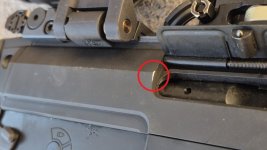
Unsuppressed gas setting on the factory configured rifle had a ejection pattern of 4:30 to 5:00 into a nice large pile of brass behind my shooting position. Changing the barrel to 12.5" and removing a recoil spring did not change the ejection pattern and ended up dinging my Aimpoint magnifier and the upper receiver. The brass also continues to peen the edge of the ejection port as it leaves the rifle. If you are left handed, you're in for a rough time.

I've seen videos from 313operator and his rifle ejects about 2:00 indicating that the rifle is over gassed, probably aiding reliability. The edge of his ejection port is also peened over pretty well.
 
Unsuppressed gas setting on the factory configured rifle had a ejection pattern of 4:30 to 5:00 into a nice large pile of brass behind my shooting position. Changing the barrel to 12.5" and removing a recoil spring did not change the ejection pattern and ended up dinging my Aimpoint magnifier and the upper receiver. The brass also continues to peen the edge of the ejection port as it leaves the rifle. If you are left handed, you're in for a rough time.

I've seen videos from 313operator and his rifle ejects about 2:00 indicating that the rifle is over gassed, probably aiding reliability. The edge of his ejection port is also peened over pretty well.
I wonder if they knew about the peening and had to change or invert the dust cover because of it? Where on the ejection port is it peening?
 
If the majority of these rifles eject to the 2:00 then a left handed shooter should be ok but knowing my luck the one I get will eject at 6:00…
 
I'd love to see pics
I wanted a cool SBR since the rifle is restricted already (and definitely a plus over the Carmel which does not have any shorter barrels available). I reused a Rosco Bloodline 12.5” M4 5.56 NATO barrel and drilled a hole for the gas block pin. Other than that, the process was identical to assembling an AR15 barrel. A BEV block may need to be modified to fit the upper receiver, but a reaction rod will work without issue. Remember to add some grease (Aeroshell 64 or similar) to the barrel nut which Brigade Mfg. had neglected to do from the factory.

The original 16" government profile barrel from the factory had a gas port size of 0.068" and had no dimpling for the gas block screws. It may have been too small to operate the short stroke gas piston system but it's hard to know for sure.

20260803_192436.jpg
 
I wonder if they knew about the peening and had to change or invert the dust cover because of it? Where on the ejection port is it peening?
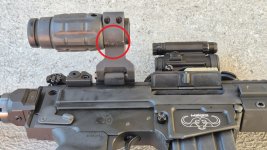
There is peening to the rear of the ejection port as the brass is ejected from the rifle. Like the original FN FAL or SIG SG540 design, brass also hits the upper receiver behind the ejection port since there is no brass deflector as seen by the light marking under the magnifier mount. For some drills, I had the magnifier flipped to the side and brass visibly marked the mount indicating that the brass is ejected about 4:30 to 5:00 in the original 16" barrel configuration. This confirms that left handed users will experience some "teething" issues. But there are videos online of the rifle ejecting in the 2:00 range so it really depends on each individual rifle I suppose.

20260803_192539.jpg20260803_192555.jpg
 
But there are videos online of the rifle ejecting in the 2:00 range so it really depends on each individual rifle I suppose.
What ammo was causing the rearward ejection with the 16 and 12.5" barrels? Difference in bolt carrier velocity could explain the different ejection patterns.

E.g. higher powered ammo and faster bolt carrier velocity cause shells to travel further back before rotating out, this makes them hit rear of ejection port on way out and bounce forward
 
What ammo was causing the rearward ejection with the 16 and 12.5" barrels? Difference in bolt carrier velocity could explain the different ejection patterns.

E.g. higher powered ammo and faster bolt carrier velocity cause shells to travel further back before rotating out, this makes them hit rear of ejection port on way out and bounce forward
The factory 16" barrel rifle ejected fairly consistently rearwards regardless of the ammunition used during the accuracy testing.

I wouldn't care about the modified 12.5" barrel because there have been so many modifications that information on a franken-rifle is meaningless to everyone. The ammunition used was PMC Bronze .223 Rem 55gr but there are plenty of factors including dwell time, gas port size, removed recoil spring, build quality, etc. that make this an unreliable data point.
 
Last edited:
Back
Top Bottom