IronNoggin
CGN frequent flyer
- Location
- Port Alberni, Vancouver Island
Aiuppa Buck Verified as the Largest Typical Whitetail Ever Taken in the U.S.
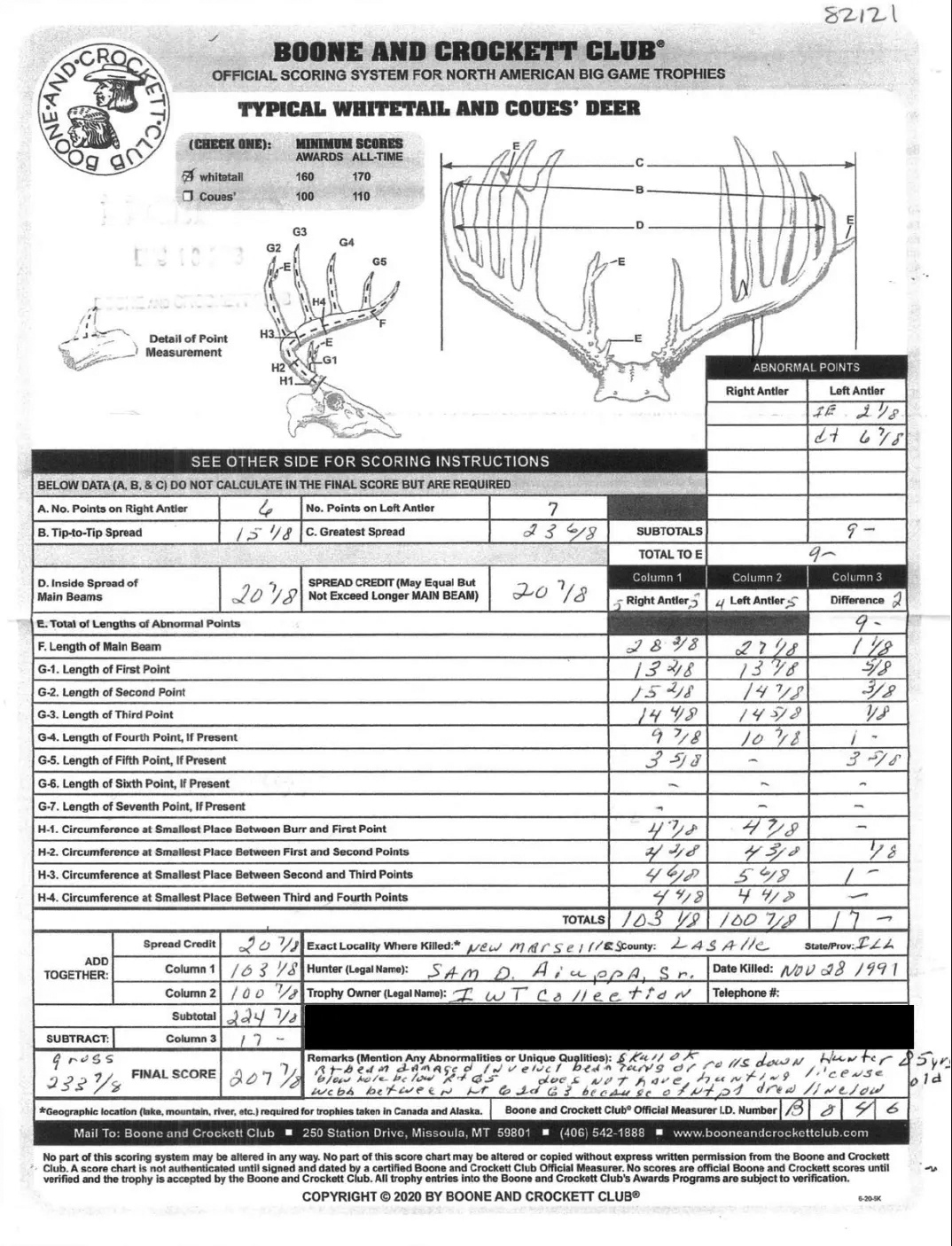
Boone and Crockett has officially verified the Sam Aiuppa typical whitetail at 207 7/8 inches, making it the largest typical whitetail ever taken in the United States.

The Boone and Crockett Club recently announced that the Sam Aiuppa/James Martin typical whitetail deer has officially been verified at a score of 207 7/8 inches, making it the largest typical whitetail deer ever taken in the United States.
The score surpasses the famous Jordan buck by 1 6/8 inches and ranks second worldwide behind Milo Hanson’s 213 5/8-inch world record.
Sam Aiuppa killed the buck in late November 1991 during a hunting trip to LaSalle County, Illinois. He mounted the antlers on a plaque and stored them in his basement, where they remained for 32 years until an electrician noticed their extraordinary dimensions, most notably eye-guards more than a foot long.
Antler collector James Martin later acquired the antlers and had them measured by a Boone and Crockett Club official measurer. After the initial score was submitted, the antlers were independently re-measured by two additional official measurers to verify the score. The completed score charts were reviewed by Dr. Jon McRoberts, chairman of the Club’s Records of North American Big Game Committee, who confirmed the official score of 207 7/8 inches.
“This is a monumental addition to North American big game records,” said Kyle Lehr, Boone and Crockett Club director of Big Game Records. “We are thrilled to officially welcome the Aiuppa buck into the Boone and Crockett records. It took more than three decades for this remarkable deer to be recognized, but its place in the record books is well deserved.”
For more details on the buck's history, read “Lost For 30 Years: The New #2 Typical Whitetail and Illinois State Record.”
https://www.boone-crockett.org/lost-30-years-2-typical-whitetail-and-illinois-state-record
https://www.grandviewoutdoors.com/news/aiuppa-buck-largest-typical-whitetail-ever-taken-us
Boone and Crockett has officially verified the Sam Aiuppa typical whitetail at 207 7/8 inches, making it the largest typical whitetail ever taken in the United States.
The Boone and Crockett Club recently announced that the Sam Aiuppa/James Martin typical whitetail deer has officially been verified at a score of 207 7/8 inches, making it the largest typical whitetail deer ever taken in the United States.
The score surpasses the famous Jordan buck by 1 6/8 inches and ranks second worldwide behind Milo Hanson’s 213 5/8-inch world record.
Sam Aiuppa killed the buck in late November 1991 during a hunting trip to LaSalle County, Illinois. He mounted the antlers on a plaque and stored them in his basement, where they remained for 32 years until an electrician noticed their extraordinary dimensions, most notably eye-guards more than a foot long.
Antler collector James Martin later acquired the antlers and had them measured by a Boone and Crockett Club official measurer. After the initial score was submitted, the antlers were independently re-measured by two additional official measurers to verify the score. The completed score charts were reviewed by Dr. Jon McRoberts, chairman of the Club’s Records of North American Big Game Committee, who confirmed the official score of 207 7/8 inches.
“This is a monumental addition to North American big game records,” said Kyle Lehr, Boone and Crockett Club director of Big Game Records. “We are thrilled to officially welcome the Aiuppa buck into the Boone and Crockett records. It took more than three decades for this remarkable deer to be recognized, but its place in the record books is well deserved.”
For more details on the buck's history, read “Lost For 30 Years: The New #2 Typical Whitetail and Illinois State Record.”
https://www.boone-crockett.org/lost-30-years-2-typical-whitetail-and-illinois-state-record
https://www.grandviewoutdoors.com/news/aiuppa-buck-largest-typical-whitetail-ever-taken-us