- Location
- Northeastern Ontario
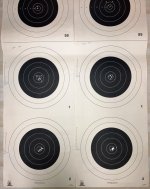
Shooters practice with the same size targets as they use in competition.I didn't know what size of target they use for practise nowadays.













































Shooters practice with the same size targets as they use in competition.I didn't know what size of target they use for practise nowadays.
I guess it's blasphemy in your opinion to practice on different size targets then?Shooters practice with the same size targets as they use in competition.
When shooters practice they use targets similar to the targets they will shoot in competition. There's nothing to be gained otherwise.I guess it's blasphemy in your opinion to practice on different size targets then?
That seems like a good static approach to solve a task !;
Works every time, eh ?
Center is centre no matter the shape of target and distance.
But hey, I cannot shoot at that because it's iced out 10mm around the rim.
You're really funny, good logic!

I won a prone State Championship with a 30 years-old Anschütz. I can confirm that they can be perfectly competitive at 100 yards. You just have to find a good lot of ammo for your barrel.I'm thinking of getting a Anschutz Match 54 if I can find one but knowing they were designed for 50yd how do they shoot with that long barrel at 100? I have a CZ 452 Varmint and a 457 in a MDT chassis both wih 20" barrels that shoot very well at 100 but I've always wanted an Annie. Just wondering if I should just spend the money on ammo. TC
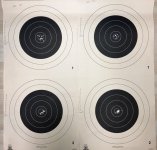
Thanks for the internet explanation, who would have known?Claiming that before a competition biathlon shooters practiced on 25mm targets (about 1") at 100 meters is what's funny.
With scope shooting shape and size of target is often not very important. But that's not true for aperture sight shooting.
With aperture sights shooters can't satisfactorily see targets that are as small as 25mm at 50 meters. At 100 they would be far too small to see adequately with the naked eye.
Aperture sights require larger targets so that they can be effective. At 50 meters the target is, in fact, 45mm, nearly twice the size of the alleged 25mm 100 meter target.
The idea is that the black target is just a little smaller than the view through the front insert. A very small target such as 25mm at 100 meters would barely be visible to the naked eye. Too small a target would not be possible to see well enough to make shooting worthwhile.


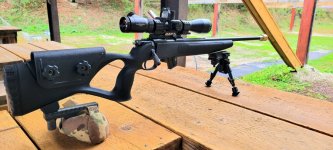
Not to hijack the thread, though thanks for the heads up on these rifles Jerry. The can and do shoot if you're willing to tinker with them. I've got one of the older 20" ones with the threaded barrel and the early trigger group.If you want to do some searching, the best deal on an "Annie 54" is the Scorpio EM322A... Older manf with the 20", 6 groove barrels
These ARE Annie 54 clones with some Chinese simplifications. Got them as a joke, was blown away by how well that batch shot. We eventually got 8 rifles all of which shot great. I competed with mine out to 400yds and it took me to the podium vs some very gucchi gear.
I would lean on the threaded version so that I can add a tuner. SK rifle match as a base... better Lapua Center X or Midas+. Lots matter and it is so rare to get a lot without some percentage of flyers. More money, good lot = less flyers.
1" or better at 100yds 5X5rds... and accept the small percentage that are flyers. Competition lots would be no more then 3rds in that 25rds test outside 1" but still inside 1.5".. Practise lot may still have 3 to 4 flyers but those zingers push 2" or more.
View attachment 1215524
Did not find the micro groove barrels to shoot all that well. The EM332X with the shorty barrels were meh.
If you don't need a sub 2lbs trigger, the Scorpio can be a great find. If you want light pulls, get a true annie as the scorpio uses a stand alone trigger group.
The actions polish up extremely smooth. Metal mags actually run well too. Some modifications needed for a scope base or you can just grooved receiver rings
Jerry
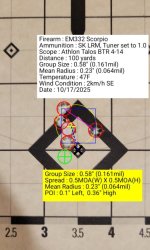
 I'd like to add that the triggers can be greatly improved upon. I ended up coming across a spare trigger group and decided I was going to modify it to see how good I could make it. I've since polished the internals, shimmed it, straightened the trigger blade some, installed an a travel set screw screw and made a new torsion spring for it. It now has a really nice break at around 7oz.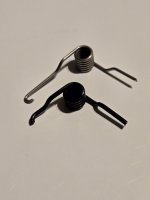
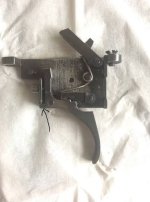
On the older ones, there's a plate on the left side that is removable via one screw . You can see the tapped hole in the center here.The older Canadaammo 522s had a good adjustable/accessible trigger setup.
I looked at briefly, but think on the 322 trigger assembly one would have to drive some pins out in order to get to the spring ?
Just because 1 can see, doesn't mean they can hit it. Ive been near sighted for 30 plus years. But based on the target borders I can figure the center. But have had shot a 100 score at 100 with apetures. Based on a 8 inch target.So, you're saying that you cannot see a 25 mm black target dot on white at 100 metres without magnification?
Well, I guess others have better eye sight and shooting skills than you do citing the Internet !
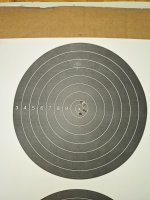
Perhaps you don' understand how aperture sights work.So, you're saying that you cannot see a 25 mm black target dot on white at 100 metres without magnification?