Standard British military-issue handgun through the 1930's, 1940's and into the 1950's. Manufacture commenced in 1927.
The British .380 service cartridge was, indeed, a military loading of the .38 S&W - originally with a 200 gr lead bullet, later changed to a 174 gr jacketed bullet, because of the International Convention banning "expanding bullets" in war. So .38 S&W cartridges will certainly work just fine in these revolvers, although the lighter bullets of most commercial loads will impact off point of aim somewhat.
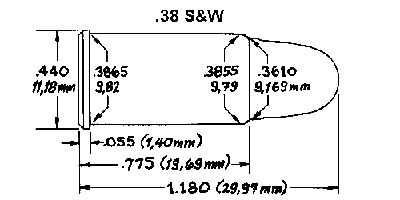
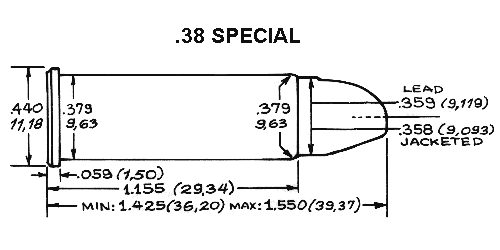
It is not particularly practical to make .38 S&W casings by cutting down .38 Special casings, because the .38 S&W case and bullet are actually
larger in diameter than the .38 Special case and bullet - see below. (In fact, a .38 S&W cartridge will not even enter a .38 Special or .357 magnum chamber.) However, since the rim diameter and rim thickness are essentially the same for both casings, you could use cut down .38 Special brass, but the body diameter would have to be "blown out" to .38 S&W dimensions. Actually, .38 S&W ammunition is still commercially loaded and sold, and casings are available, though perhaps not as common as .38 Special.
Here's a picture of my Enfield No. 2 Mark I revolver - a rather early-dated (1931) one. Later on, the MarkI* version was adopted, in which the hammer spur was absent, so the revolver could only be fired in double-action mode. Thsi is sometimes referred to as the "Tanker Model" (supposedly because it was the Royal Armoured Corp which requested the modification because the hammer spur was prone to snag on things in the close confines of tanks and their hatches - but that doesn't explain why
all Enfield revolvers were thereafter made without the hammer spur ....)
Here's a link to the relevant Wikipedia article:
http://en.wikipedia.org/wiki/Enfield_revolver