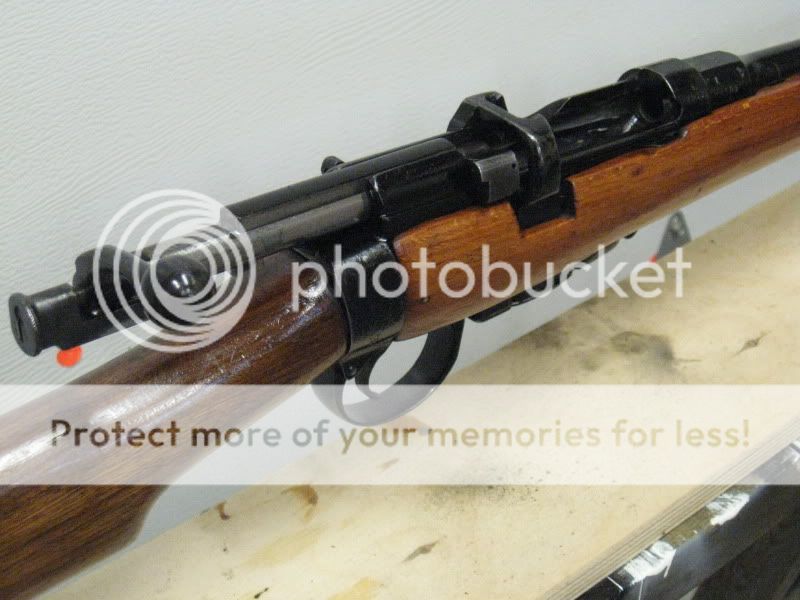
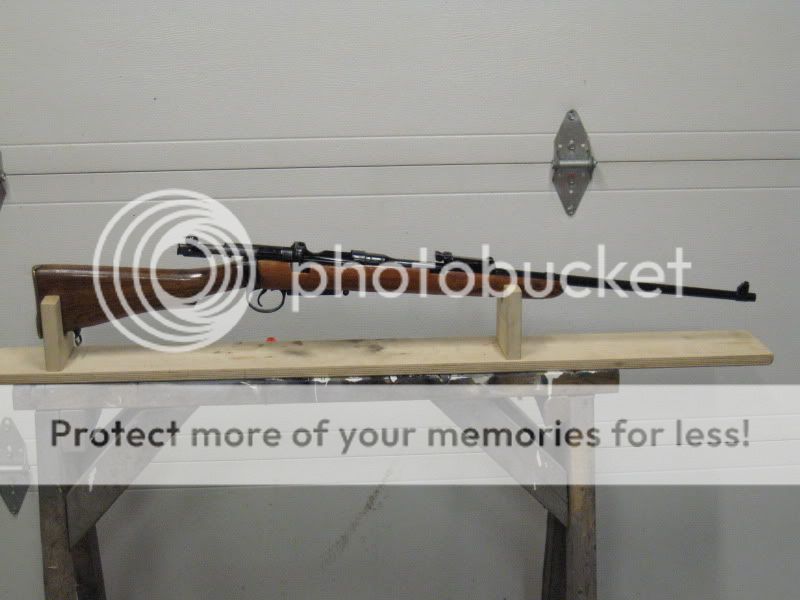
From what you say in your post, you need a whole bunch of practise with a tangent sighted 22 rim fire. Something with low recoil and cheap to shoot but also has a similar sight picture. You also need to find mentor at the range to show you how to properly use the sights on that rifle. It is most likely sighted in for 300 meters at its lowest rear sight setting or in other words, 12cm to 17cm above point of aim at 100m.
From your pics, the forward retaining band is still in place but the fore end pressure plate and spring area has been cut away. This might or might not lead to accuracy issues. Another thing, that rifle wasn't made to shoot into nice little sub minute of angle groups. In 1915, 10cm groups were perfectly acceptable and normal.
The statement made by your brother in law that iron sights won't group well at 100 meters just shows his inexperience and ignorance. Anyone that takes the time to learn to shoot iron sights of all types, can shoot as well at 100m as anyone with a scoped rifle. Sometimes, even better.
I was at an egg shoot once, where an egg is glued to a 1/2m string and hung to swing in the wind from the bottom of the target rack. The rules were, any 22rf any sights, any ammunition and off the bench. Some clown with a Long Branch built No 7 (lee enfield No4 MkI*) single shot, with CCI standard velocity ammo, won the match hands down, over 6 other shooters with some pretty spiffy/pricey, scoped sporters. There were all sorts of excuses, but it was all in good fun. At another match, I saw some targets that were shot with a 7x57, 1908 Brazilian mauser in full regalia, shot by the same clown. The rules were any rifle/ammo, off the bench as long as it wasn't a purpose built heavy/medium built match rifle. It was scored by measuring the distance center to center between two shots only on target and then, closest to center if ther were a tie. The other target was the same but closest to center was the winner. The 1908 mauser shooter took out some very surprised shooters with some very decent rifles. That same clown also won an offhand match at 300 meters on a swinging 25cm gong with that same rifle. I'm willing to bet it took a lot of practise to get to that point though.
Now let me point out one glaring thing. The light was right. That means mid day with the sun behind the shooter. Perfect conditions for open iron sights. That is where scopes really pay off. Scopes are better in low light conditions and if shaded a bit into extreme light conditions as will happen late in the day or early morning, during sunset or sunrise minutes.
I suspect, you bought the No1 MkIII, because it was cheap. Not a bad decision by any means. You just have to learn to shoot it properly and how to properly take care of it. It will, usually, place the first few shots from a newly cleaned barrel where ever it pleases. Maybe close, maybe not. It should also be practise shot with a cold bbl. That will teach you an important lesson about patience and simulate hunting conditions. You shoud also do a lot of off hand shooting once you're satisfied with what you're doing from the bench. That's where the 22rf really shines. You won't develop a flinch from shooting off the bench rests/bags. In my opinion you should have at least a hundred rounds down range from that NoI MkIII before you hunt with it. Then, there should be at least another 500 rounds of 22rf practise from standing, prone, sitting and leaning against something to get started and your head around what's going on with your hunting rifle. You owe that to the game you are planning to hunt.
That's just the start of things. There are many nay sayers but like it or not, that reall is just the beginning if you're at all serious about the sport and hunting. Then there is the other matter of learning to hunt successfully. Hopefully your brother in law is a better mentor in that department.
The above posts are all correct, that's why you need a hands on mentor. Cheek weld, shoulder positioning and trigger control, are all need to know stuff. They're hard to learn by yourself, especially when you're first starting out. It might take several trips to the range and then to a field shooting area that's safe and will give you several challenges to become proficient but it will all be worth it when it counts.