












































You are using an out of date browser. It may not display this or other websites correctly.
You should upgrade or use an alternative browser.
You should upgrade or use an alternative browser.
'holy grail' of canadian military handgun collecting acquired!
- Thread starter GrantR
- Start date


- Location
- Algoma region
I had to look again....I just love the battle hardened beauty of it!
Get some newly made nipples and your good to go, before you put her away after a cleaning put the origionals back in.
She begs to be shot, a real hotrod in what looks like excellently maintained condition!
Cheers to you Sir!
Get some newly made nipples and your good to go, before you put her away after a cleaning put the origionals back in.
She begs to be shot, a real hotrod in what looks like excellently maintained condition!
Cheers to you Sir!
REJOICE WITH ME!
I am pleased to announce that, after considerable soul searching followed by a bit of dickering, I have struck a deal with a Canadian antique arms dealer to purchase from him an example of the "Holy Grail" of Canadian Military Handgun collecting - a Canada Militia London Colt "Navy" revolver, 811 of which were acquired in 1855/56 by the pre-Confederation Province of Canada as part of the equipment for issue to Troops of Volunteer Militia Cavalry. Being the rarest .... and costliest, of course ..... this was the only original 1855-1955 primary-issue Canadian military handgun I did not yet have in my collection ..... until now!
Pre-Confederation Canada (a union of Lower Canada and Upper Canada - the southernmost parts of present-day Quebec and Ontario, respectively) along with the other self-governing colonies in the Empire had just had a much-expanded responsibility for its own military defense thrust upon it, as a result of Britain's involvement in the Crimean War. A new Militia Act was passed in 1855, under which the Militia was reorganized and expanded, and which also provided for the acquisition and distribution of the necessary arms and equipment. (All arms and equipment had been provided by Britain, previously.)
The variation of the Colt Model 1851 percussion revolver manufactured in Colt's London Factory was the issue handgun for Militia Cavalry, who were organized in Troops of (nominally) 50 men. Each revolver was to be marked either "U.C." (Upper Canada) or "L.C." (Lower Canada) over a Letter ("A", "B", etc.) denoting the specific Cavalry Troop, over a "rack number" for that revolver within the allotment issued to that Troop. Records indicate that 255 revolvers were issued and appropriately marked in Lower Canada, and that there were 556 "Upper Canada Colts". Only about 200 of these revolvers are known to have survived.
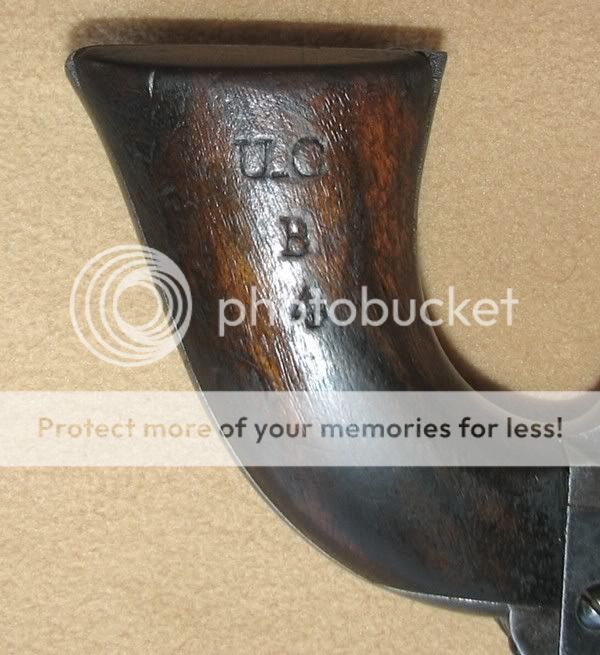
The revolver I have just acquired is one of the Upper Canada Colts - number 4 of those issued to "B" Troop, headquartered at St. Catharines .....


In case you wish to read more, here are some relevant "period" documents. (Click on each thumbnail to view - you may have to click again on the image which comes up in my Photobucket album, to see it full size.)
Militia General Order of 16 May 1856, dealing with the distribution of newly acquired Arms. Note that over half of this document relates specifically to the newfangled "six-shooting Colt's pistol", including fairly detailed instructions for loading and cleaning -
Receipt signed by the Captain of an Upper Canada Cavalry Troop - in this case. Troop "I", headquartered at Essex - for the arms and equipment to be issued to members of his Troop -
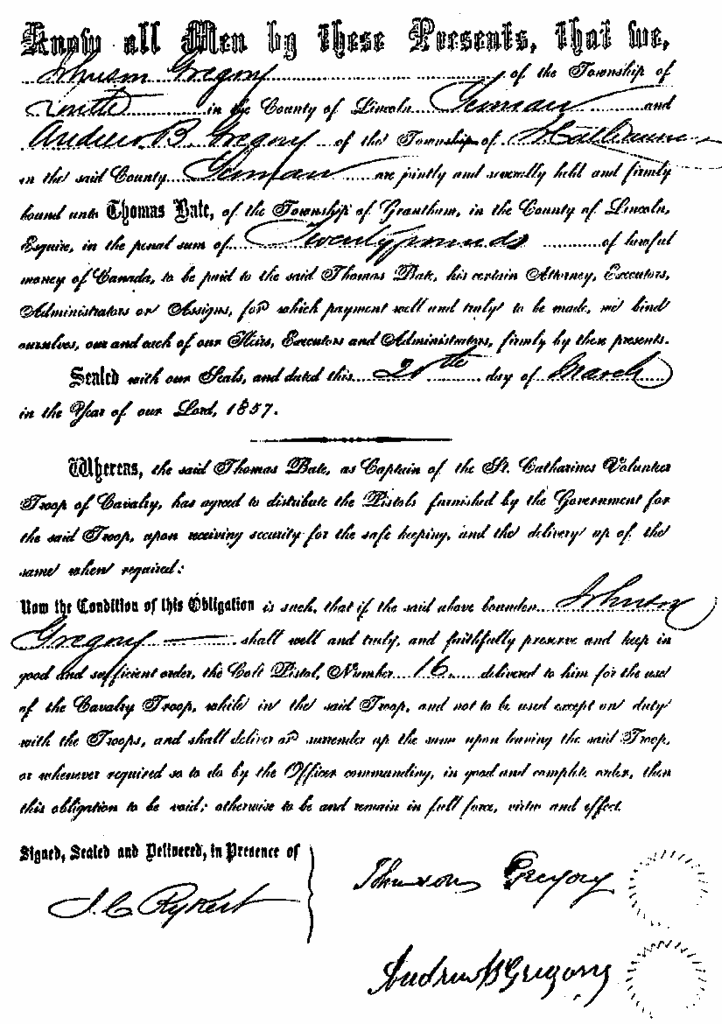
Bond of Indemnity entered into by a Trooper and Guarantor (likely his father, or perhaps a brother) for the return of the Colt revolver issued to him. Note that this Bond relates to revolver number 16 issued in the same St. Catharines Troop as my revolver!


Well theres one more gun gona stay in Canada and not get lost to the south.
Good score Grant
Real nice find, there is a guy in Ontario that has about 10, (at last count) Upper Canada and Lower Canada Colts and most were found in the US and brought back to Canada. They will likely stay here now.
RK

- Location
- In lalaland, that is Ottawa.
THE Colt
Why stop there, parkerize it and get some nice new grips
Great acquisition Grant!
Looks like it needs to be reblued and the grips could do with a good sanding
Why stop there, parkerize it and get some nice new grips
I rejoice with you!
I've looked through my copies of Arms Collecting with the articles by Paul Lederer listing surviving UC and LC Colt 1851 serial and stamp numbers, and as far as I can see yours is a new addition - making at least 15 known survivors from the St Catharine's troop. His article in Vol 27, no 1 (Feb 1989) is especially interesting as in it he researches his own UC-B-5 - only one number above yours - and discusses the involvement of the St Catharine's Troop in the two Fenian raids, for which the participants received the Canadian General Service Medal. I think this gives your revolver particular interest because it's just possible that it saw action, in the sense of being carried on border patrols though perhaps not actually being fired in anger!
I bet you shoot it ...
I've looked through my copies of Arms Collecting with the articles by Paul Lederer listing surviving UC and LC Colt 1851 serial and stamp numbers, and as far as I can see yours is a new addition - making at least 15 known survivors from the St Catharine's troop. His article in Vol 27, no 1 (Feb 1989) is especially interesting as in it he researches his own UC-B-5 - only one number above yours - and discusses the involvement of the St Catharine's Troop in the two Fenian raids, for which the participants received the Canadian General Service Medal. I think this gives your revolver particular interest because it's just possible that it saw action, in the sense of being carried on border patrols though perhaps not actually being fired in anger!
I bet you shoot it ...


right on. It is impressive that more than 200 have survived.
Actually, I was just parroting something the vendor said, or had in his listing, when I indicated that over 200 of these pistols have survived.
Since then I have been reviewing my own references (including Clive Law's Canadian Military Handguns, 1855-1985 and four different items which appeared in the Canadian Journal of Arms Collecting over the forty years it was published).
Turns out that there are over 200 known serial numbers, but (as of 1997) only 162 surviving revolvers. (Or fewer - exact number depends on whose compilation you look at.)
The reason for the discrepancy is that a fair number of the surviving revolvers have mismatched serial numbers, possibly as a result of the revolvers being worked on and reassembled without keeping the serial numbers matched (as some of the writers surmised) or, perhaps even more likely, because parts were salvaged from damaged pistols to keep others operational (as has been done for years with the Inglis High-Power pistols which are our current primary-issue military handgun.)
Colt Model 1851 revolvers had their serial number marked on at least four main components (the frame, barrel, cylinder and - I think - the loading lever). Accordingly some of the surviving revolvers have two or more serial numbers on them - I even saw one listed with all four numbers different!
Although there are a few cases where two surviving pistols clearly have "swapped" parts - i.e the frame number of one matches the barrel number on another pistol, and vice versa - there are quite few revolvers with "extra" serial numbers on some parts - and those parts must have come from other Canadian-issue revolvers which haven't survived ...... or at least haven't surfaced yet.
With that many "mismatched" examples, the best (perhaps only) way to logically identify and list the survivors is by the unit marking on the grip, which would have been applied to a single revolver.
The revolver I am awaiting has at least two different serial numbers - frame (I presume) and cylinder - neither of which is on the published lists. Nor is my grip marking ("UC" over "B" over "4") on any of the lists either. So it would seem my revolver "surfaced" since the last of those lists was published in 1997.
I've looked through my copies of Arms Collecting with the articles by Paul Lederer listing surviving UC and LC Colt 1851 serial and stamp numbers, and as far as I can see yours is a new addition - making at least 15 known survivors from the St Catharine's troop.
- - - - - - -
I bet you shoot it ...
I suspect you are right ..... if only once!
As mentioned in my post above, I've been going through the Lederer articles, plus Nathan L Swayze's article published in Vol 6 No 2, (when it was still "The Canadian Journal of Arms Collecting") and the details in Appendix D of Clive Law's book.
It appears to me that there are actually only 13 UC B Troop-marked revolvers in Lederer's serial number-based compilation - i.e. as of his 1997 follow-up piece: 2, 5, 6, 9, 10, 13, 15 (which is marked both B and F), 16, 17, 36, 37, 43 and 50. (IIRC the revolvers numbered 6 and 9 appear twice, because they had mismatched serial numbers.)
In any event it does indeed appear that the revolver I am getting is a "new one" since the 1997 compilation. IIRC, the seller mentioned he had acquired it about 1997 or so ..... I have asked him to provide whatever details he can (when and where acquired, from whom, any provenance or history which came with it, and so on.)

Bittermansbro
CGN frequent flyer
- Location
- Calgary, AB
In any event it does indeed appear that the revolver I am getting is a "new one" since the 1997 compilation. IIRC, the seller mentioned he had acquired it about 1997 or so ..... I have asked him to provide whatever details he can (when and where acquired, from whom, any provenance or history which came with it, and so on.)
I like that information best, its nice to hear what kind of trail the old guns followed since their time in service.
Thanks for the info!
Grant - yes, I think you are correct: I added one by failing to conflate Lederer's two listings for either 6 or 9. At any rate, the total would appear to stand at 14 for UC B Troop, including yours.
I have knowledge of at least four additions (none of them the St Catharine's Troop) to Lederer's list, one of which I've handled and can authenticate. The others come from noting down auction and other listings over the past couple of years. These include both UC and LC marks.
Yes, the serial number is also stamped under the loading arm.
Regarding mixed serial numbers, I know of one case where two mixed-serial number UC marked pistols were bought at auction years ago fused together with rust, and when separated proved to contain the serial numbers for two matching pistols - so at some point long ago someone had taken two matching-serial number pistols apart and not put them back together again with matching numbers. Of course that was the genius of Colt's mass-production design, precisely to allow that. But I do wonder whether this would have happened during Service use when more care would perhaps have been taken.
I wonder how these revolvers survived at all. At the end of his chapter in Canadian Military Handguns dealing with the 1851 Colt, Clive Law states that the Dept attempted in 1879 to dispose of all obsolete arms held in District stores, including 178 Colt pistols, but that 'ultimately the arms remained unsold'. Perhaps they lingered on in stores for decades (like all of those Snider-Enfields), and perhaps that accounts for the condition of several I've seen - surface patina as if they've been neglected in store, but internally in virtually unfired condition.
I have knowledge of at least four additions (none of them the St Catharine's Troop) to Lederer's list, one of which I've handled and can authenticate. The others come from noting down auction and other listings over the past couple of years. These include both UC and LC marks.
Yes, the serial number is also stamped under the loading arm.
Regarding mixed serial numbers, I know of one case where two mixed-serial number UC marked pistols were bought at auction years ago fused together with rust, and when separated proved to contain the serial numbers for two matching pistols - so at some point long ago someone had taken two matching-serial number pistols apart and not put them back together again with matching numbers. Of course that was the genius of Colt's mass-production design, precisely to allow that. But I do wonder whether this would have happened during Service use when more care would perhaps have been taken.
I wonder how these revolvers survived at all. At the end of his chapter in Canadian Military Handguns dealing with the 1851 Colt, Clive Law states that the Dept attempted in 1879 to dispose of all obsolete arms held in District stores, including 178 Colt pistols, but that 'ultimately the arms remained unsold'. Perhaps they lingered on in stores for decades (like all of those Snider-Enfields), and perhaps that accounts for the condition of several I've seen - surface patina as if they've been neglected in store, but internally in virtually unfired condition.
Last edited:
My Upper Canada-marked Colt London Navy has reached its new home!
Turns out all of the visible serial numbers match on frame, barrel, loading lever, trigger guard, grip frame/backstrap, and it is just the cylinder which is mismatched. (It is also British proofed, so my mild concern that it might turn out to be an inappropriate US-produced cylinder haven proven groundless.)
Looks like the bore and chambers will take a bit of scrubbing ..... There is quite distinct rifling, but some apparent patches of moderate pitting. Cones (nipples) appear to be quite "elderly", although I cannot if course say if they are original. They are fairly rusted and there is a fair amount of rust in and around the cone recesses, so some soaking will clearly be necessary before any attempt to remove them.
There is quite a bit of forward/back play of the cylinder on the cylinder pin, which at its maximum leaves a gap of about 1/16th of an inch between the rear of the barrel and the cylinder face .... so I'm not terribly keen on trying to actually fire it in its current state. Must determine if there is any sort of "approved fix" for such a problem which does not involve irreversible alteration to the revolver ..... but It actually appears to me that a washer-like shim of suitable thickness, and clearing the "ratchet projections", could be placed at the rear of the cylinder to ride between its rear bearing surface and the corresponding raised bearing surface on the recoil shield to keep the cylinder ahead but still permit complete functioning.
Here are a few of my initial photographs:


Couldn't resist a shot of my new acquisition together with its Uberti reproduction "great-great-grandnephew" (my mid-1970's Albion Arms "limited edition/commemorative") -
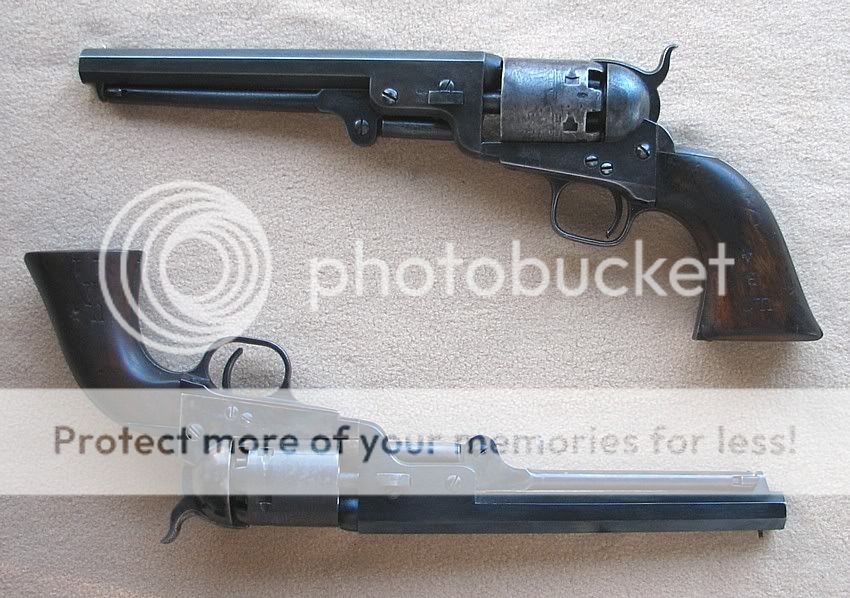
Turns out all of the visible serial numbers match on frame, barrel, loading lever, trigger guard, grip frame/backstrap, and it is just the cylinder which is mismatched. (It is also British proofed, so my mild concern that it might turn out to be an inappropriate US-produced cylinder haven proven groundless.)
Looks like the bore and chambers will take a bit of scrubbing ..... There is quite distinct rifling, but some apparent patches of moderate pitting. Cones (nipples) appear to be quite "elderly", although I cannot if course say if they are original. They are fairly rusted and there is a fair amount of rust in and around the cone recesses, so some soaking will clearly be necessary before any attempt to remove them.
There is quite a bit of forward/back play of the cylinder on the cylinder pin, which at its maximum leaves a gap of about 1/16th of an inch between the rear of the barrel and the cylinder face .... so I'm not terribly keen on trying to actually fire it in its current state. Must determine if there is any sort of "approved fix" for such a problem which does not involve irreversible alteration to the revolver ..... but It actually appears to me that a washer-like shim of suitable thickness, and clearing the "ratchet projections", could be placed at the rear of the cylinder to ride between its rear bearing surface and the corresponding raised bearing surface on the recoil shield to keep the cylinder ahead but still permit complete functioning.
Here are a few of my initial photographs:
Couldn't resist a shot of my new acquisition together with its Uberti reproduction "great-great-grandnephew" (my mid-1970's Albion Arms "limited edition/commemorative") -
Last edited:


Congratulations on your latest acquisition and thanks for sharing the history of that fine piece. I wasn't aware that the Colt 1851 was used in a military role in Canada but I have always liked them and bought a reproduction as my first gun.
In the picture of the original and the reproduction it is amazing how similar they look,except for the Navy scene on the cylinder being stronger on the original. Again thanks for sharing this piece of Canadian history.
In the picture of the original and the reproduction it is amazing how similar they look,except for the Navy scene on the cylinder being stronger on the original. Again thanks for sharing this piece of Canadian history.






















