












































Does a 375 H&H need a stock recoil bolt...

thepitchedlink

Regular
Super GunNutz
Rating - 100%
256   0   0
Location
Lumby Town!!
Sorry, "recoil bolt" might be the wrong term...
I've got a 375H&H m70 classic, and picked up a nice walnut stock for it. I'm wondering if the stock should have a re-enforcing bolt put in behind the recoil lug to stop the stock from cracking, or is glass bedding that area considered to be good enough? What do other 375H&H owners think? thanks
 
I'd glass bed for sure.

I read somewhere that adding a crossbolt was as easy as digging a trench with a dremel in the wood behind the recoil lug. Then cut the head off a course threaded screw, trim length to fit the trench and glass bed that screw into the hole. Sounds very easy and effective. I`d be tempted to use one or two long decking screws for the job and leave the heads intact, one at each end.


.
 
Jack Lott often used hidden crossbolts on his heavy rifles ,Weatherby uses something similar with a steel bar epoxied behind the recoil lug.
I'll be doing it when I put my .375 in it's new stock.
 
Crossbolt!!, ya that's what it's called. Can any one see an advantage over the old school crossbolt, you know , the one you can see from the outside, but that would actually be applying pressure to the wood. Or the hidden type, epoxied into the recoil lug...that one won't be applying any pressure...just stop the wood from moving "out". thanks for the replys.
 
I am building a .375 on a piece of walnut right now and I have decided to go the "semi" exposed route. ie talley crossbolts hidden with ebony plugs. I have often wondered how a piece of threaded rod could help. The flex that I think of during recoil forces the mag well area out so a "headed bolt" with some surface area would work best in my opinion. I hope some of the other knowledgable folks on here can shed some light.

I am going to cap the bolt heads with ebony as I like the look better. But as to your original question I have been told by many that anything from .375 and up should have a crossbolt or two.
 
Crossbolt!!, ya that's what it's called. Can any one see an advantage over the old school crossbolt, you know , the one you can see from the outside, but that would actually be applying pressure to the wood. Or the hidden type, epoxied into the recoil lug...that one won't be applying any pressure...just stop the wood from moving "out". thanks for the replys.
If I understand correctly, they both do the same by keeping the wood from spreading during recoil and preventing splits at the action screws and tang.

.
 
I got it used off the EE:D It has been glass bedded already, so the quieston is how much do I hog out? Just enough to do a new skim coat, or everything so that I can get a cross bolt in there. OR, skim coat and then use a regular crossbolt, that is drilled through from the outside.....Hhhmmm, ebony plugs might be nice. Then I could just use a big, beefy screw, and hide it with the plugs. All good advice, thanks
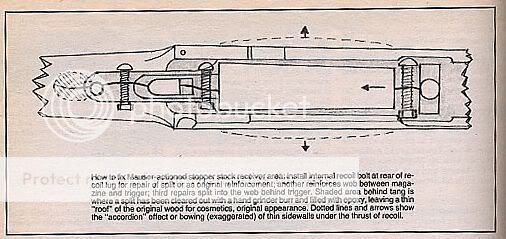
 
I would cross-bolt it. Either internal or external.

I use internal cross-bolts on all the rifles I've restocked. These include 35 Whelen, 9.3X62, .375 H&H and .375 Ruger.

The key is to make them longer than the width of the recoil lug so that the ends of the bolt extend into the sides of the stock. I use 1/4' Redi-rod with a nut on each end. The nuts are crushed in a vice then ground so that the whole works looks like a small I-beam. Route out a appropriately shaped groove and install them when the bedding's done.

I also install similar cross-bolts behind the mag box while I'm at it.

Here's a picture from the Jack Lott article.

lott06picture.jpg
 
the only things I can add to whats already been posted is that #1 on a Model 70, the rear x-bolt is more important than the one behind the recoil lug, and #2 is is easier to put a x-bolt in when you're bedding a rifle, than it is to repair a cracked stock, install a x-bolt, and then re-bed the rifle you've already bedded once.
 
Thanks Mauser 98 that makes some sense to me. Jack Lott makes sense to me. He was a shooter and gun guy through and through. I just could not understand how a single piece of rod bedded in behind the recoil lug could help anymore than a good bedding job. However a internal bolt bedded outside the width of the recoil lug and full length of the barrel channel acts as one unit. Makes sense to me. Now I can sleep.
 
Despite the fact that I have hidden cross bolts in my .375's McMillan stock, I'm not sure why they work. My head tells me that the cross bolts should put the stock material into compression to be most effective, and I have conventional cross bolts installed in my ZG-47's factory stock. I'm assuming that the cross bolts when installed in a fiberglass stock don't benefit from putting the stock in compression as there is no grain in the stock material, but I wouldn't choose hidden cross bolts for a wood stock. Besides, I like the look of a cross bolted wood stock with exposed bolt heads.
 
Despite the fact that I have hidden cross bolts in my .375's McMillan stock, I'm not sure why they work. My head tells me that the cross bolts should put the stock material into compression to be most effective, and I have conventional cross bolts installed in my ZG-47's factory stock. I'm assuming that the cross bolts when installed in a fiberglass stock don't benefit from putting the stock in compression as there is no grain in the stock material, but I wouldn't choose hidden cross bolts for a wood stock. Besides, I like the look of a cross bolted wood stock with exposed bolt heads.

it works just like a piece of rebar in concrete. Wood has very low tensile strength in the cross-grain direction, as in during recoil, whe the magazine box bows outward. The hidden crossbolt, if installed properly, will prevent the wood or fiberglass from cracking under tension.

Having said that, external crossbolts, especially if they put things in slight compression are better, if for no other reason that they encapsulate a larger dimension of the stock.

One of the problems with external crossbolts is that unless they fit very tightly, and stay tight, or better yet are epoxied solid, can weaken the stock more than they strengthen it.
 
A .375 might need crossbolts. The way to find out is to shoot it a bunch and see if it breaks. See a problem there? I got the B-Square jig and did both of my CZs, ironically after the .375 soaked up 1400 rounds without splitting. It's cheap insurance, and like Boomer I don't beleive in the hidden cross-bolts.
 
I would give serious consideration to an internal cross piece behind the recoil lug held in place with epoxy. Devcon bedding to finish the job. Threaded rod works well as does square metal stock. To each thier own.
 
Back
Top Bottom






















