Rust bluing solution?

ErikT

CGN frequent flyer
Rating - 100%
104   0   0
I'm looking at rust bluing a few of my projects in the next few years, but I'm having trouble locating a suitable bluing solution. Naturally, Brownells and other Yank companies won't ship those chemicals to Canada, so I'm stuck looking for something up here. Does anyone know of a Canadian supplier for rust blue solutions, or a recipe that doesn't require impossible to locate (or pronounce) chemicals? Cold bluing and Duracoat just doesn't cut it for a 113-year-old lever action Winchester or an even older rolling block. Thanks!

Erik.
 
I'm looking at rust bluing a few of my projects in the next few years, but I'm having trouble locating a suitable bluing solution. Naturally, Brownells and other Yank companies won't ship those chemicals to Canada, so I'm stuck looking for something up here. Does anyone know of a Canadian supplier for rust blue solutions, or a recipe that doesn't require impossible to locate (or pronounce) chemicals? Cold bluing and Duracoat just doesn't cut it for a 113-year-old lever action Winchester or an even older rolling block. Thanks!

Erik.

Brownells will send Laurel Mountain products to Canada(at least they did my last two bottles). It's a good product that does a nice job.

http://www.brownells.com/.aspx/pid=7780/Product/BARREL_BROWN___DEGREASER

Also, Boss Hogg on this site was marketing a product made by a fellow in BC. I've used the product and it's excellent.
 
As another poster mentioned, Brownells will ship Laurel Mountain's rust blue formula to Canada (that's the only one they'll ship).

For an "express" rust blue, using boiling hot water, I've had very good luck with Radocy. I bought a bottle directly from the company and they had no issues with shipping to Canada.

PJ's (http://www. pjsproducts.com) is a Canadian company that also carries a number of blueing formulas, including Radocy.
 
You're a real ray of sun:p

Ain't he just though.

About half the time (OK, more than that) I figure that his posts are auto generated by Bot software. Between coming off all cryptic and unclear, and, as often as not, not having a real apparent clue what he is posting about...

Every few days he actually comes up with a few answers that are on the money, though... Which strange enough, still leaves me thinking Bot software. :D

I picked up some Birchwood Casey Plum Brown, to try for use as a rust blue agent. Read that it is supposed to work OK. We'll see, one of these days.

The chemistry that goes in to some of the rust blue stuff is a pain to gather together, unless one wishes to get in to the reselling game. Small amounts of various components, that are required to be bought in bottle quantities, and used in the solution, in eyedropper amounts.

Have seen bottles for sale at the Calgary Easter Show. Suspect it is the same stuff that was referenced above, as sold by Boss Hogg.

Cheers
Trev
 
Erik T;
I'll apologize for a long response in advance, but since you asked - here goes.

This is an ancient recipe passed onto me by a late friend who taught me to rust blue, to glass bed and to checker. If memory serves he was given it by an old smith who frequented the Port Moody gun club in the '50's.

I'll begin with the caution that this whole concoction is malignantly corrosive and must be stored in a stout plastic container with a good fitting plastic lid. A metal lid will rust off of it.

Do all of the processes described in a well ventilated area, wearing rubber gloves and safety glasses. A charcoal filter mask might not hurt either, but I've not dragged mine home from work when doing the mixing and have still survived - so far.

Into a heavy stonewear or glass container mix the following:

- 2½ oz. - liquid measure of Nitric Acid
- 2 oz. - liquid measure of Hydrochloric Acid

Pour one acid into the other slowly as I seem to recall the mixing causes an exothermic reaction, so dumping them together quickly isn't advised.

-Add 1 oz. by weight of uncoated, clean nails. I clean them in a strong lacquer thinner first to entirely degrease them, then let them dry. Add the nails slowly and keep away from the container with your face.

An orange gas comes off during this process that will flat take your breath away and I suspect might do you in if you don't have enough fresh air - no kidding.

The nails should dissolve in a few hours.

- Add the resulting mix slowly to 30 oz. of distilled water.

The resulting mix is actually a bit strong for my liking and I cut it further with distilled water to slow the oxidizing process.

The metal being blued must be cleaned to bare metal, then degreased - I use Coleman white gas - and then not touched with bare hands again or finger prints will be seen in the bluing. I buy a bulk pack of cotton gloves and wear them over nitrile gloves to ensure no oils touch the metal.

I sandblasted a couple first and that turned out nice, but isn't necessary. Simply buffing down to bare metal evenly with emery cloth will result in an even finish.

My tank was made from 1/16" flat steel about 4" wide x 5" deep x 36" long with the sides welded so the tank will hold water. The lid is made from a car door skin - a long story as well - but again light metal.

I put a couple chunks of ceramic tile in the bottom of the tank so the actions/barrels aren't touching the bottom of the tank.

I used to buy distilled water, but lately have been having good results with clean rain water.

To use the tank, I've used either a two burner camp stove or even an old stove in a buddy's garage and lay it across two burners. Anyway, two burners is better than one and of course more stable.

So we buff down the barreled action, degrease it, boil it and then take it out of the water with some sort of hook/pliers and blow any water out of the bolt holes.

I apply the bluing solution now while the action is hot and then the solution doesn't pool in spots as much. The pools create deeper pits which ruin the look. So far I've used cotton swabs to apply the acid solution and that's worked out fine.

When you've got an even coating of acid, let the action hang and watch it rust. With the full strength solution in our desert climate it will be ready to buff off in 12 hours or so. I try to reduce the strength so I can do a cycle every evening, so I'm aiming for a 24 hour oxidization cycle.

The action should appear to be evenly rusted, that is to say no deeper pits in any spots or that will appear through the finish when done.

I use a soft wire wheel from Brownell's to buff or as they say "card" the action now, but used 0000 steel wool for years and that worked fine. Oh - degrease the steel wool in white gas before you use it!

After buffing/carding the action, it goes into the water tank for a 5 minute session of boiling, followed by another application of acid.

Most actions/parts will take at least 6-8 repetitions to get a full deep blue. When it doesn't get any deeper in appearance you are done.

Some actions, in particular the Ruger investment cast actions, will not blue up the same as the steel in most barrels. It still looks better to my eye than anything else, but it isn't exactly the same.

When you are happy with the finish, boil it for 5-8 minutes, take it out and bath it in something like Break Free CLP or any good light penetrating, rust preventative oil.

The resulting finish is pretty tough really, cause we've rusted the heck out of the action already, right? A friend who hunts the north country and the Kootenays in "all weather" did his Weatherby using the above method and he swears by it. I don't hunt much in the rain, but even on our saddle guns it's proven to be a really tough finish.

I've likely forgotten a couple details, so if you have questions give me a shout and I'll do my best to answer them. If you ever pass near Okanagan Falls, give me a shout, bring some containers and I'll give you the acid as I inherited a lifetime supply when my friend passed.

Hopefully that was some use to you and good luck with your rust bluing.

Regards,
Dwayne
 
Wow, thanks for all the replies so far! The Winchester has NO collector value, believe me. Bubba has definitely had his way decades ago. I just want to return it to some sort of respectability in terms of appearance. I've already had the bore relined, and replaced the firing pin and other broken/missing parts, so it functions and shoots decently now at least. But it has ZERO finish left (it had been painted at one point, which looked so bad, I think it gave me cancer!), coupled with plenty of scratches and dings in the metal. So once I polish the whole thing as carefully as I can, I want to give it a decently tough, attractive finish. And no, I don't plan to hot blue, as some seem to think is the same as rust bluing. Hot caustic doesn't sound like a very healthy pastime.

Erik.
 
ErickT;
I forgot to throw up a couple pics of rust blued rifles.

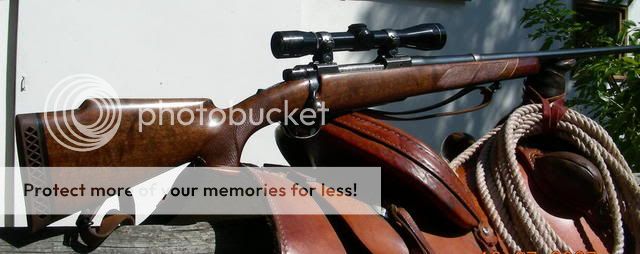
This is a money pit Mauser .270 that will go out in bad weather, which admittedly isn't that often here in the south Okanagan. ;)

270.jpg


This is a .308 Norma put together on a Centennial Ruger 77 action. You can sort of see how the bluing took a bit differently on the action as opposed to the barrel.

DSCN1176.jpg


Until I finally finished the .270 this past year, the Norma was my walking around gun for almost 2 decades now. The finish does hold up quite well as far as wear resistance and as noted for rust resistance as well.

Again, good luck with your project.

Regards,
Dwayne
 
What exactly does rust blueing mean? Is this a steel only treatment or can it be used on aluminum?

Aluminum doesn't rust, so that sort of rules that out doesn't it? :p

Steel only.

Bluing is just an oxide coating on steel. Rust is an oxide coating on steel.

(see where this is going?)

So what you want to do, is cause the steel to rust, how you want it to, in order to get the results you desire. Once the rust has formed, but not to the extent that it pits the surface noticeably, you boil the part to convert the interface between the rust and the steel, into bluing. Then you card off the rust, with a brush or wire wheel, and repeat the process a bunch of times.

The rust bluing solution causes the steel to corrode evenly and rapidly. Usually, the part is placed in a humid environment (a sweat box) to make the rust work it's magic in a reliable and predictable way.

Lots more labour to get it to a nice finish, which is pretty much why guys that do it, charge for it. Hot bluing with molten salts is faster and provides a serviceable blue without as much work, but requires exposure to molten salts, and the blue is not quite the same. Nothing wrong with it, but it's not the same. Rust blue can be done with very few dollars invested in equipment. Hot bluing needs tanks, burners, protective gear, etc. to do a decent job of it.

Touch-up bluing with cold blue solution is really kinda cheesy in comparison. Not nearly as durable.

There are chemical blackening agents for aluminum, or it can be anodized, plated, or a paint or paint-like coating can be used.


Clear as mud?

Cheers
Trev

 
Here's a couple of pictures taken during the rust bluing process

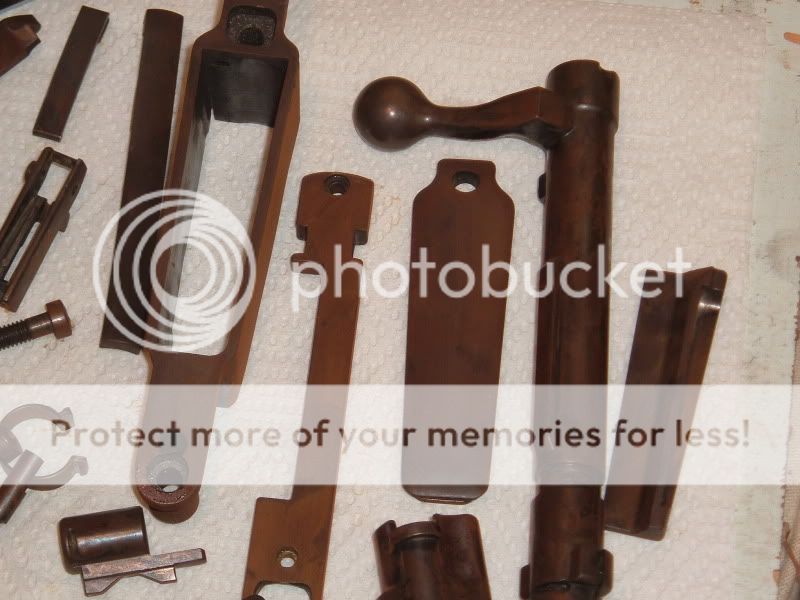
After rusting in the 'damp box' at high humidity and temperature - approx 80%/85 F and before boiling

RedRust004.jpg


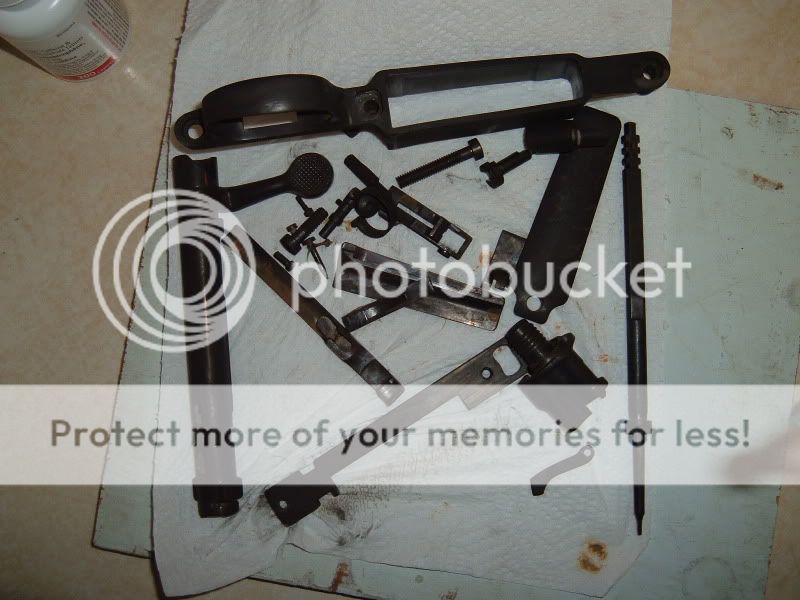
After boiling but before carding.

BoilingSetup003.jpg


After 6-7 rust/boil/card cycles and a final oiling

KimsMauser98002.jpg
 
Beautiful work, Mauser98.

Do you card by hand, and if so, what do you use? Brownell's sells carding wheels, but they're pretty pricey. I've had good results using degreased 0000 wool, but also like green scotchbrite pads (non-abrasive).

I remember when I first read about rust blueing a couple of years ago. It seemed like the perfect blueing solution for the DIYer at home and so far I've had good success with it, although I've only done the odd part and never a whole rifle.
 
You can get the nitric acid and hydrochloric acid at Petrocraft in Calgary. Order the 10% solutions, or ask if they can cut it for you down to 2%. If you want to go whole hog, you can also order in pure elemental iron filings from them, no additives, no artificial sweeteners, works great. I used cotton balls stuffed into wooden clothes pegs to dab the solution onto to parts before they go into the rust box. You may be able to use a cardboard box; cheap, accessible but throw it out after the project is done.

I did my Savage 1899 and it took time, but was fairly easy to do. The toughest part was getting a pot big enough for the barreled action and keeping it boiling. Other than that, easy.

Just watch the acid mixtures, ALWAYS add acid to water, not the other way around.
 
Aluminum coloring

ALUMINUM can not be blued by the processes used on steel.

However it can be Anodized. This is a process that involves using a battery charger, a rheostat, and chemicals. A good coloring agent is RIT dye that is used for clothing.

Aluminum oxydizes when exposed to the atmosphere. It forms a hard "skin" on the outside. You can see this in that Aluminum usually turns dull after a period of time.

You have to clean this old skin off when you anodize aluminum. You then hook up the electricity using the proper polarity, and imerse the part into the solution. The solution dies the aluminum whatever colour you have mixed.

It works well for trigger guards and other small aluminum parts, but I have never really tried a receiver, no do I wish to.
 
Beautiful work, Mauser98.

Do you card by hand, and if so, what do you use? Brownell's sells carding wheels, but they're pretty pricey. I've had good results using degreased 0000 wool, but also like green scotchbrite pads (non-abrasive).

I remember when I first read about rust blueing a couple of years ago. It seemed like the perfect blueing solution for the DIYer at home and so far I've had good success with it, although I've only done the odd part and never a whole rifle.

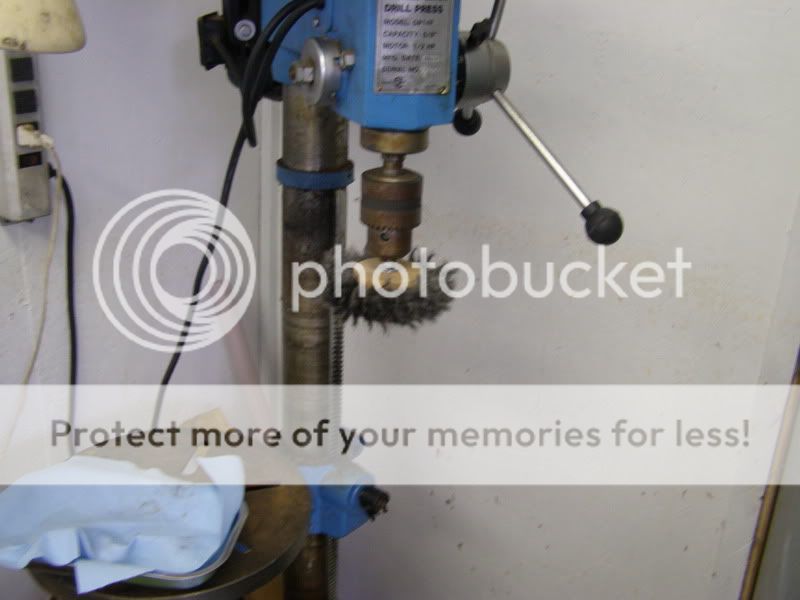
I use the Brownell's carding wheel and degreased steel wool. I have the wheel turning at about 750 ***.

P5050065.jpg


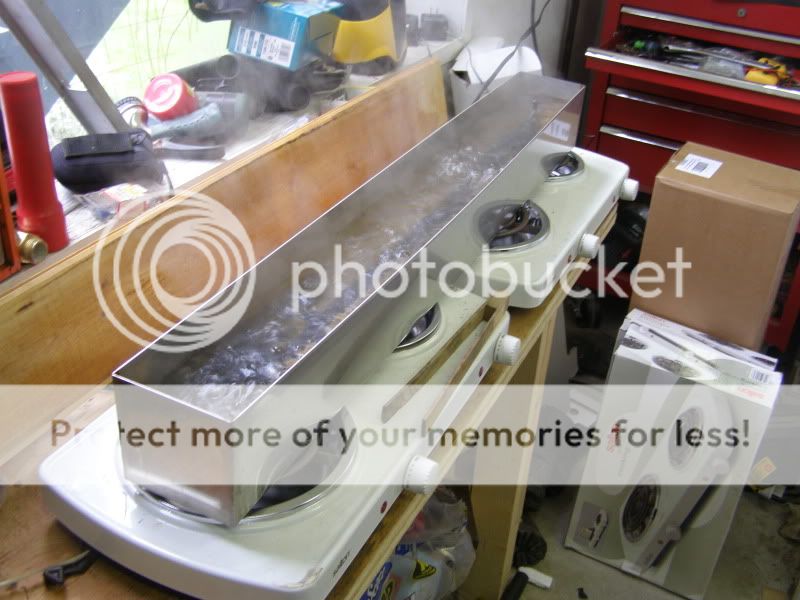
Here's a shot of newly acquired stainless boiling tank and hot plate setup

P5050063.jpg


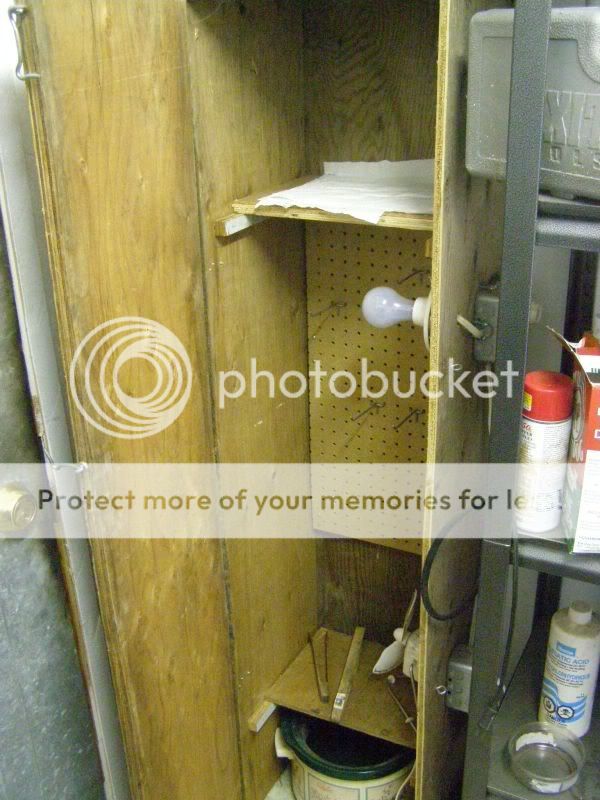
And lastly, my damp box with an old crock-pot for moisture and heat and a light bulb on a rheostat to control humidity - higher temp = lower humidity

PC160132.jpg
 
I use the Brownell's carding wheel and degreased steel wool. I have the wheel turning at about 750 ***.

P5050065.jpg


Here's a shot of newly acquired stainless boiling tank and hot plate setup

P5050063.jpg


And lastly, my damp box with an old crock-pot for moisture and heat and a light bulb on a rheostat to control humidity - higher temp = lower humidity

PC160132.jpg

Hey Mauser,

Where did you get your steel container or how did you make it?
 

Very nice setup! I've made the unfortunate mistake of trying to boil a barrelled action in too small a container. I was able to submerge the barrel, but not the receiver and ended up with a visible line on the receiver where the water line left a discolouration.

I've thought that a good solution to the boiling might be to use an ABS pipe with a cap on the end and a submersion heater from an old water heater. I think the average heater should be able to boil the water and ABS has a melting point above 100 degrees C so should be OK (I'd want to double-check that first, though).
 
Back
Top Bottom