Some Questions about Antique Cartridge Rifles.

1874 Gras in original 11mm caliber fits the description ,but last I looked brass and dies are hard to find .That was a while back so it might not be the case anymore.

There is also a Chassepot needle gun.No brass or dies needed since it uses paper cartridges and parts can be obtained from France.
Problem is the cost-they run about a 1000$ and parts can be expensive as well.
Of course you have to be good with handling BP with it.
 
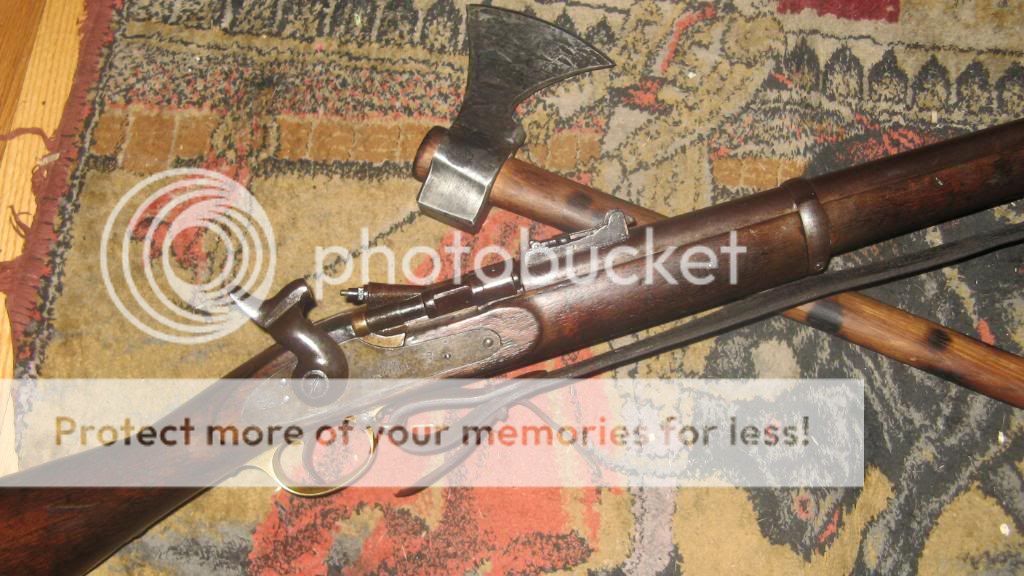
Well, I can't resist. A very good Canadian choice would be the Snider or the Martini Henry. I don't agree about hard to find bullets or brass for either. Canadian marked rifles are still cheap here compared to elsewhere. My Snider artillery carbine will put five .590" balls in the black at 50 yards consistently in a three inch or less grouping. It will also knock down anything in the big game we have here as long as the range isn't past 100 yards. Dies are available for both from Lee for about $100.00. Both the 577 and the 577-450 are monster cartridges with a great history here, unlike the 45-70 or the 43 Mauser. If you are close just meet me at the range for some hands on experience. Dave
 
First off, that's a factory converted Martini by Greener and this one (I believe) is actually a 22LR. I just posted the pic as an example of how a converted Martini would look like.

Second, what would you say about all those junker Martinis with rusted out bores IMA is selling for dirt cheap (the "unserviceable" ones). There's two options for those: an external clean up/repair and a lifetime as a wall-hanger or... salvaging the action, restoring the action and rebarelling to something like a .44 Magnum. Personally, I'd go for that second option ANY day of the week and I don't care if it looks "Bubba". I would never convert my fully functional M-H to another caliber, but if the bore were shot on it beyond repair... then hell yeah. I'd try to keep the looks as much "stock" as possible though (reuse the wood, bands, maybe even the sights if possible).


Also, 577/450 is a b*tch to find components for and brass + dies are insanely expensive. That, plus cast bullet molds are as common as hen's teeth. Trust me, I've gone through the process of getting everything together and it's cost me probably almost as much as the rifle itself. :bangHead: Yet more reasons to consider a more modern & wallet-friendly caliber for a M-H action (if it is needy of a new barrel).

:popCorn:


No personal slight intended and no need to get the knickers in a twist, just having some fun at bubba's expense :) I agree a Martini Henry in 44 magnum would be very cool.
 
No personal slight intended and no need to get the knickers in a twist, just having some fun at bubba's expense :) I agree a Martini Henry in 44 magnum would be very cool.

None taken... but I am a bit ticked off at the general approach towards modified guns by some collectors and the remarks that sometimes result (without prior investigation as to why a gun's been modified to begin with). What a lot of people don't realize is that there comes a time in every old gun's life where "Bubbaeing" it is the only recourse, as parts are scarce or in-existent and the gun cannot be fired safely otherwise. So it's wither that or a lifetime on a wall... personally, I prefer them being functional. And that's also why I'd never buy a "dewat", no matter how cool it looked - deactivated guns are not guns in my book, lol... might just as well buy an airsoft replica! At least that one shoots... (plastic pellets, but still!).

Funny thing is, after typing this suggestion I actually went to IMA's website and they have some incomplete Francotte pattern M-H for $89 (parts guns) still for sale. The only catch 22 is that they don't promise the action or anything else to be complete and state that you're taking a complete shot in the dark upon ordering these. Now... if they were the British-made ones (instead of the Nepalese Francottes), I'd probably go for 2 or 3 without hesitation... and step 2 would be finding a brand new .44 barrels for them! But... I don't have much confidence in the Francotte pattern versions, as they couldn't even get the original bore size right! (they're .450 to 455" instead of the .468 of the real deal British gun - so it makes you wonder about other tolerances they also didn't get 100% right!).

;)
 
I am a bit ticked off at the general approach towards modified guns by some collectors and the remarks that sometimes result (without prior investigation as to why a gun's been modified to begin with). What a lot of people don't realize is that there comes a time in every old gun's life where "Bubbaeing" it is the only recourse, as parts are scarce or in-existent and the gun cannot be fired safely otherwise. So it's wither that or a lifetime on a wall... personally, I prefer them being functional.
;)

If you look at the snider sporter I posted above you'd be hard pressed to believe what it started as. I bought it at the local gunshop for $50. It was cut down, the muzzle appeared to be hammered in, the breechblock was sloppy, sights were missing and the stock was broken in two pieces. It's been derusted, crowned, restocked, had the breechblock, sear spring and sights replaced. Also polished, bead blasted and reblued. Some of you may call it bubba'd but it's a million times better that way than as a beat up wallhanger....
 
If you look at the snider sporter I posted above you'd be hard pressed to believe what it started as. I bought it at the local gunshop for $50. It was cut down, the muzzle appeared to be hammered in, the breechblock was sloppy, sights were missing and the stock was broken in two pieces. It's been derusted, crowned, restocked, had the breechblock, sear spring and sights replaced. Also polished, bead blasted and reblued. Some of you may call it bubba'd but it's a million times better that way than as a beat up wallhanger....

That little Snider of yours looks really cool... And kudos to you for rescuing a salvageable antique from a lifetime of collecting dust on someone's wall (and then, at some point, finally rotting away completely and ending up as scrap metal and firewood).

:)
 
Well, the Trapdoor .45-70 has better sights, more comfortable stock, uses cheaper brass, and is much easier to get shooting accurately. It also costs twice as much as a Snider. :(

My Sniders shoot well enough to hit a 16" boulder every shot at 240 yards, using Minie balls. The same ones I shoot out of the Parker-Hale musket. That's three different Sniders, too. The best bullet was the Rapine Trashcan, but I understand you can no longer get that mould.

Best option today, I think would be to re-barrel a rolling block to either .45-70, or .38-55.
 
.577

sniderbayonet010.jpg

strapandrod006.jpg


The Snider is probably your best all around starter antique rifle "in my opinion".


1/Here in Canada they are rather common and thus affordable.

2/-Extremely- easy to hand load your own cartridges
-you dont need any special tools-;)

3/ brass AND spare parts are available and easily obtained

4/ can shoot either round-ball or slug.

5/ 577 cal makes it a excellent candidate for med- big game hunting

6/ very easy to repair and maintain

7/ absolutely beautiful aesthetically


I myself have 2 --a late pattern cadet carbine and a early pattern Canadian military marked 3 bander-

-fantastic rifles that carried our armed forces up until ww1 as the early repeaters were considered too fragile for our needs.[/QUOTE

Agee on all points. Whwere can I get brass for reloading??
 
I'm a little thrown off on David's remark as well. I just started loading for my 71 and the biggest difference I have been able to ascertain so far is that the nominal bullet diameter is typically .451 (71) vs .446 (71/84). I understand that the throat of the chamber can be somewhat sensitive to bullet size, slightly too big and won't fit, too small and poor accuracy. OAL, Loads and brass are otherwise similar. That said with some trepidation I recently cracked off a couple of vintage(1888) paper patched black powder rounds out my 71 and at least out to my 50 yard target it was suprisingly accurate. So maybe the smaller diameter bullet paper patched up is the key?

Again I am at newb with the mauser so perhaps I am missing something key here.
I also look forward to our more experienced folks to edify me.
 
I'm a little thrown off on David's remark as well. I just started loading for my 71 and the biggest difference I have been able to ascertain so far is that the nominal bullet diameter is typically .451 (71) vs .446 (71/84).

You just explained it to yourself. A 451 bullet will not chamber unless the case is trimmed way back. I shot lots of 446 out of a 71 and it was good enough for fun but shooting grossly undersized bullets aint cool IMHO. The best option I found was an idea from a member here who sent me teflon tape wrapped .446ish bullets. Modern paper patch worked great.
If you have a choice get a 71/84 and not a 71.


I shoot 2" groups with my 71 mauser at 50 yards with ease. Not sure what's hard about loading for them

Your rifle should be able to shoot better then 8 inches off target at 200 yards! 2 inch groups at 50 is what is hard about em. A single shot mauser shooting properly sized cast bullets should be cloverleafing projectiles at 50.
 
I'll try and dig up one and post a pic. Lube goes on over the tape. Think about the direction of twist when you wrap the bullet. (do not know if it matters but it sure does on pipethread). All in all the 71 is a fantastic rifle just gotta do that little bit extra. like getting components and dies was'nt enough!
 
Thanks for the info Mr doyle, as I have a couple 71/84s and like them a lot but have my heart set on finding a really good /71
Cheers
 
I have a couple of mushroomed snider slugs that I dug out of the berm that used to be at Clover Pt in Victoria (it is a park now). The diameter would tell nothing but the skirt is about .1" thick and about the same deep. The originals were supposed to be filled with a mix of bees wax and clay but this one after 100 years the mixture has the texture of a fine grained brick. Presumably the slug actually has a conical cavity filled with the mix but as above as found the plug/filler leaves a square topped or bottomed cavity about .1" deep

I actually had a double barreled pistol of 12 or 13 mm (around .53 if memory is correct); it was relatively easy to load and fairly accurate

cheers mooncoon

I am sort of glad that I am not the only one frustrated with with trying to get some sort of reasonable accuracy out of a Snyder.
The original slug had a fired clay plug that was suppose to upon discharge move forward to expand the skirt.
Another unique feature of the originals was the nose of the bullet, it had a hollow point which appearers to be approximately 3/16 in diameter with a wood plug filling the cavity, apparently this was suppose to lighten the nose of the bullet and help with aerodynamic stability, can't really wrap my single active brain cell on how that would help.
Needles to say I got tired of making noise and given up.
I have in front of me a original rolled foil cartridge with above mentioned wood plug.
 
Back
Top Bottom