What kills?

Nope light makes vampires sparkle like pretty gems.:p

For a second, before they burst into flames. Pretty gems sparkle, while your wallet goes up in flames. I can see how a person could get confused, but one is diffused light, and the other is a defused situation.

It gets more confuseing when one uses the diffused light of compressed carbon to defuse a situation like your hunting partner telling your wife you've booked an elephant hunt before you do. I'm running a class if you're interested.:cool:
 
This:

IMHO people make it way more complicated than it is. CNS hits and blood loss are what kill quickly. For more info google Dr Martin Fackler. [spelling corrected]

Dr. Gary Roberts has some more information here. It's geared more to combat, but the principles are basically the same.
http://m4carbine.net/showthread.php?t=34714

Typically when a game animal drops immediately on being shot, despite not being hit in the brain or spinal chord, the cause is blunt trauma to the spinal chord caused by temporary cavitation. More detail can be found in the last article here:
http://firearmstactical.com/briefs28.htm
 
Anyone seen an aweful movie called The Quick and The Dead? Light killed Gene Hackman.

56be88ec.jpg
 
Well I think Boomer and Dogleg (ha,ha) have said it best. The expanded shockwave of the bullet opening up, goes a long way toward a quick kill. Best evidenced by hitting something small with a lightly contructed bullet carrying lots of velocity. The hole can be huge, or the animal can be separated over a large area.

Frankly I'm a little taken aback that after being around this long, you've never shot anything that had way too big a hole in it or read about permanent, and temporary crush cavities. You hunt?

BTW kudos to asking the question. If we add some bullet construction advice in here, it would make a good sticky.
 
I once saw a tv special on firing squads that are still employed in some countries, and they all shot to the body and not the head with the statement that shots to the body result in "shock". and it kills much faster than shots to the head.

Don't know how true this is but i know shock can kill very quickly even though the wound may not look life threatening at all.

*shrugs

just my 02 cents
 
I once saw a tv special on firing squads that are still employed in some countries, and they all shot to the body and not the head with the statement that shots to the body result in "shock". and it kills much faster than shots to the head.

Don't know how true this is but i know shock can kill very quickly even though the wound may not look life threatening at all.

*shrugs

just my 02 cents

Not exactly. What you are refering to is hydrostatic shock, which is the result of a bullet creating a very large temporary wound cavity, forcing blood back through vessels and creating a high blood pressure spike. This does not necessarilly kill faster, but it does render an instant incapacitation or knock out. This is how the .357 mag with 125 JHP rose to the top of the heap as a man stopper with it's high velocity and rapidly expanding bullet dumping a fair bit of kinetic energy where it counts.

The effect is somewhat like receiving a very powerful punch or kick to the torso which can also shock the heart or temporarily paralyze the diaphram, except it is from the inside.

What we call death is when oxygen can no longer be delivered to the brain, and it runs out of it. Or the brain is scattered several yards behind the victim. One is faster. I'll let you decide which.

That being said, some people have been lobotomized through brain injuries, but lived and some animals have hard to hit brains, due to skull size and unfamiliarity with anatomy. There is a part of the brain which will shut things down for sure and some parts are extraneous for life. 99% of the time brain shot is instant death.

Sometimes the appearance is that the body kills quicker, in that there may be less movement but I have seen where there was no brain left to do anything or brain body connection and the nerves have left it twitching and moving for quite a while. This is actually fairly common and seems to show that the nervous system is not completely contained in the brain, and has a shorter reflex path.
 
...read about permanent, and temporary crush cavities. You hunt?
Permanent crush cavity = "the hole" (the thing that I postulate makes the biggest contribution to the reasonably rapid death of big game animals)
In much of my reading the "temporary (crush) cavity" (aka hydrostatic shock; AKA "knock-down power" ) is mostly discredited for common calibres on large(ish) animals, with the rare exception of hits to solid organs like the liver or spleen (Solid organs like the liver have very low elasticity, and virtually any streching will result in large tears causing massive blood loss).

If the hydrostatic shock were the major component in reasonably fast kills, why wouldn't a cartridge like the .22 CHeeta be ideal for elk and bears? After-all, having a bullet arrive at nearly 4000fps would cause a massive shockwave.

And yes, to answer Tactical Lever's question, I hunt, and have for a couple of decades, which lead directly to my opinion that bullet placement and sufficent penetration to reach the vital structure I was aiming for, were the key to good "game killing". While I use expanding-type bullets, because they are mandated, by law, everywhere I've hunted, I've never been that worried about extreme expansion on game animals, and have had excellent success (but I've only done it a few times, not nearly often enough to have decent data to form an opinion, which is the reason for this thread) using hard-cast bullets in the .30-06, even tho the recovered bullets showed very minimal deformation.
 
Permanent crush cavity = "the hole" (the thing that I postulate makes the biggest contribution to the reasonably rapid death of big game animals)
In much of my reading the "temporary (crush) cavity" (aka hydrostatic shock; AKA "knock-down power" ) is mostly discredited for common calibres on large(ish) animals, with the rare exception of hits to solid organs like the liver or spleen (Solid organs like the liver have very low elasticity, and virtually any streching will result in large tears causing massive blood loss).

Yes, I agree with this. What I got from what you posted earlier was just the bullet hole that does the killing. When we say the permanent crush cavity, that's acknowledging the shock damage where the tissue was stretched beyond it's elastic limits and ruptured and torn.

Also with extremely large tough animals, a couple thousand, or few thousand fpe just isn't going to have the capability of knocking it down. Especially considering the more heavily constructed bullets designed to impact heavy bone and hold together while penetrating deeply. As per my .357 example, to achieve something similar on an animal that weighs 3000 lbs. we would be looking at more like 9000 fpe of terminal energy.


If the hydrostatic shock were the major component in reasonably fast kills, why wouldn't a cartridge like the .22 CHeeta be ideal for elk and bears? After-all, having a bullet arrive at nearly 4000fps would cause a massive shockwave.

A major component, but not the sole one. Maybe I was ambiguous about needing penetration as well. Interestingly I have heard of all things a .17 Hmr killing a black(?) bear with a chest shot. Did not penetrate but stopped the bears heart. I am actually not a huge fan of the hyper velocity cartridges for hunting as it's too hard to get something to expand nicely at long range, and not blow up at close range.

And yes, to answer Tactical Lever's question, I hunt, and have for a couple of decades, which lead directly to my opinion that bullet placement and sufficent penetration to reach the vital structure I was aiming for, were the key to good "game killing". While I use expanding-type bullets, because they are mandated, by law, everywhere I've hunted, I've never been that worried about extreme expansion on game animals, and have had excellent success (but I've only done it a few times, not nearly often enough to have decent data to form an opinion, which is the reason for this thread) using hard-cast bullets in the .30-06, even tho the recovered bullets showed very minimal deformation.
[/ QUOTE]

I'm not saying it's impossible to kill with bullets that don't expand, however even if they are deforming a bit, they will still be creating a shock wave. And like you said, the best bullets won't make up for poor shot placement and in addition, for the largest heaviest game, guys are for the most part using monolithic solids or they used to use FMJ as anything else would break up.

In these cases, the breaking of bones helps to slow the animal and cause additional damage as bone fragments are blown into the chest cavity.

 
Permanent crush cavity = "the hole" (the thing that I postulate makes the biggest contribution to the reasonably rapid death of big game animals)
In much of my reading the "temporary (crush) cavity" (aka hydrostatic shock; AKA "knock-down power" ) is mostly discredited for common calibres on large(ish) animals, with the rare exception of hits to solid organs like the liver or spleen (Solid organs like the liver have very low elasticity, and virtually any streching will result in large tears causing massive blood loss).

If the hydrostatic shock were the major component in reasonably fast kills, why wouldn't a cartridge like the .22 CHeeta be ideal for elk and bears? After-all, having a bullet arrive at nearly 4000fps would cause a massive shockwave.

And yes, to answer Tactical Lever's question, I hunt, and have for a couple of decades, which lead directly to my opinion that bullet placement and sufficent penetration to reach the vital structure I was aiming for, were the key to good "game killing". While I use expanding-type bullets, because they are mandated, by law, everywhere I've hunted, I've never been that worried about extreme expansion on game animals, and have had excellent success (but I've only done it a few times, not nearly often enough to have decent data to form an opinion, which is the reason for this thread) using hard-cast bullets in the .30-06, even tho the recovered bullets showed very minimal deformation.


I wonder if you aren't confusing two different bullet effects on tissue. First is the hole created by the passage of the bullet. When the bullet passes through a large bone we see that it is very similar in diameter to the expanded diameter of the bullet, so when a massive wound is observed in soft tissue following the passage of a relatively small bullet, something other than the diameter of the bullet must have caused it.

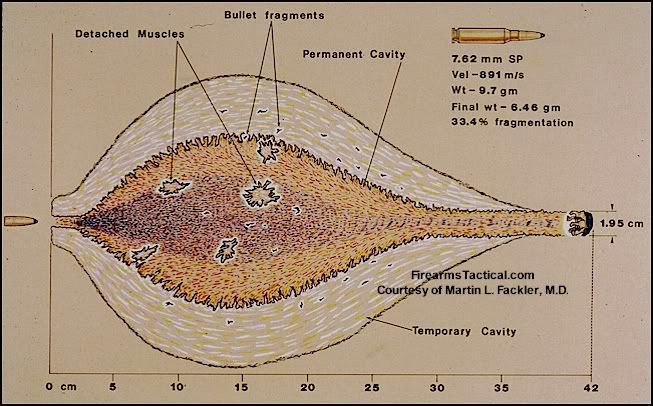
Lets consider the following diagram.
308Winchesterjpg653406pixels.jpg


We see there is both a permanent wound cavity and a slightly larger temporary wound cavity. The temporary cavity is IMHO unimportant beyond being a necessary by-product of the forces which produced the permanent wound cavity. These forces are created by the super-sonic shock-wave that comes off the expanded nose of the bullet. We see that as the bullet slows the permeant wound cavity becomes smaller in diameter, until such time as the bullet drops to a subsonic velocity at which time the permanent wound cavity is only equal to the expanded diameter of the bullet. The large wound diameter created by shock-wave exists only in soft tissue, not in bone, although bone fragments projected ahead of the bone, relative to the direction of travel of the bullet, can be scattered throughout the soft tissue by the shock-wave. The shock-wave is a significant force, which permanently crushes, tears, and displaces soft tissue.


The final expanded diameter of the bullet combined with it's velocity determines the diameter of the wound volume, but not its depth. The depth of the wound is dependent on a bullet's momentum, its construction, and it's rotational velocity. Momentum, that is the bullet's velocity combined with it's mass, enables it to overcome friction. The bullet's construction, results in the deepest penetration when the least amount of mass is lost as the bullet expands. An explosive varmint type bullet might very well have momentum equal too a big game bullet, but that momentum is rapidly lost at impact through the reduction in mass and the resulting wound though large in volume is shallow in depth, sometimes just under the skin. Rotational velocity enables the bullet to overcome the precession that occurs at the moment the bullet impacts a target which is denser than air. Precession is the degree of yaw, and the longer the bullet the greater the precession; a bullet in yaw cannot penetrate as deeply or as straight as one which impacts nose on.

Now here are some interesting observations. Momentum doesn't really care if it is created by a light bullet going fast or a heavy bullet going slow, when momentum is the same, penetration will be the same, all else being equal. When all else remains equal, a bullet with a larger frontal area creates the largest wound volume, but when the frontal area is the same, the difference in velocity that is necessary to increase the wound diameter in any meaningful way, must be great, well in excess of 1000 fps. GS Custom Bullets managed to pull it off when comparing antelope shot with 100 gr .243 bullets and antelope of similar size that were shot with their 45 gr monometal .224 bullets at 5000 fps. Note the velocity difference was 2000 fps.
 
These forces are created by the super-sonic shock-wave that comes off the expanded nose of the bullet. We see that as the bullet slows the permeant wound cavity becomes smaller in diameter, until such time as the bullet drops to a subsonic velocity at which time the permanent wound cavity...

A small point; but, the velocity of sound in water (which would also be similar to velocity of sound in flesh), is nearly 5000 (yup, five-thousand) feet-per-second.
Therefore, except when the striking velocity is near 5000fps, there are no supersonic shockwaves in tissue.
 
I don't believe it was mentioned but bullet shape will also have an effect on wound channel as well. The spire points tending to cut through disrupting the least amount, and a wide flat point cuting a wider swathe at low velocities and transmitting more shock at higher velocity.

I was and am sceptical about the speed of sound creating the shock wave; but from what I've read, it seems like it may be an incidental threshold velocity for the damage caused by hydrostatic shock. (or should this be called hydro-dynamic?)
 
I don't believe it was mentioned but bullet shape will also have an effect on wound channel as well. The spire points tending to cut through disrupting the least amount, and a wide flat point cuting a wider swathe at low velocities and transmitting more shock at higher velocity.

I was and am sceptical about the speed of sound creating the shock wave; but from what I've read, it seems like it may be an incidental threshold velocity for the damage caused by hydrostatic shock. (or should this be called hydro-dynamic?)


I disagree about bullet shape, as the spire point is nearly instantly altered on impact and is not even close to spire shaped after even just 1/2"- basically upon just breaking the skin. Watch the Barnes video of even their super tough TSX initiating expansion within only an inch of tissue contact, at low velocity.

A large, sharp metplat seems to make a big difference if it contacts bone, I've shoulder shot animals this way and it's a sack of potatoes proposition. But so's a well constructed expanding bullet placed likewise. I think every caliber range has different best combinations, and sweet spots for bullet type, profile, and weight and one thread like this can't cover them all.
 
I disagree about bullet shape, as the spire point is nearly instantly altered on impact and is not even close to spire shaped after even just 1/2"- basically upon just breaking the skin. Watch the Barnes video of even their super tough TSX initiating expansion within only an inch of tissue contact, at low velocity.

A large, sharp metplat seems to make a big difference if it contacts bone, I've shoulder shot animals this way and it's a sack of potatoes proposition. But so's a well constructed expanding bullet placed likewise. I think every caliber range has different best combinations, and sweet spots for bullet type, profile, and weight and one thread like this can't cover them all.

I am not refering to expanding bullets when I mentioned this. However I do believe it may make some difference in tracking straighter through bone and have a slight advantage upon entry.

I did not think a spire point would start pushing a big cavity on entry unless it was lightly constructed.

I will have to look at the video.
 
I only shoot game deer and up sized with Barnes bullets now, either the TSX or banded solid. I find both track equally well, and both resist deflection strongly provided the caliber is heavy enough. In .375 H&H, in the 9 head of game I've taken with that rifle, only a very large Cape Buffalo bull stopped a TSX from fully penetrating and exiting the other side, so I generally choose them over solids as they penetrate like a freight train and expand.

If there's one truism I've noted heavily constructed bullets, the TSX, and Partition for instance, do kill better on deer and up. Penetration is clearly the one of the strongest variables, and a good solid does this better than any. I do believe there's a balance though between pure pentration and the benefits of expansion, and feel that's perfectly represented by the TSX.

I'm a Barnesophile, so here's a quote from their info section, they have a high speed video of shooting thin hanging slabs of gelaton, with near instant nose profile change/expansion.

Barnes Bullets said:
Do TSX Bullets always expand on game?

Ballistic tests in gelatin show good bullet expansion within the first inch of penetration.
 
On the first page of this thread there is an article linked that tries to suggest to be from an expert. Except this statement here seems to invalidate his credibility. Or am I wrong?

"Under 50-75 yds most AP is no more effective than regular rounds as it has not developed critical velocity/energy for penetration. From 125 out to 250 yards, penetration is almost guaranteed. This occurs as the high velocity AP projectile is still gaining speed(6) and stability out to 125 yards or more."
 
Back
Top Bottom