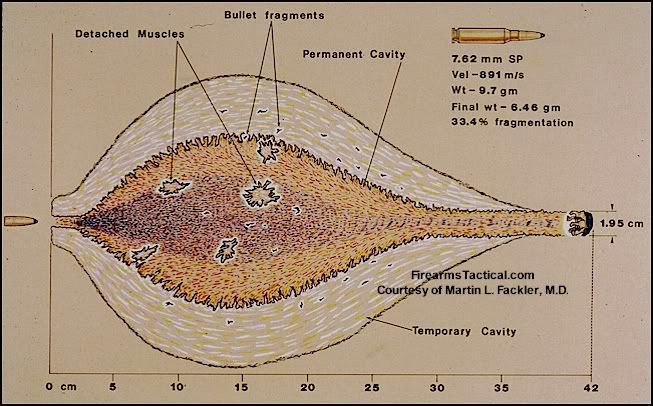
Permanent crush cavity = "the hole" (the thing that I postulate makes the biggest contribution to the reasonably rapid death of big game animals)
In much of my reading the "temporary (crush) cavity" (aka hydrostatic shock; AKA "knock-down power" ) is mostly discredited for common calibres on large(ish) animals, with the rare exception of hits to solid organs like the liver or spleen (Solid organs like the liver have very low elasticity, and virtually any streching will result in large tears causing massive blood loss).
Yes, I agree with this. What I got from what you posted earlier was just the bullet hole that does the killing. When we say the permanent crush cavity, that's acknowledging the shock damage where the tissue was stretched beyond it's elastic limits and ruptured and torn.
Also with extremely large tough animals, a couple thousand, or few thousand fpe just isn't going to have the capability of knocking it down. Especially considering the more heavily constructed bullets designed to impact heavy bone and hold together while penetrating deeply. As per my .357 example, to achieve something similar on an animal that weighs 3000 lbs. we would be looking at more like 9000 fpe of terminal energy.
If the hydrostatic shock were the major component in reasonably fast kills, why wouldn't a cartridge like the .22 CHeeta be ideal for elk and bears? After-all, having a bullet arrive at nearly 4000fps would cause a massive shockwave.
A major component, but not the sole one. Maybe I was ambiguous about needing penetration as well. Interestingly I have heard of all things a .17 Hmr killing a black(?) bear with a chest shot. Did not penetrate but stopped the bears heart. I am actually not a huge fan of the hyper velocity cartridges for hunting as it's too hard to get something to expand nicely at long range, and not blow up at close range.
And yes, to answer Tactical Lever's question, I hunt, and have for a couple of decades, which lead directly to my opinion that bullet placement and sufficent penetration to reach the vital structure I was aiming for, were the key to good "game killing". While I use expanding-type bullets, because they are mandated, by law, everywhere I've hunted, I've never been that worried about extreme expansion on game animals, and have had excellent success (but I've only done it a few times, not nearly often enough to have decent data to form an opinion, which is the reason for this thread) using hard-cast bullets in the .30-06, even tho the recovered bullets showed very minimal deformation.
[/ QUOTE]
I'm not saying it's impossible to kill with bullets that don't expand, however even if they are deforming a bit, they will still be creating a shock wave. And like you said, the best bullets won't make up for poor shot placement and in addition, for the largest heaviest game, guys are for the most part using monolithic solids or they used to use FMJ as anything else would break up.
In these cases, the breaking of bones helps to slow the animal and cause additional damage as bone fragments are blown into the chest cavity.