What kills?

On the first page of this thread there is an article linked that tries to suggest to be from an expert. Except this statement here seems to invalidate his credibility. Or am I wrong?

"Under 50-75 yds most AP is no more effective than regular rounds as it has not developed critical velocity/energy for penetration. From 125 out to 250 yards, penetration is almost guaranteed. This occurs as the high velocity AP projectile is still gaining speed(6) and stability out to 125 yards or more."

Yeah... physics tells me that the projectile is gaining neither energy nor velocity DURING its flight. Maybe it's possible that the AP bullets were still disintegrating due to impacting at TOO high a velocity at those close ranges, whereas their intended impact velocity was at 125 yards+? This could be confused by someone who didn't understand terminal ballistics as meaning that the bullet gained energy further down range when they see better penetration. However, if we're talking about Armor Piercing rounds, I wouldn't think that they could hit at too high a velocity, since breaking up at high fps is usually a failure of expanding type bullets only...

I... I just don't know.
 
A small point; but, the velocity of sound in water (which would also be similar to velocity of sound in flesh), is nearly 5000 (yup, five-thousand) feet-per-second.
Therefore, except when the striking velocity is near 5000fps, there are no supersonic shockwaves in tissue.

Actually about 4665 depending on the temperature of the fluid. But a shock-wave is produced when a bullet moves through a water bearing target beginning at about 1200 fps and it is easily seen in any water bearing material such as tissue; although its not until the impact velocity approaches 2000 fps that the effect becomes dramatic. I did err by describing it as a supersonic shockwave, when in fact I was describing supercavitiation. Fluids, unlike air, are not compressible. Thus the passage of a bullet that is super-sonic in the air does indeed set up a shock wave where a bubble of gas envelopes the bullet, displacing soft tissue as it moves through the target; the effects of which are obvious and cannot be disputed. The shape of the bullet as it passes through the target is important to the ultimate wound diameter. Note the design of Woodleigh's newish hydrostatically stabilized bullet, which is designed to maximize the benefits of supercavitation.
 
Last edited:
caused by hydrostatic shock. (or should this be called hydro-dynamic?)

I believe that Roy Weatherby was the one that coined the term "hydrostatic shock". He was quite a salesman, but did also manage to kill more animals than many can comprehend.

He also knew about light, which is why he made his rifles shiney enough to scare some animals to death.
 
I just want to know one thing -- Now that Dogleg seems to be talking about light and shiny bright things so often, do you think we can expect to see him smile once in awhile in his hunting pics? Based on his past photos, I always would have expected him to claim that darkness kills :p
 
I just want to know one thing -- Now that Dogleg seems to be talking about light and shiny bright things so often, do you think we can expect to see him smile once in awhile in his hunting pics? Based on his past photos, I always would have expected him to claim that darkness kills :p

Na, darkness soothes. If you don't believe me, stare at the sun. That's just a tiny bit of light penetration through the tiny pin-holes that are our pupils. Visualize great gobs of deadly sunlight traumatizeing your vitals, and the shock that results.

Another example is comeing out of the dark into bright light. Most people are rendered helpless by a bit of light, even though they've done it thousands of times before. Chances are an animals heart and lungs have never seen the light of day before, and can't survive the shock of experienceing it the first time.
 
Anyone care to comment on the penetration qualities of a pointed bullet (that stays pointed) due to a very low impact velocity at extended range.

Can a pointed bullet at very low velocity be directly compared to a certain elephant hunters kills with his 7x57 mauser?


That is the crux of he argument, which has been missed and avoided.


There is a real reason other than "hole size" that we need pointed bullets to impact at a high enough velocity to deform.
 
Anyone care to comment on the penetration qualities of a pointed bullet (that stays pointed) due to a very low impact velocity at extended range.

Can a pointed bullet at very low velocity be directly compared to a certain elephant hunters kills with his 7x57 mauser?


That is the crux of he argument, which has been missed and avoided.


There is a real reason other than "hole size" that we need pointed bullets to impact at a high enough velocity to deform.

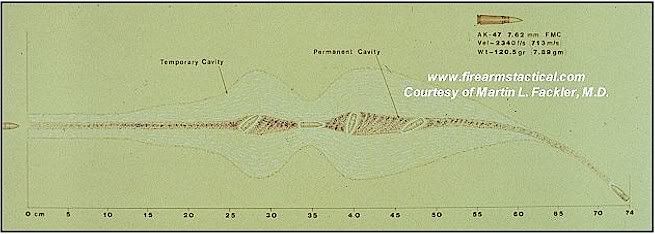
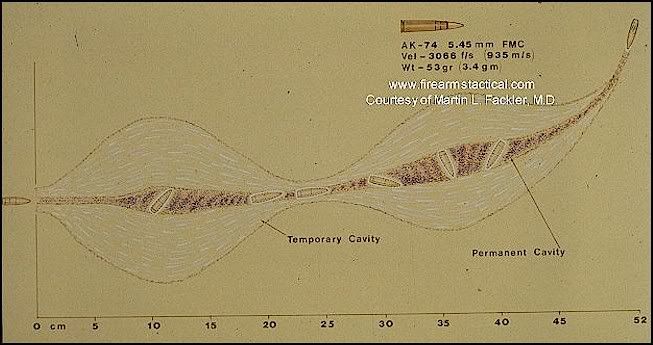
I've still got some .30 caliber Lapua 200 gr sub-sonic boat tail banded FMJs that might be interesting to run an experiment with, although I've never attempted to shoot them at high velocity or grouped them at long range. But from what I know (or what I think I know) a non-expanding bullet with a tapered nose section performs miserably on game due to its tendency to do one of two things. Either the heavier base to want to lead the way, which results in the bullet swapping ends and following the path of least resistance, rather than penetrating in a straight line . . .
AK-47762x39mmjpg655234pixels.jpg

AK-74545x39jpg653345pixels.jpg


Or if the bullet if particularly long, bends and the trajectory through the game becomes unpredictable.
Untitled-Scanned-02.jpg


Also, traditional Woodleigh FMJs following the Kynoch design compared poorly to more modern designs which are short in length, with hemispherical or flat noses and parallel sides. Having said that, I recall seeing a bullet chart that was posted on here some years back that showed examples of various .30 caliber bullets that impacted at various velocities and their resulting penetration and retained weight. Without exception, the greatest penetration was when impact velocity was south of 1700 fps. The same bullet that produced only 12" of penetration at 3000 fps produced 4' of penetration at 1700. I don't recall what the test medium was, but chances are that the medium was of uniform density and mass, unlike game.

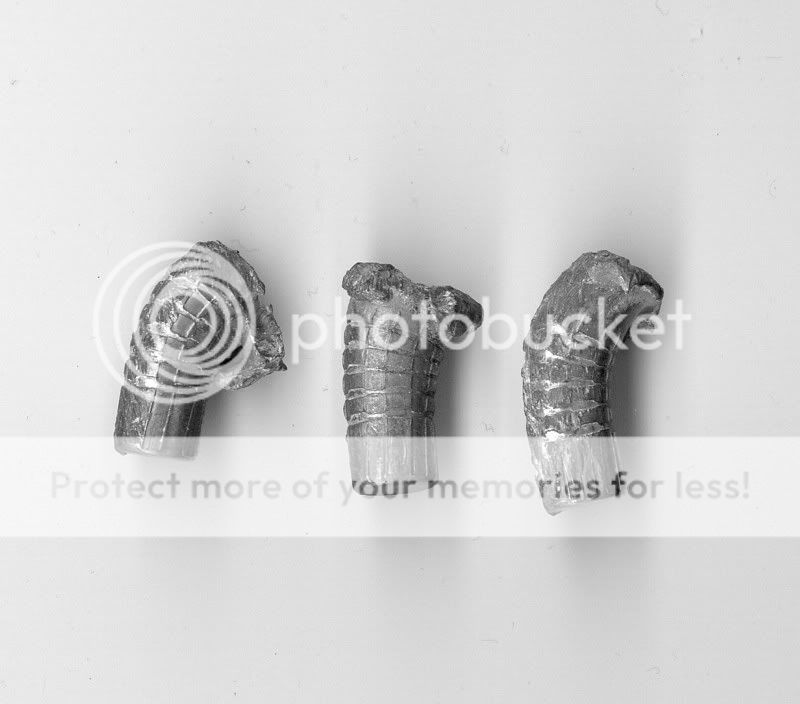
When I attempted to shoot conventional hunting bullets at low velocity in my .375, I managed to recover these which impacted at 1200 fps
Lowvelocity.jpg

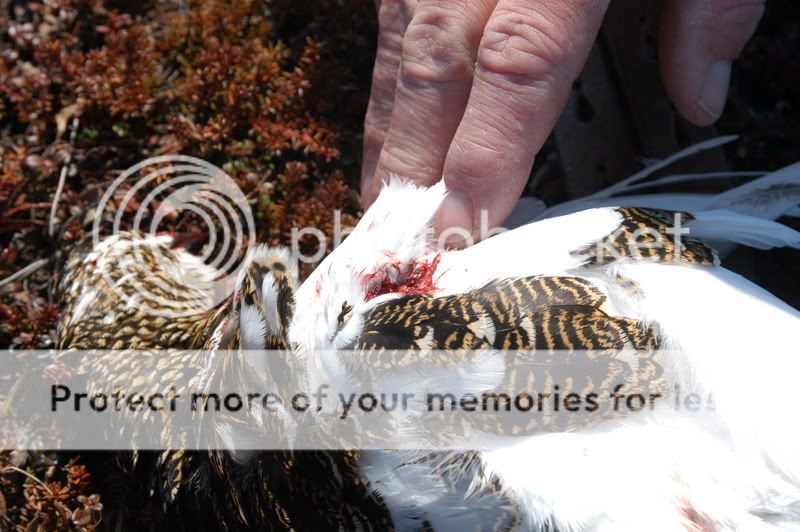
Penetration was less than inspiring, I killed some ptarmigan and found the bullets a short distance away on top of the snow. The wounds were also uninspiring, looking for all the world like the wound from a .22.
cabinmay0789.jpg

cabinmay0788.jpg


If the bullet is going to be designed not to expand, yet have the necessary characteristics to kill a game animal in a humane fashion, it must be short, blunt faced, and very hard. These are not the best characteristics for a long range game bullet.

For the long range shooter, the bullet must have the same characteristics as the bullet chosen by his traditional brother, plus have a very high BC. That is, the bullet must expand to create a large wound volume, and allow the center of balance to shift to it's nose, promoting straight line penetration. The trick is that it must pull this off with a low impact velocity combined with a high rotational velocity. Make the bullet too fragile, and the high rotational velocity will tear it to pieces while it is in the air. Make it too tough, and it will pencil through at low velocity. Perhaps Berger provides a solution.

 
Last edited:
I never understood how the "energy transfer" could be the killer. Didn't every joule of that energy also get absorbed by the shooter's shoulder? Why doesn't he drop dead of hydrostatic shock if that is the case?

Jeff
 
Jeff,

Hydrostatic shock is very velocity dependent, the impact must be, as was said before, around 1200fps to start taking effect, and only becomes noticeable around 2000fps. (Quoting an earlier post in this thread) You can have a slower, heavier bullet below those velocity thresholds that will kill, but it won't cause hydrostatic shock to the same extent in doing so, it will do damage by transferring its energy by other means (such as a wider wound channel).

When a rifle hits a shooters shoulder, you're looking at an 8 pound object with a wide surface area (the butt plate) moving at about 15fps give or take, and distributing that force across the shoulder evenly. A bullet that is 140 grains traveling 2500fps on impact with a frontal area coming to a point before impact and measuring half an inch after mushrooming (and doing so after penetrating a bit already) will behave very differently.

just to illustrate the difference in penetration vs surface area, if someone punches you in the stomach, it just hurts but doesn't wound because the force is distributed across his whole fist. If he puts that same force into your stomach being led by a knife point, well... it'll more than just hurt!

Red
 
To second much of Boomer's perspective:

I used to be a Barnes-o-holic but then a couple years ago I started tinkering...

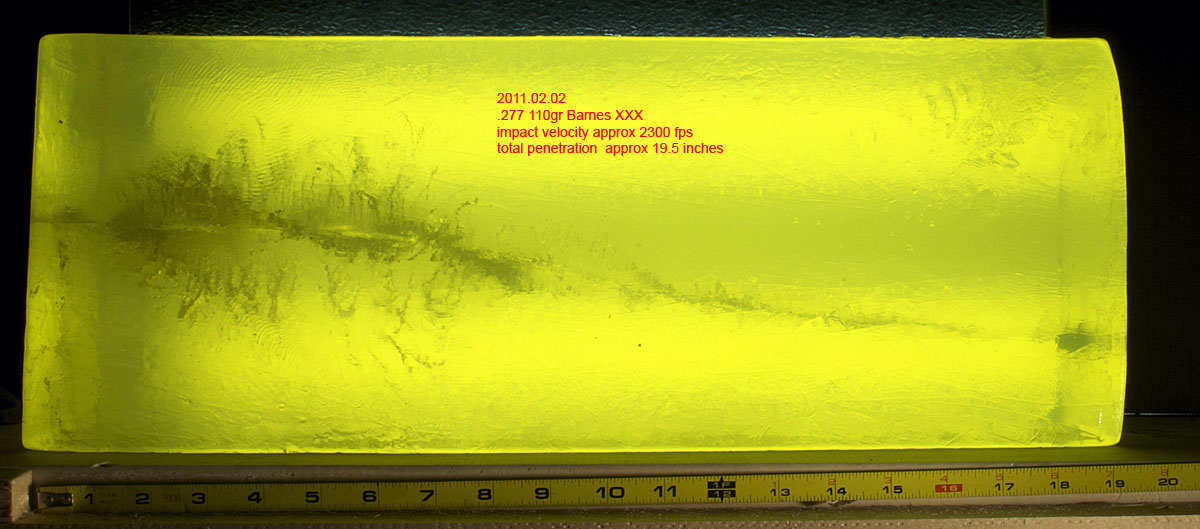
I did some gelatin shooting yesterday evening as part of my test program this year (I'm on year 4...I can only do it in the winter as I use my detached garage for refrigerating the big gelatin blocks); some of it is relevant to discussion in the this thread so I thought I'd post it for folks reference. Each of the gelatin blocks illustrated below measures 9 inches wide x 9 inches wide x 20 inches long. The temporary stretch cavities and permanent crush cavities are pretty accurately represented in the photographs.

.308 150gr Barnes ###, impact velocity ~2500fps:

308_barnes_composite_a_annotated.jpg


Experimental flat-metplate-monolithic-machine-turned-solid, .308 155gr, impact velocity ~2500fps:

308_danger_game_block_composite_b_annotated.jpg


And then slowing things down a bit with my 6.8spc:

.277 110gr Barnes ###, impact velocity ~2300fps:

6.8_barnes_block_a%20copy.jpg


Experimental flat-metplate-monolithic-machine-turned-solid, .277 110gr, impact velocity ~2300fps:

6.8_danger_game_block_composite_a_annotated.jpg


308_danger_game_slug_comparison_b.jpg


I've killed about a dozen animals with these bullets now and can attest to their effectiveness. They suck in the long-range-trajectory department, however at ranges less than 250 yards (ie: within my point-blank-range-trajectory) my experience is that they kill better (ie: more reliably across a larger range of variables) than anything else I've tried.

Cheers,

Brobee

edited to add: I also shot some 405 gr lead cast .459 round nose bullets out of my antique Springfield Trapdoor. These loads are light, say ~1400fps. Penetration was 3 and a 2/3 blocks (that's in the neighbourhood of 75 inches...I've been thinking "how cool is oldschool!" ever since) and temporary stretch cavity was clearly exhibited for at least 36 inches. No photographs of that though as I only had enough energy to properly document my monolithic solid project. When I turn my .459 slugs out and get my re-barreled trapdoor back, next winter I will definitely be doing the lead vs copper shootout in my .45-70!
 
Weapon effectiveness is a complex subject involving much wider issues than just what happens when a bullet hits a body. The size of the wound channel is a function
of the calibre, weight, impact velocity, shape and construction of the bullet.


~~~happiness is a warm gun~~~
 
To second much of Boomer's perspective:

I used to be a Barnes-o-holic but then a couple years ago I started tinkering......<snip images>

I've killed about a dozen animals with these bullets now and can attest to their effectiveness....

my experience is that they kill better (ie: more reliably across a larger range of variables) than anything else I've tried.

Cheers,

Brobee

(I added the emphasis for clarity)

So, if I understand you correctly, you've had generally better (more reliable "game killing") performance with these blunt machine-turned solids than with conventional expanding-type bullets?
If so, what do you attribute the success to, if you have formed that opinion.
(If I've distorted the meaning of your post with my quoting and added italics, it was not my intention)
 
Weapon effectiveness is a complex subject involving much wider issues than just what happens when a bullet hits a body. The size of the wound channel is a function
of the calibre, weight, impact velocity, shape and construction of the bullet.
Yup, complex, a-yup... which brings us to the reason for this thread.
What matters most.
My argument is that IMHO the most important factor is bullet placement, and close behind that is sufficent penetration to reach the actual vital structure that I'm aiming at. I contend that factors like striking velocity (beyond what is necessary to give the required penetration), bullet expansion, bullet material, bullet diameter, etc, are only minor (or less) factors in the "effective killing" of big game animals.

However, my opinion is just that, an opinion, and quite frankly has been formed with only a small fraction of the sum of the experience of the other members of this forum and board.
So I came here, and posted my hypothisis (spelling?) looking to "go to school".
Is my opinion close to right? Am I completely wrong? or something nearer the middle? Are there other factors that I've not considered? Are my assumptions invalid?

Maybe I should use the term "bagging" to denote the effective killing of a big game animal? Because it's really not terribly important if the animal dies in 1 second or 1 minute, so long as it is incapable of traveling more than, perhaps, a few hundred metres. (of course a faster, pain-free death is the actual goal)
 
Yup, complex, a-yup... which brings us to the reason for this thread.
What matters most.
My argument is that IMHO the most important factor is bullet placement, and close behind that is sufficent penetration to reach the actual vital structure that I'm aiming at. I contend that factors like striking velocity (beyond what is necessary to give the required penetration), bullet expansion, bullet material, bullet diameter, etc, are only minor (or less) factors in the "effective killing" of big game animals.

I agree that bullet placement trumps all other concerns. Having said that, changing even one element of bullet design can have dramatic effects on the wound volume or depth of penetration, which very much has an effect on the length of time it takes the game animal to die, even with good placement. My criteria when considering a cartridge or bullet for game is to choose one which has a reasonable expectation of killing the game in question with a single shot from any angle within the range limitations of the rifle, cartridge, and shooter. Of course such a statement is meaningless without a basis for comparison. If I were to write a Bullets for Dummies book, I would simply recommend big game hunters choose a light weight TSX in the caliber of their choice, work up a load driving it as fast as possible, and go hunting. Such a recommendation is pretty safe for North American game and takes thinking out of the equation. I prefer to go in the other direction myself, with a heavy for caliber bonded core bullet with a solid shank, that has the potential of a larger expanded frontal area, yet has enough mass to ensure deep penetration. Hence my appreciation of the 380 gr Rhino bullet for the .375 and the 240 Woodleigh in the .30/06. But thats just me.



Brobee's GS Custom FN bullets provide a similar answer to the TSX, albeit in a format that perhaps better suits Africa than North America; where long shots are the exception to the rule, and where the chance of running into a testy buffalo or hippo (or lion or elephant or . . . well, you get the idea) is always a possibility while you are out looking for camp meat with a light rifle. His tests certainly provide evidence of the superior penetration of these bullets and illustrate that there is little loss to wound diameter, compared to a soft point, due to the blunt nose. For those of us who like exit wounds, the draw of these bullets is strong, as shots from difficult angles on big animals are no longer questionable, when your bullet is capable of penetrating feet rather than inches. Should your only shot be a rear quartering or Texas heart shot, you can take it with confidence. If your game faces you head on, you don't have to worry about your bullet breaking up on the heavy frontal bones. Yet if you are provided with a text book broadside shot, this bullet will put meat in the freezer, just like a soft point.
 
Brobee,
To me the intial wound channels of both the TSXs and the flat point solids look about the same, with the solids giveing up a little at first, then getting more or less double the penetration after with identical wound channels.

That lines up with what I've observed on animals. I know that Barnes is nearly a religion (or at least a cult) for some, but my blood and guts research has convinced me that a flat pointed solid kills just as fast. 'course, that doesn't mean that I endorse solids for everything, but I do agree that if you are going to use a "sorta solid" you may as well use a real one.
 
Back
Top Bottom