Anyone care to comment on the penetration qualities of a pointed bullet (that stays pointed) due to a very low impact velocity at extended range.
Can a pointed bullet at very low velocity be directly compared to a certain elephant hunters kills with his 7x57 mauser?
That is the crux of he argument, which has been missed and avoided.
There is a real reason other than "hole size" that we need pointed bullets to impact at a high enough velocity to deform.
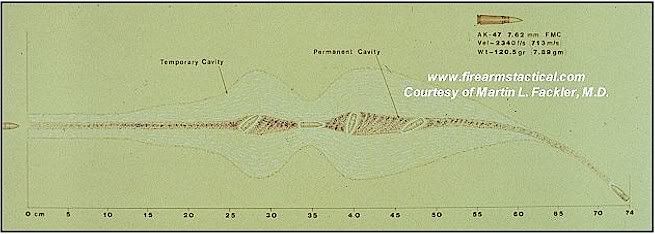
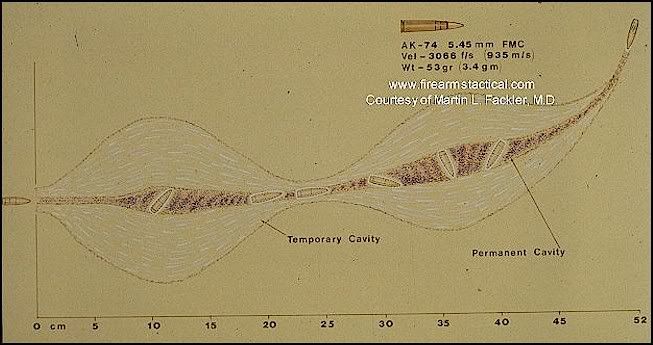
I've still got some .30 caliber Lapua 200 gr sub-sonic boat tail banded FMJs that might be interesting to run an experiment with, although I've never attempted to shoot them at high velocity or grouped them at long range. But from what I know (or what I think I know) a non-expanding bullet with a tapered nose section performs miserably on game due to its tendency to do one of two things. Either the heavier base to want to lead the way, which results in the bullet swapping ends and following the path of least resistance, rather than penetrating in a straight line . . .
Or if the bullet if particularly long, bends and the trajectory through the game becomes unpredictable.
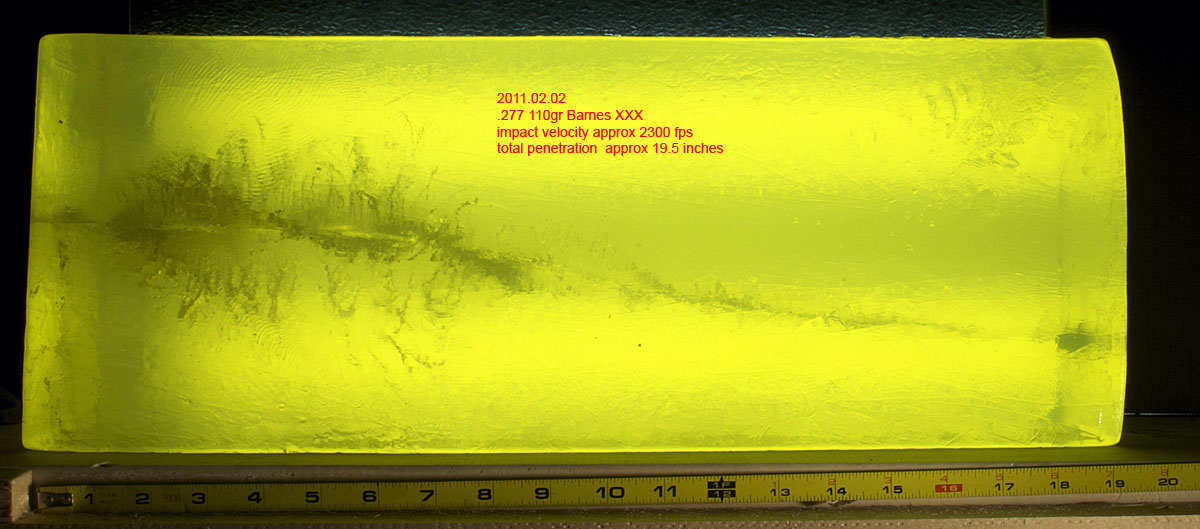
Also, traditional Woodleigh FMJs following the Kynoch design compared poorly to more modern designs which are short in length, with hemispherical or flat noses and parallel sides. Having said that, I recall seeing a bullet chart that was posted on here some years back that showed examples of various .30 caliber bullets that impacted at various velocities and their resulting penetration and retained weight. Without exception, the greatest penetration was when impact velocity was south of 1700 fps. The same bullet that produced only 12" of penetration at 3000 fps produced 4' of penetration at 1700. I don't recall what the test medium was, but chances are that the medium was of uniform density and mass, unlike game.
When I attempted to shoot conventional hunting bullets at low velocity in my .375, I managed to recover these which impacted at 1200 fps
Penetration was less than inspiring, I killed some ptarmigan and found the bullets a short distance away on top of the snow. The wounds were also uninspiring, looking for all the world like the wound from a .22.
If the bullet is going to be designed not to expand, yet have the necessary characteristics to kill a game animal in a humane fashion, it must be short, blunt faced, and very hard. These are not the best characteristics for a long range game bullet.
For the long range shooter, the bullet must have the same characteristics as the bullet chosen by his traditional brother, plus have a very high BC. That is, the bullet must expand to create a large wound volume, and allow the center of balance to shift to it's nose, promoting straight line penetration. The trick is that it must pull this off with a low impact velocity combined with a high rotational velocity. Make the bullet too fragile, and the high rotational velocity will tear it to pieces while it is in the air. Make it too tough, and it will pencil through at low velocity. Perhaps Berger provides a solution.